

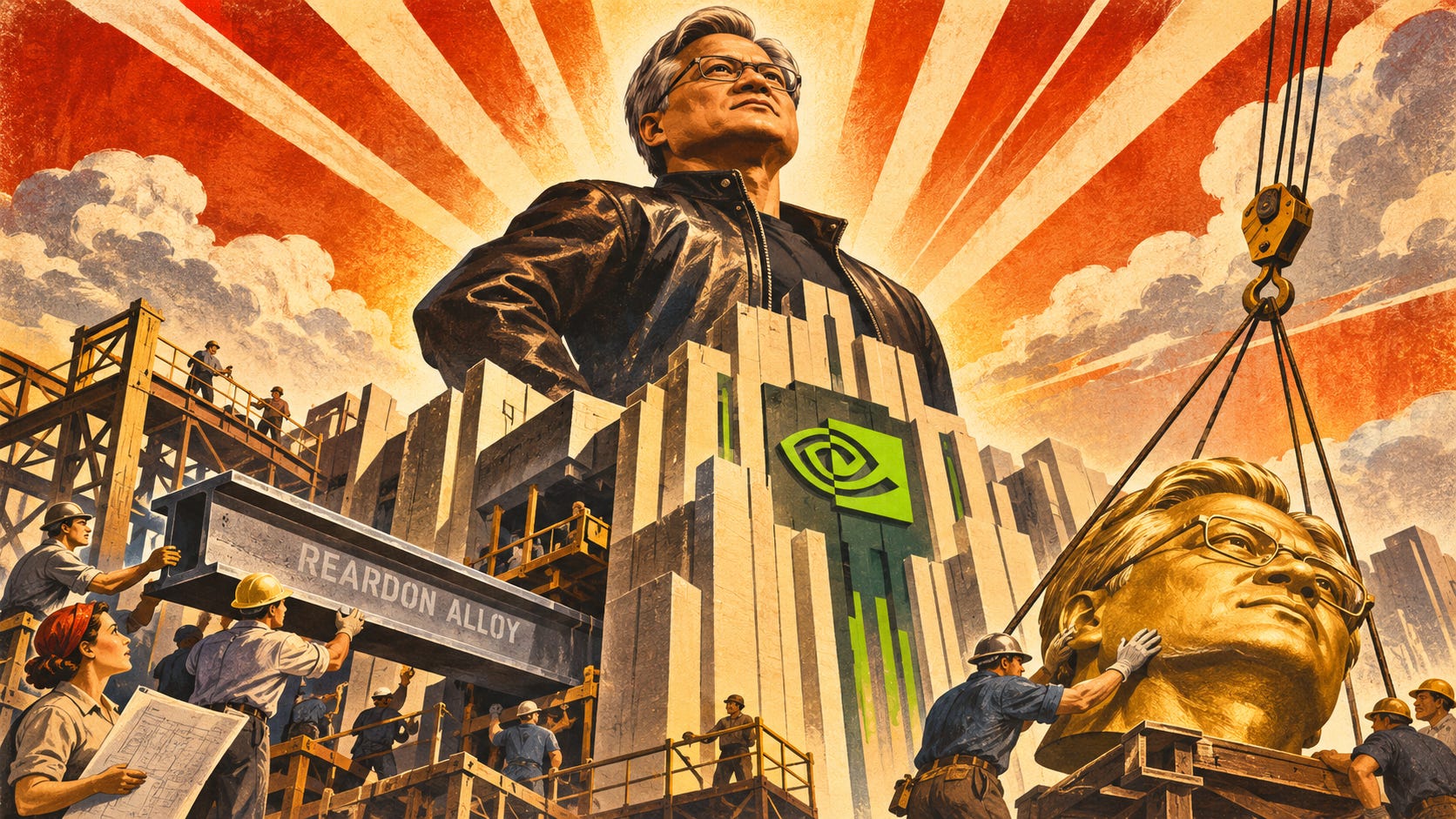
I was halfway through a Caucasian when Donny showed me a petition to bring Jensen Huang back to Nvidia.
I sprayed half-and-half and vodka halfway across the bar.
“Jesus Christ, Donny.”
Apparently, the man who built a multitrillion-dollar semiconductor empire, helped launch the AI revolution, and spent thirty-three years becoming one of the most powerful figures in technology had encountered an unexpected obstacle.
His company’s board of directors.
They had accepted his resignation, appointed an interim CEO, and begun investigating reports involving an affair with a suspected Chinese intelligence operative, another relationship with a subordinate, and questions about the company’s handling of sensitive chip sales.
Now, ordinarily, when your personal life becomes entangled with a potential counterintelligence problem at a company selling strategically important technology, the board might want to examine the situation before handing you the keys again.
Not in Silicon Valley, apparently.
Elon Musk, Tim Sweeney, and a collection of investors, executives, and admirers had joined a campaign demanding that Nvidia bring Jensen back. According to the Financial Times, one of his allies was even assembling a war room to pressure the board and potentially enlist the White House.
A war room.
For a billionaire who lost his job.
I showed Walter.
“GODDAMN RIGHT,” he said. “Thirty-three years, Dude. Thirty-three fucking years. The man built that company from nothing. And now a bunch of suits want to throw him out?”
“Walter, he resigned.”
“UNDER DURESS!”
“We don’t know that.”
“Exactly! We don’t know! That’s the whole point!”
And there it was. Walter wasn’t entirely wrong. Huang had built something extraordinary, and losing the guy who’d been calling the shots for thirty-three years was bound to make people nervous. Especially when the whole AI business was starting to look a little shaky.
I conceded the point.
Walter looked disappointed. He’d been preparing a much longer argument.
Then Donny asked something.
“Didn’t Jensen hire all the people who work there?”
Walter stared at him.
“What?”
“Well, if he built the company, didn’t he build the team too?”
And that’s when I began to appreciate what was really happening.
Because this wasn’t just about Jensen Huang.
It was about Howard Roark.
The Fountainhead Has a Human Resources Problem
Howard Roark, for those fortunate enough to have avoided Ayn Rand in their formative years, is the hero of The Fountainhead. He’s an architect of uncompromising individual genius, forever battling mediocrities who fail to recognize his greatness.
Rand’s point, more or less, was that civilization advances because exceptional individuals refuse to surrender their creative vision to the demands of the collective.
Silicon Valley has been dining out on a version of this mythology for decades.
The brilliant founder sees what nobody else can. He builds something extraordinary while conventional thinkers dismiss him. Eventually the world recognizes his genius, the money rolls in, and his extraordinary success becomes proof that ordinary rules should not apply to extraordinary people.
It’s a wonderful story.
There’s even some truth in it.
Steve Jobs really did see possibilities others missed. Bill Gates understood the economics of software when much of the industry was still thinking about hardware. Jensen Huang recognized the potential of GPUs for general-purpose computation long before the current AI feeding frenzy.
These were consequential people who made consequential decisions.
But somewhere along the way, Silicon Valley quietly changed the story.
The founder stopped being the person who created an extraordinary institution.
He became the extraordinary institution.
And the distinction matters.
Mark Zuckerberg has a voting structure that makes removing him from Meta extraordinarily difficult. Elon Musk has accumulated enormous influence at Tesla through his ownership, board relationships, and personal identification with the company’s value.
Huang, however, owned only a small minority of Nvidia.
He had influence, prestige, and an immense personal fortune.
But the board could still tell him to leave.
And it did.
This is apparently a constitutional crisis.
The Great Man Theory of Shareholder Value
Maude arrived while Walter was explaining that Nvidia’s board had committed what he called “corporate regicide.”
“Jensen Huang is not a monarch, Walter.”
“HE BUILT THE KINGDOM!”
“He built a corporation. A corporation with employees, shareholders, directors, and legal responsibilities.”
“Same goddamn thing.”
“No. It is rather specifically not the same thing.”
Maude pointed out that Nvidia had already appointed Colette Kress, its longtime CFO, as interim CEO. And behind her were thousands of engineers, developers, and executives who’d spent decades making Nvidia what it was.
Apparently, none of that was enough without the man in the leather jacket.
Which raises a question. If Jensen Huang is such an extraordinary builder, shouldn’t he have built something that can survive without him?
Otherwise, that’s a hell of a succession-planning problem.
Losing a founder of Huang’s caliber is no small thing, particularly with the AI boom looking increasingly wobbly. But his supporters seem to be arguing something closer to a matter of faith.
Nvidia needs Jensen because Jensen is Nvidia.
Convenient, isn’t it?
The Most Expensive Group Therapy Session in History
There’s a peculiar feature of Silicon Valley’s billionaire class.
These men celebrate rugged individualism, entrepreneurial independence, meritocracy, and the heroic outsider who refuses to bow to institutional authority.
Yet when one of their own encounters an institution that actually exercises its authority, they suddenly discover the virtues of collective action.
Petitions. Public letters. Shareholder pressure. Coordinated messaging. Political lobbying.
Howard Roark has formed a committee.
And he’s asking the President to intervene.
The irony would be difficult to improve upon if somebody had written it as fiction.
What I find especially revealing is that the campaign isn’t simply asking Nvidia to conduct a fair investigation. That’s a reasonable request. The allegations involving foreign intelligence haven’t been proven, and a personal scandal doesn’t automatically establish corporate misconduct.
They’re asking the board to bring Huang back while the investigation proceeds, unless it can demonstrate that keeping him out is justified.
The presumption is that Huang belongs in charge.
Accountability must establish why he shouldn’t be.
That’s an interesting standard. I wonder how many Nvidia employees accused of serious workplace misconduct would receive a petition from the richest men in America demanding their immediate return to the office.
Not many, I’d wager.
But then, those employees aren’t indispensable.
Which brings us to the possibility that makes this entire spectacle so interesting.
What if Nvidia does just fine?
What If the Building Stays Standing?
We’ve seen this movie before.
Steve Jobs was probably the closest thing Silicon Valley ever had to a living embodiment of the indispensable-founder mythology.
When he died in 2011, there was widespread uncertainty about whether Apple could survive without his extraordinary product instincts and personal authority.
Tim Cook was a supply-chain executive. A competent operator. Not a visionary in the Jobs mold.
And yet Apple went on to become vastly more valuable.
People can argue about whether Apple lost some of its creative magic. That’s fair. Leadership matters, and different leaders produce different companies.
But Apple didn’t collapse.
The institution outlived its creator.
Now imagine Nvidia doing something similar.
Not necessarily growing forever. The AI market may be headed toward a correction that would challenge even the most brilliant executive.
But imagine Nvidia continuing to ship excellent products, maintaining its software ecosystem, managing its customers, and navigating the industry without Huang.
Imagine the thousands of people who built the company simply continuing to do their jobs.
That would be an awkward development for the people insisting that Jensen is irreplaceable.
Because the proposition being tested wouldn’t merely be that Nvidia can survive without Huang.
It would be that these extraordinary corporations are, in fact, corporations.
Organizations built by human beings, employing other human beings, governed by institutions, and capable of surviving changes in leadership.
The founder might be brilliant.
He might even be historically important.
But he isn’t divine.
And I wonder whether that’s the possibility the billionaire rescue committee finds most unsettling.
Not that Nvidia might fail without Jensen Huang.
But that it might succeed.
Walter had been unusually quiet during this part of the conversation.
Finally, he said, “You’re missing the point, Dude. Some men are simply irreplaceable.”
Donny looked up from his phone.
“Didn’t they already replace him?”
Walter opened his mouth, considered the question, and reached for his beer.
Somewhere in Silicon Valley, a group of the world’s wealthiest individualists was organizing a coordinated campaign to restore the independence of a man who apparently couldn’t manage without them.
I thought about Howard Roark.
The architect spent an entire novel refusing to compromise his vision for anybody.
Now his spiritual descendants were circulating a petition asking everybody to please put the architect back in charge of the building.
Meanwhile, the lights were still on, the engineers were still working, and the elevators appeared to be running just fine.
The Dude abides.
"Howard Roark" - man, I had to puke a little into my mouth there.
If I could go back into time, I'd kick my-then 14 yr old ass so hard for wasting that week in Grade 9 reading Rand's POS trash.