I was sitting at the bar the other day, nursing a White Russian and reading the New York Times, when I came across something remarkable.
Erick Erickson had discovered weirdos in the Republican Party.
Not just a few weirdos, either. Apparently the place was crawling with them. Christian nationalists, dictator enthusiasts, guys who want to take away women’s right to vote, billionaires lecturing about the Antichrist. A whole menagerie of people who make the average bowling league meeting look like a gathering of Renaissance scholars.
Erickson had written an entire New York Times op-ed about it.
“Walter,” I said, “Erick Erickson says the Republican Party has too many weirdos.”
Walter looked up from polishing his bowling ball.
“No shit, Dude. He’s been saying that for years. Erickson was Never Trump before half these people knew what Never Trump meant.”
“Yeah, man. That’s what makes it interesting.”
The Price of Admission
See, Erickson wasn’t some innocent bystander who wandered into the wrong convention.
Back in 2016, he understood Trump pretty well. He thought the guy was dangerous, unprincipled, and fundamentally unfit for the presidency. He even warned that Trump would poison the church from within.
Pretty perceptive, actually.
Then 2019 rolled around, and Erickson decided he could support Trump after all.
“We cannot have the Trump Administration policies without President Trump,” he wrote, “and there is much to like.”
“Well, of course!” Walter said. “That’s politics, Dude! You don’t get everything you want. Supreme Court appointments. Religious liberty. Abortion. You think those things happen by themselves?”
“No, Walter. I’m saying he knew what he was buying.”
“AND HE GOT WHAT HE PAID FOR!”
Maude had arrived sometime during Walter’s explanation. She was looking at her phone.
“Walter, you do understand that Google exists. We can look up what Mr. Erickson said. And whom he voted for.”
She scrolled.
“Opposed Trump in 2016. Endorsed him in 2019. Supported him in 2020 and 2024. He has publicly acknowledged all of this.”
Walter shrugged.
“So? He changed his mind.”
“Indeed,” Maude said. “And now he appears to be changing the subject.”
I ordered another Caucasian.
The House Always Wins. Until It Doesn’t.
The thing is, Walter had a point.
Erickson made a political calculation. Trump delivered policies he wanted—judicial appointments, abortion restrictions, a government more receptive to his understanding of Christian morality. That’s how coalitions work. You accept things you don’t like to get things you do.
And Erickson is right about the people he’s condemning. Guys who admire Francisco Franco and want to abolish women’s suffrage aren’t ordinary religious conservatives. They’re authoritarians with a theological vocabulary.
But they didn’t materialize last Tuesday.
They’ve been organizing, raising money, building institutions, and finding increasingly comfortable accommodations inside the Republican coalition for years. Erickson knew what Trump represented and continued supporting the arrangement.
Then came the midterms.
Republicans took a beating, and suddenly Erickson was in the New York Times explaining that the party needed to do something about all these weirdos.
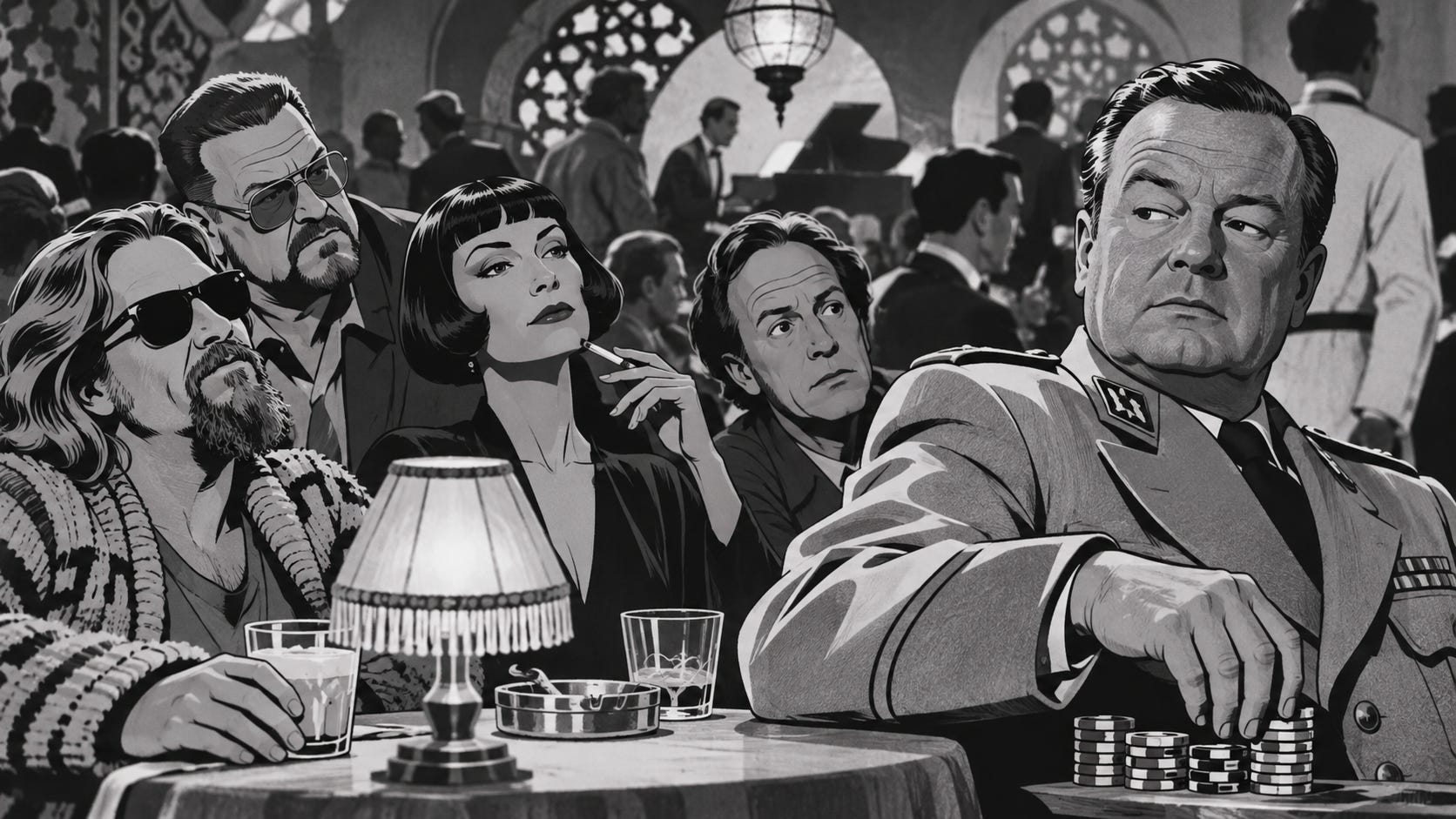
“Walter,” I said, “you ever see Casablanca?”
“Of course I’ve seen Casablanca, Dude.”
“Remember Captain Renault? Shocked to discover gambling at Rick’s?”
“That’s different.”
“Yeah, man. Renault was collecting his winnings.”
Walter frowned.
“Erickson isn’t running a casino!”
“No, Walter. But he sure liked the payouts.”
The Respectable Weirdos
And then there’s Erickson’s proposed solution.
After denouncing grievance politics, authoritarian impulses, and culture-war obsessives, he offers examples of the normal Republicans who could restore the party’s credibility.
Ron DeSantis.
Greg Abbott.
I put down my drink.
“Man, that’s quite a rehabilitation program.”
“What’s wrong with DeSantis?” Walter demanded.
“Nothing, Walter, if you’re looking for a governor who knows how to turn a culture war into a full-time government job.”
Maude glanced up.
“Both governors have made confrontations over cultural and social issues central features of their administrations.”
“THEY’RE NOT FASCISTS, MAUDE!”
“I didn’t say they were, Walter.”
And she hadn’t. There’s a difference between elected conservatives pursuing aggressive cultural agendas and guys fantasizing about a Protestant Franco. It’s an important difference.
But Erickson seems to want the political apparatus that delivered his preferred outcomes, just with fewer embarrassing passengers.
Keep the judges. Keep the policies. Keep the voters. Get rid of the guys who have started saying the quiet parts into microphones.
Donny had been quietly eating his fries.
“So who let the weirdos in?”
Walter sighed.
“Nobody let them in, Donny. Political parties are coalitions. You can’t control everybody who supports your candidates.”
“But Erickson supported the candidates too, right?”
“YES, DONNY. THAT’S HOW ELECTIONS WORK.”
Donny considered this.
“So why isn’t he in the article?”
Maude put down her phone.
“An excellent question.”
Closing Time at Rick’s
Maybe Erickson genuinely wants to save the Republican Party from the authoritarians. He certainly recognized the danger early enough.
But he recognized it in 2016, decided the benefits justified the arrangement in 2019, supported Trump through two more presidential elections, and now, immediately after a painful electoral defeat, has rediscovered the urgency of keeping unsavory characters out of the establishment.
It’s not that he didn’t know about the gambling.
He knew the dealers. He knew the house rules. He knew the management.
He’d been playing at the tables for years.
And now the winnings have dried up, he’s standing beside Captain Renault, demanding that somebody shut the place down.
The difference is that Renault at least collected his winnings before announcing the raid.
The Dude abides.