

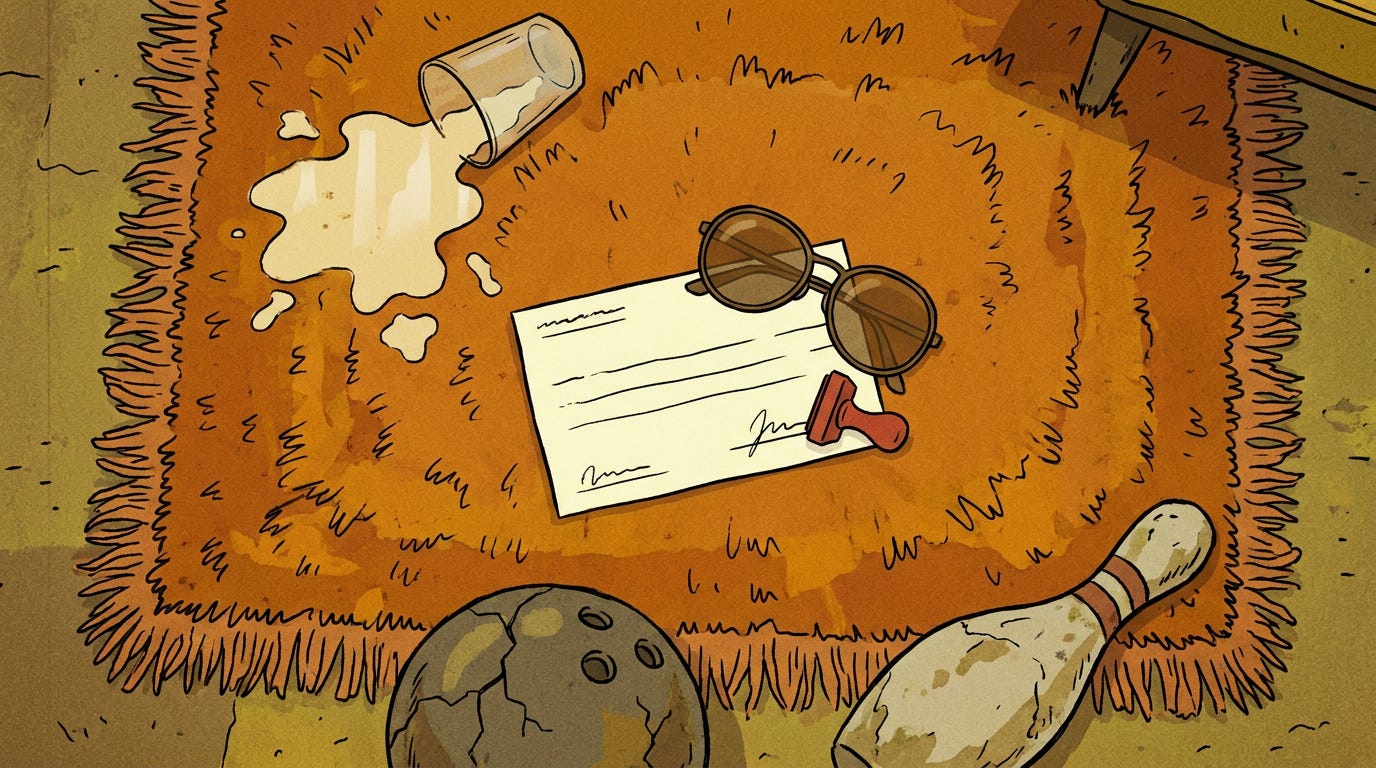
In 1986 the government made it illegal to knowingly hire someone without papers. The trick, man, is in the “knowingly.”
Another post inspired by a deep look at Ronald Reagan and his Presidency. The post I am drafting on the immigration reform from 1986 was ripe for a Shitpost Dude treatment, so here it is!
If you want to follow that deep dive on Reagan, from his radio announcers days through his canonization in Conservative lore, be sure to check it out here: “The Fulcrum: how Reagan was the pivotal point in conservatism”, episodes drop Mondays, Wednesdays and Fridays, so subscribe for free to not miss a beat!
So Maude calls. She doesn’t call, usually. She sends a guy, or a fax, or a look. But she called, and she said, “I have a form.”
I was on the floor. That’s where I do my reading. It’s the correct posture for a form. Any form.
“November 6, 1986,” she says, in the voice she uses for numbers, which is the voice of a woman reading you your own lab results. “President Reagan signs an immigration law, standing next to the Statue of Liberty. Nearly three million people applied to stay.”
“Three million. That’s a lot of people, Maude.”
“It is. The law also had a second half.”
I should explain that I was around for 1986. Southern California, man. You didn’t have to read about it. You drove past it. The guys out in the fields past the freeway at dawn, the crews on the corner, the whole thing running on people nobody ever wrote the name of on a sign. And the taco truck at the end of my street, which I will defend with my life as the single most honest business in the county. Years later I’d hear guys on TV get nervous about taco trucks, like they were an invasion. I’d think, those guys have never had a carnitas burrito at one in the morning. They don’t know what they’re missing, man.
I got off the floor. Partly.
“What’s the second half?” I said.
“It’s illegal for an employer to hire someone knowingly unauthorized.”
“That’s good, Maude. That’s a good law.”
“Read the word again.”
I read the word again. I’ll be honest, I read it three times. It’s one of those words that looks like a door until you push on it.
“Here’s what it says,” Maude says. “The employer fills out a form for each hire. It’s called an I-9. And the law says he doesn’t have to figure out whether the papers are real. If they look reasonable, that’s enough.”
“So if a guy hands over a card, and the boss glances at it...”
“Then he did exactly what the law asked.”
“And if the card is fake?”
“He didn’t know.”
“But the law says knowingly.”
“It does.”
“So the best thing a boss can do...”
“Is know as little as possible. Yes.”
I sat back down. I spilled some of the Russian. I want to say that again because it keeps happening. It’s the half and half. It always goes first, and it’s never a good sign.
“That’s not a law, Maude. That’s a game of Don’t Look.”
“There are fines. There are criminal penalties for a pattern or practice of violations. On paper.”
“On paper,” I said.
“On paper.”
Now I told this at the lanes, because that’s what the lanes are for. And Walter, who has been waiting his whole life for a person to say something about a betrayal, puts down his ball.
“Dude,” he says. “Dude. You know what this is? This is a fucking Saigon deal. These are the guys who signed the checks. They sit in the air-conditioned office and they never carried anything. They write ‘I didn’t know’ on a form and they go home. And the guy who actually does the work, who’s out there at five in the morning with a hat, he’s the one they stare at.”
“Walter...”
“You want to stop the crossings? Start putting the guys who sign the checks in jail. Done by Tuesday. Am I wrong?”
“Maude says the law has penalties, Walter.”
“On paper, Dude. Paper doesn’t walk into an office. Paper doesn’t have a hat.”
“You weren’t in any of these offices, Walter.”
“I was in them emotionally, Dude.”
And then Donny, who has been eating something out of a bag, asks it. Donny always asks it.
“If the boss doesn’t know, and the guy doesn’t have papers, who gets in trouble?”
“Donny,” says Walter, “you are out of your fucking element.”
But I called Maude back and asked Donny’s question, because it was the only real question anybody had asked all night. And she said, in the exact same voice:
“Neither of them.”
The finding, as far as I can tell
“In 1990, the Government Accountability Office surveyed 4.6 million employers,” Maude says. “It estimated that 891,000 of them, nineteen percent, had begun at least one discriminatory practice because of the law.”
“Against the bosses?”
“Against applicants. About 227,000 stopped hiring people whose appearance or accent suggested they might not be authorized. In a hiring test in Chicago and San Diego, matched Anglo applicants got fifty-two percent more job offers.”
“So the law was supposed to land on the guy hiring...”
“And it landed on the guy who looked like he might be hired.”
I didn’t say anything for a while. A person can only absorb so much at once. That’s why I do it on the floor.
“And the fields?” I said. “Because the fields were the whole thing, Maude. The fields were the reason.”
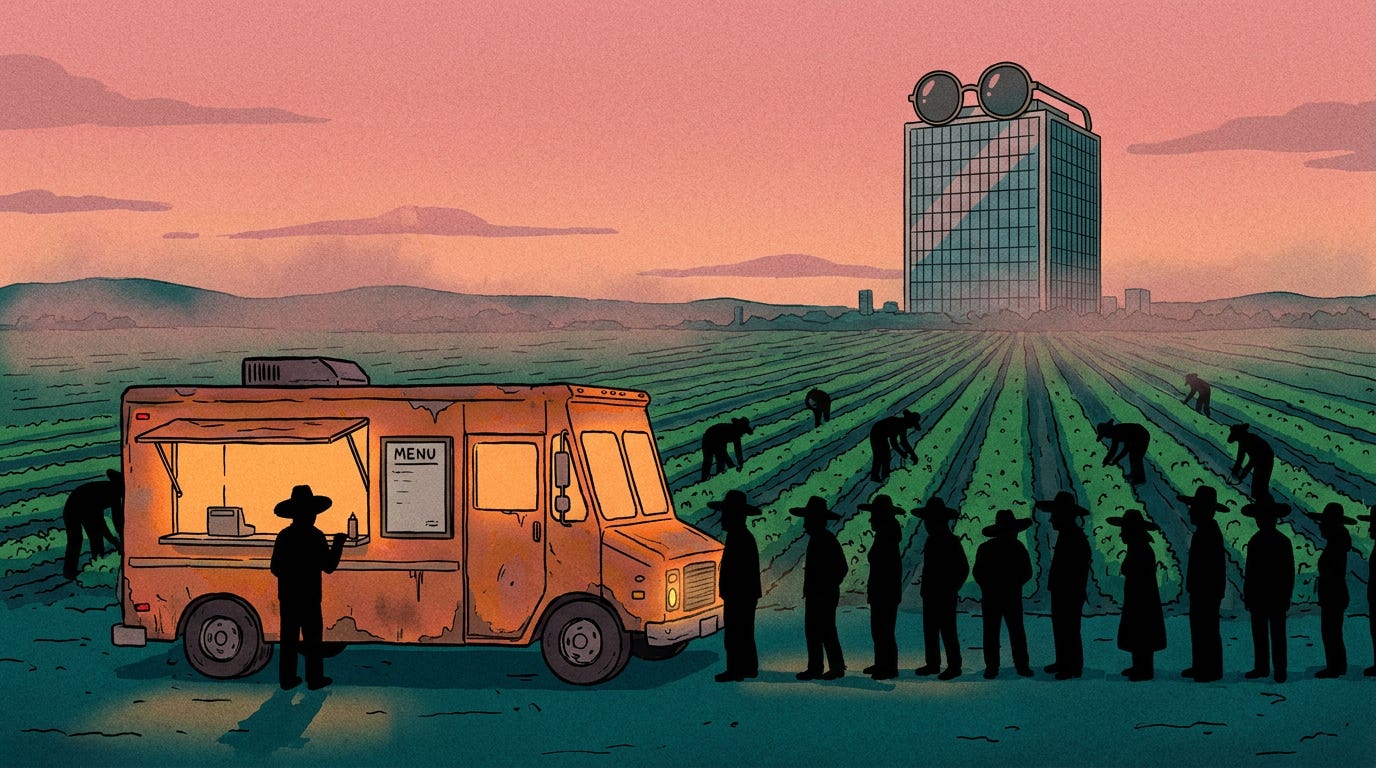
“The farms got their own program. Ninety days of farm work, applications from June 1987 to November 1988. About one point two eight million applicants, about one point one million approved. Roughly fifty-five percent were in California.”
“That’s my neighbors, man.”
“The growers lobbied for it.”
“They got a door.”
“They got a door.”
The rug
I keep coming back to the rug. People think the rug’s a joke. The rug is the most reliable measuring stick I own. A guy, a stupid guy, in a stupid hurry, ruined my rug, and nobody was held to account, because nobody ever knew whose idea it was. And I’ll tell you something. I’ve been upset about that rug for longer than the government has been serious about a boss signing a form.
That’s not a joke. That’s a data point.
Because here’s the thing. The border dipped for a couple of years, Maude says, and then it came right back. About five million people without papers in 1986, eleven million by 2013. They legalized the people who were here. They never touched the thing that kept pulling the next ones in. The amnesty worked fine. The fine print is still sitting right there.
“Reagan said it himself,” Maude says. “On national TV, in 1984. He believed in amnesty for people who put down roots.”
“And now?”
“Now they say it like a curse word.”
“Man.”
“Mm.”
I don’t know what it says about the human condition, or the government, or me. Maybe it says that when both sides leave the same door open for forty years, it isn’t an accident, it’s a decision. Or maybe it says nobody likes to be the one who knows.
I’m hungry. Anyone want a burrito?
The Dude abides.