

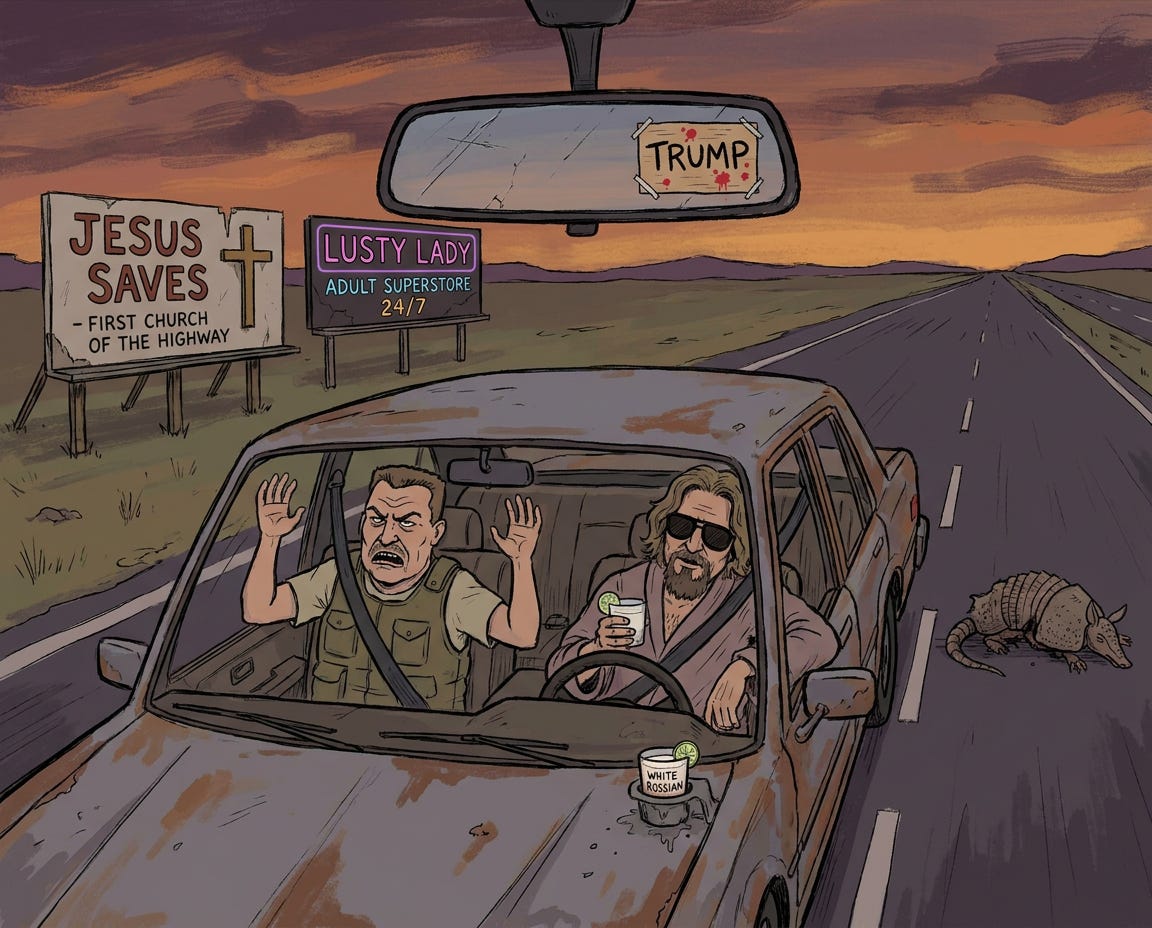
The Dude does not road trip lightly1. There are preparations. The White Russian situation must be resolved before departure — you cannot trust the interior of this country to have Kahlúa at a reasonable price point. Creedence goes on the speakers somewhere around Albuquerque, which feels right, and then you point the car east and let America happen to you.
What America serves up, it turns out, is a lot of emptiness. Beautiful, occasionally unnerving, geographically humbling emptiness. New Mexico fades into the Texas panhandle, which is basically New Mexico with more evangelical radio. Oklahoma opens up like someone took Kansas and removed the interesting parts. Missouri gets greener and hillier and the deer start appearing on the roadside, but we’ll get to the deer. The point is that the interior of this country is, in the most literal sense, mostly not there. Half of all Americans live east of a line running roughly through Chicago and Nashville. The western two-thirds of the lower 48 hold the other half, and most of them are in a handful of cities huddled on the coasts and in the mountains. Everything in between is exactly what you see from the interstate: space, sky, a gas station every forty miles, and more sky.
It’s one thing to know this. It’s another thing to drive through it for two days with Creedence on the speakers and your elbow out the window. The map is not the territory, man. The map has never been the territory.
Where Are All the Damn Teslas
The Dude is no stranger to Teslas. In California they are like cockroaches — everywhere, silent, vaguely smug, occasionally driven by people who will absolutely tell you about their carbon footprint before you ask. On this particular drive from New Mexico through Texas, Oklahoma, and Missouri, the Dude counted maybe four. Possibly five if one of those was actually a Tesla and not just a Hyundai that had been detailed recently.
This is not an accident. The Biden administration put five billion dollars into something called NEVI — the National Electric Vehicle Infrastructure program — to build charging stations across the country. As of early 2025, most of that money had not been spent. Then the Trump administration froze it. Then there was a lawsuit. Then they “streamlined” it, which the Sierra Club noted had accomplished roughly six months of additional delay. The net result: as of last spring, the federal government’s entire EV charging buildout had produced 384 actual charging ports. In the entire country. Against a promise of 500,000 by 2030. The gap between those two numbers is the gap between the press release and the parking lot, and if you’ve ever wondered why nobody in Oklahoma is buying a Kia EV6, it is because nobody in Oklahoma wants to do long division about charging stops while they’re trying to get to Tulsa.
“This is a catastrophic institutional failure,” Walter said, from the passenger seat where Walter always is when the Dude needs someone to be furious about infrastructure. “You had the money, you had the mandate, you had a bipartisan bill. This is not complicated. In Vietnam, we built an entire logistical network across triple-canopy jungle. Triple-canopy jungle, Dude. And these people couldn’t plug in a charging station in Ohio.”
The Dude pointed out that we also lost that war.
Walter was briefly quiet.
What you do see on the interstates, in impressive volume, are hybrids. RAV4 Hybrids. F-150 Hybrids. Camry Hybrids. The hybrid is the product that correctly solves the problem as it actually exists in the American interior: better mileage, familiar refueling, no existential range anxiety on the way to a town with a population of eight hundred. The political valence is also zero. A F-150 Hybrid in rural Missouri announces nothing about its owner except that they’d prefer not to pay four dollars a gallon for longer than necessary. This is a purchasing decision the Dude respects. The Dude drives what he drives, man, and he’s not judging. He’s just noting that the future of transportation in this part of the country is a sensible Japanese-German hybrid powertrain in a domestic-branded truck, and that this was always more likely than a charging network that took four years to produce fewer ports than a single California Costco.
The Wildlife Situation Is Out of Control
Nobody warned the Dude about the armadillos.
There are a lot of them. Or rather: there were a lot of them, in the past tense that counts on a Texas highway at night. They appear on the shoulder in quantity, small armored shapes in the headlights, and the Dude, who is a gentle soul, found this troubling enough to look into.
Here is what the Dude learned about armadillos, and it is both fascinating and genuinely sad. The nine-banded armadillo’s primary defensive reflex, honed over millions of years of evolutionary pressure, is to leap straight up into the air. Three to four feet, straight vertical, when startled. This works with tremendous effectiveness against foxes, coyotes, and most other biological threats, which it startles into a momentary hesitation that allows the armadillo to escape. Against a vehicle doing seventy-five miles per hour, this response positions the armadillo to be hit by the undercarriage. A slower animal — your opossum, your standard-issue turtle — at least has a chance of a car passing harmlessly over it. The armadillo, through no fault of its own, has been optimizing for the wrong threat model for approximately forty million years, and is now paying for this in volume on the shoulder of I-44.
“It’s a failure of tactical doctrine,” Walter said. “Complete failure. You don’t commit to a vertical defense posture against a mechanized threat. This is basic. This is so basic.”
“What’s an armadillo?” Donny asked.
“Donny, you’re out of your element.”
The skunks had their own problem, which was the opposite kind: too much confidence. A skunk’s chemical defense is so reliably effective against everything in its natural environment that skunks have simply stopped being afraid of things. They mosey. They take their time. Their entire behavioral model assumes that anything approaching will smell the warning and reconsider. This works on bears. It does not work on a Peterbilt at highway speed whose driver cannot smell anything until it is far too late for the information to be useful.
By Missouri, the roadside sociology shifted to deer, which are a different situation entirely. The white-tailed deer population in the Midwest is at historically enormous levels — predators gone, agricultural landscape creating perfect habitat, suburbs providing supplemental food and zero hunting pressure. They are everywhere in numbers that would have seemed impossible two hundred years ago, and the interstates cut through their movement corridors like a slow-motion disaster. An estimated one to two million vehicle-deer collisions happen in the United States every year. The average one costs twenty thousand dollars. This is, in some sense, an infrastructure problem, a wildlife management problem, and a predator reintroduction problem simultaneously. It is the kind of problem that could be substantially addressed but mostly isn’t, because it would require thinking about several things at once, which is not the country’s current strong suit.
Indiana Has the Best Rest Stop on Earth and the Dude Will Not Be Taking Questions
This is not a bit.
Crossing into Indiana on US-71, the first rest area — also a visitor information center — stopped the Dude cold. Racing themed. An actual IndyCar in the lobby. A kids’ play area that appeared to have been designed by someone who had children and also taste. Architecture that seemed to have been conceived by a human being with intentions, rather than assembled from a DOT catalogue of beige rectangles.
The Dude stood in the lobby for a moment longer than was strictly necessary for a rest stop, taking in the IndyCar, which was very shiny, and thought: America, man. Sometimes you’re driving through five hundred miles of highway mortality statistics and armadillo tragedy and then this. A genuinely excellent rest stop. In Indiana. The Dude does not know who designed it or who fought for the budget or who said yes, put the race car in the lobby, but that person is doing God’s work and the Dude thanks them.


There was a White Russian situation to resolve and then it was back on the road. But the rest stop stays with you. It was good, man. It was really good.
The Signs, or The Lack Thereof
Anyone who drove through rural America during the Trump first administration remembers the signage. Barn-sized flags. Multiple competing displays per property. Hand-lettered plywood declarations. The general aesthetic of a political movement that felt, for the first time in a long time, like it was winning something and wanted everyone driving past to know it. Every farm, every country store, every fence line — somebody had feelings and a staple gun and the combination was visible from the highway at sixty miles an hour.
This trip: not so much.
The first thing the Dude saw with TRUMP on it — first visible piece of political signage across New Mexico, Texas, Oklahoma, and into Missouri — was a piece of plywood, maybe four feet by seven, white background, hand-lettered TRUMP in black. On US-71 through Illinois. Pulling past it, it became clear that local kids had used it for paintball practice at some point. Maybe more than once. The sign was still standing, still legible, but it had clearly become part of the landscape rather than a statement — furniture rather than a flag.
The Dude thought about this for a while, somewhere around the Missouri-Illinois line with Creedence’s “Lookin’ Out My Back Door” doing its thing on the speakers, which felt cosmically appropriate.
The first-term signage was insurgency energy. The movement had the emotional fuel of people who felt perpetually ignored and condescended to, and suddenly had a vessel for all of it, and were going to make damn sure the people driving past knew. That feeling is real and it was always going to be hard to sustain once the guy actually won and started being in charge of things rather than raging against them. The grievance that generates barn-sized flags requires an enemy that controls everything. When your guy controls everything, the energy has nowhere clean to go. The farmers who watched their export markets contract while tariffs played out, who spent a year doing math on soybean prices — they didn’t switch to hating Trump. The anger doesn’t travel that direction in these counties. But it also doesn’t repaint the barn.
The paintball sign isn’t opposition. It’s indifference, which is its own kind of data point, and in some ways a more interesting one.
The Billboard Economy of the Soul
The Dude is not easily surprised by American commercial creativity. He has seen things. He has driven past things. But the Bible Belt interstate billboard situation merits some extended contemplation, specifically the way in which God talk and marital aid advertisements exist in cheerful adjacency across the full length of Texas, Oklahoma, and Missouri, as though whoever is selling display space made a philosophical peace with the contradiction sometime around 1987 and has not revisited it since.
The adult stores along the southern interstates are not the seedy Times Square relics of the Dude’s youth. They are well-lit, well-marketed, and their billboards specifically target women in the language of self-improvement and relationship wellness — the implication being that this is a purchase a sensible and responsible wife might make, not a transgression but a contribution to domestic harmony. The Dude is not here to judge anyone’s purchasing decisions. The Dude is here to note that this framing exists because it has to exist — because the customer base is the same population that fills the megachurches, living in communities where desire is publicly suppressed enough that even the billboard has to provide cover. You’re not buying something shameful. You’re being a good partner. The off-ramp from the interstate provides anonymity. The marketing provides deniability. It’s a complete system.
“The commerce is a direct expression of the repression,” Maude said, from wherever Maude is when the Dude needs someone to make the uncomfortable point with clinical precision. “This isn’t a contradiction. The billboards exist because the culture requires them to exist in exactly this form.”
The Dude considered this.
“Yeah,” he said. “That tracks.”
And then there was the other billboard. Simple. Black background. White lettering. The message, roughly: if you have taken the abortion medication and have regrets, call this number, it may not be too late.
The Dude drove past it and did not say anything for a while.
Here is the clinical reality, which Maude would want stated plainly: the “abortion pill reversal” protocol is not established medicine. It is based on a single small study that was halted for safety reasons and has not been replicated. The American College of Obstetricians and Gynecologists does not endorse it. The hotline routes to crisis pregnancy centers rather than licensed providers. The progesterone protocol carries its own risks when administered in non-clinical settings, and the outcome data on pregnancies carried to term after attempted reversal is thin.
And the regret question, which the billboard presents as self-evident, is more complicated than it appears. Genuine post-abortion regret exists but is uncommon — studies consistently put it in the low single digits, and it correlates most strongly with social pressure and lack of support rather than the individual’s own decision. The population most likely to call that number almost certainly skews toward people for whom a partner or a parent or a pastor found out, and who are now looking for a way to reframe what happened as something done to them rather than a choice they made. The billboard is engineered to serve that reframing. It presents medical-sounding hope to people who may be in coercive situations, offering an unproven intervention in a non-clinical context, with incomplete safety data.
The Dude drove past it and Creedence played and the road kept going.
The Dude Abides, Man
Here is the thing about driving through the middle of America, which the Dude commends to anyone who has strong opinions about what the middle of America is or isn’t: it does not confirm what you think it is. It doesn’t confirm what the people who live there think it is, either. The map — the cultural, political, demographic map that everyone is always arguing about — is a simplification of a place that is doing several contradictory things simultaneously and has been for a long time.
Half the population lives east of Chicago. The armadillos are out here leaping toward their doom with the confidence of creatures whose threat model hasn’t updated in forty million years. The EV infrastructure was never really built. The political signage is sparse and weathered and someone’s kids shot paintballs at it. The adult stores and the churches share the same billboard inventory and the same customer base. And in Indiana, on US-71, there is a rest stop with an IndyCar in the lobby that is genuinely, uncomplicatedly excellent, and the Dude stood in it for a moment and felt something like affection for the whole improbable project.
The rug that was supposed to tie this room together — the coherent story about what rural America is and believes and wants — the Dude has been looking for it since Albuquerque, and man, he’s not sure it was ever really there. What’s there is complicated and contradictory and not particularly well-served by anyone’s narrative about it, including the people who live in it.
The Dude abides. He’s got a long way to go yet.
Creedence plays. The road continues. Somewhere in Ohio, the population density is finally going to pick back up.
The Dude is a founding member of the Venice, California bowling community and a signatory of the Port Huron Statement, probably. His views do not represent those of anyone rational. He has opinions about Kahlúa sourcing.
The Dude is doing a solid for his sister, taking a week off of work to help her get her second car from where she used to live in New Mexico, to where she lives now, Jamestown, New York.
In the three years before I retired and moved overseas (which involved selling all the stuff I didn’t want to schlepp along, including my car), I made three long cross-country trips, to visit my *very* widely scattered family.
Georgia to Utah and back, with different routes each direction so I could catch everyone 🤦♂️
The southern route out included stops in Louisiana, Texas, Arizona, and Nevada before curving back into Utah. The northern route back took me up into Iowa and Illinois before turning south for home
Each trip took a couple of weeks, and covered about 5500-ish miles
I made side-trips and long detours along historic Route 66, just to get off the interstate and explore a bit between family hellos along the way
All in a Tesla Model 3 that I heartily abused on at least a few “roads” that more closely resembled the aftermath of a bad avalanche
The interesting part, and the whole reason for this reply, is that I was - in all those wide-open spaces and some of the most empty parts of the country - never more than 100 road miles from a compatible charger, which usually only cost about half what I would have paid for an equivalent amount of gas. Some were even free
Granted, the charging stops took longer - sometimes a lot longer - than a quick gas-and-go
As it happens, I’m old enough that the breaks were actually welcome, and I wasn’t in a hurry. I still kept up a fairly respectable average speed (I’ll admit to a bit of a lead foot, but I promise I kept the speedo mostly under three digits)
All this by way of saying that the infrastructure is there, albeit a bit sparse. Some stops only had two ports. Even so, the only place I ever had to wait for a spot was in Dallas, and I only had to wait about five minutes even there
We certainly need a lot more charging infrastructure if we’re ever going to move the needle by much, but it does exist here-and-now, in places you’d never expect, and is sufficient to power truly epic road trips with only a bare minimum of route planning.
The billboards are worth another whole post, though, especially across the South 🤣🤦♂️🤣