

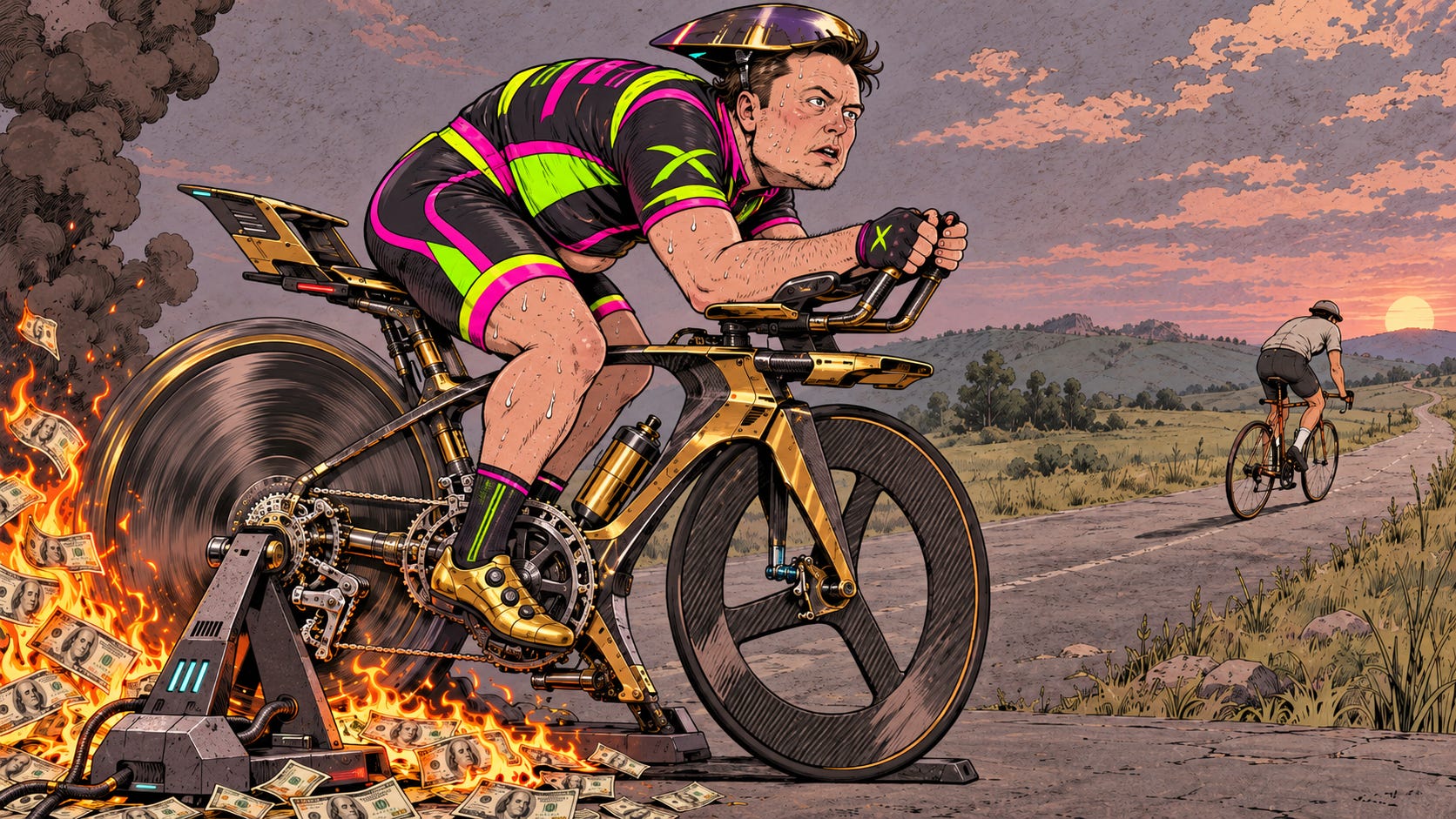
I was watching the election returns Tuesday night, and somewhere between my second White Russian and Walter explaining why the entire Democratic Party should be investigated under the RICO statutes, I came across a number that made me put down my drink.
Four hundred and forty-six million dollars.
That’s how much Elon Musk had poured into the 2026 midterms, according to the latest campaign finance reporting. Mostly to help Republicans hang on to Congress, with an especially generous helping reserved for his adopted home state of Texas.
Four hundred and forty-six million dollars, man.
Now, some of you may recall my earlier investigation into the hundred-and-fifty-eight-million-dollar ransom. A rather magnificent piece of financial analysis, if I do say so myself. I had barely finished congratulating myself on that discovery when Elon apparently decided the appropriate response was to spend another couple hundred million dollars.
The man is making it difficult to keep up.
“Dude,” Walter said, staring at his phone. “You have to understand. Elections are expensive. You need infrastructure. Television. Digital targeting. Ground operations. You can’t just show up and expect to win.”
“Yeah, Walter. But apparently you can spend four hundred million dollars and expect to lose.”
“That’s not what happened.”
Well, not everywhere. But down in Texas, something rather peculiar had happened.
James Talarico defeated Ken Paxton for the United States Senate. Gina Hinojosa defeated Greg Abbott for governor. Democrats broke a statewide Republican winning streak that had lasted more than thirty years.
And Musk, who had moved his business operations to Texas partly to escape California’s politics, had just spent a spectacular amount of money trying to preserve the political environment he preferred.
The environment declined his generous offer.
A Very Expensive Rescue Mission
Maude had the numbers.
“Jeffrey, the four hundred and forty-six million represents Musk’s reported large political contributions across the election cycle. His involvement in the Texas Senate race was approximately one hundred and ninety million dollars.”
She explained that Musk had given $75 million to the Senate Leadership Fund in September. The following day, that organization transferred $75 million into a new Texas political committee. Two weeks later, Musk contributed another $83 million. Another matching transfer followed.
It was an impressive demonstration of modern campaign finance plumbing.
The Republican establishment had actually preferred incumbent Senator John Cornyn in the primary. Its strategists estimated that nominating Paxton instead would require an additional $150 million to $200 million to defend the seat.
Paxton won the nomination anyway.
Musk subsequently helped finance the rescue operation.
And Talarico won the election.
“See?” Walter said. “The problem was the candidate. You can’t blame the donor.”
“I’m not blaming him, Walter. I’m admiring the invoice.”
For a moment I considered explaining the Supreme Court’s Citizens United decision and the subsequent legal machinery that permits essentially unlimited contributions to independent political committees. The point of that system, at least as its defenders describe it, is that political spending is a form of protected expression.
Fair enough. Elon was certainly expressing himself.
At a volume previously associated with Saturn V launches.
But the curious thing about unlimited political spending is that it doesn’t confer unlimited political persuasion.
And that reminded me of bicycles.
The Titanium Bolt Theory of Politics
I used to be a reasonably serious bicyclist1. Not Greg LeMond serious, but serious enough to understand that bicycles are an excellent way to turn disposable income into increasingly microscopic improvements in performance.
Back then, you could get a genuinely good bicycle for somewhat less than a thousand dollars. Spend more and you’d get lighter components, better bearings, a nicer groupset. All worthwhile, up to a point.
Then things started getting ridiculous.
A fellow would spend several thousand dollars shaving a few hundred grams off his bicycle, ignoring the considerably larger opportunity for weight reduction located directly above the saddle.
There is a point where the cheapest way to improve the power-to-weight ratio is to put down the cheeseburger.
Now, Greg LeMond on my thousand-dollar bicycle would have demolished some weekend warrior on a five-thousand-dollar racing machine. The expensive bike would be better. The rider would still be the limiting factor.
Politics has a similar problem.
The first million dollars can buy a struggling campaign staff, advertising, voter research, and a functioning organization. The next ten million can expand its reach. Another fifty million can ensure that practically every persuadable voter has encountered the candidate’s message.
But eventually, everybody has heard the pitch.
And some of them have decided they don’t want the product.
“That’s bullshit,” Walter said. “More money gets you better targeting. Better ads. More sophisticated data. You can identify voters nobody else even knows exist.”
“Sure, Walter. And titanium bolts are lighter than steel.”
“Exactly!”
“But you’re still riding the same bicycle.”
Donny had been listening quietly.
“Couldn’t they just get a better rider?”
Walter opened his mouth, considered the question, and returned to his phone.
Sometimes Donny has a gift.
The World’s Most Expensive Focus Group
There’s another dimension to Musk’s political adventures that interests me.
The man owns Twitter. Sorry, X. Whatever we’re calling the thing this week.
He has an enormous following. He can post a political opinion and receive an immediate avalanche of approval, outrage, reposts, and enthusiastic declarations that he’s the only person brave enough to say what everyone is thinking.
Which must feel pretty good.
But I wonder whether Elon has considered that the people applauding him on a platform he owns might not constitute a representative sample of the American electorate.
It’s a perfectly understandable mistake. Spend enough time surrounded by people who agree with you and eventually agreement starts looking like a universal law of nature.
In the technology business, we’d call that confusing your most engaged customers with your total addressable market.
It’s how companies discover that the people who spend twelve hours a day using their product are not necessarily representative of the people who might someday purchase it.
Now, I don’t know what Musk’s political advisers told him. Maybe they warned him. Maybe they had excellent research showing exactly how difficult Texas would be. We shouldn’t pretend that election results give us access to the man’s private conversations.
But owning a megaphone doesn’t make the crowd any more representative.
And spending another hundred million dollars to repeat the same message doesn’t necessarily make that message more convincing.
It may simply make people more familiar with the reasons they dislike it.
The Fortress Gets Expensive
The Texas results create another rather awkward problem.
For decades, Republicans could treat Texas as a dependable source of forty electoral votes. They didn’t have to spend presidential-election money defending Houston, Dallas, Austin, and San Antonio the way they spent it fighting over Pennsylvania or Wisconsin.
That was a tremendous strategic advantage.
Now Texas has elected a Democratic senator and a Democratic governor.
Does that mean Texas will vote Democratic for president in 2028?
Of course not. Voters are perfectly capable of distinguishing one election from another.
But Republicans can no longer look at Texas’s recent history and assume the general-election contest is a formality.
And defending Texas is expensive. It’s a gigantic state with multiple major media markets, an enormous electorate, and enough political geography to keep consultants employed until the heat death of the universe.
Money that has to be spent protecting Texas is money that can’t simultaneously be spent protecting somewhere else.
Meanwhile, Hinojosa’s victory suggests that at least some Texans were dissatisfied with the government they’d been living under, not merely the personalities running for Washington.
Musk can fund another candidate. He can’t simply purchase public satisfaction with the condition of the state.
Which brings us back to the bicycle.
At some point, another titanium component isn’t solving your problem.
The Billionaire Relocation Program
“Hey, Dude?” Donny asked.
“Yeah, Donny?”
“Where does Elon move if Texas stops doing what he wants?”
Walter didn’t look up.
“Florida, Donny. Obviously. No state income tax. Republican governor. Mar-a-Lago. It’s practically designed for the guy.”
“Didn’t Florida have a close election too?”
It had. Republicans held the governor’s office and Senate seat, but Byron Donalds and Ashley Moody won by relatively narrow margins.
“Florida’s still Republican,” Walter said.
“Sure,” Donny replied. “But what if he doesn’t like it there either?”
“Then he can buy himself a goddamn island.”
Donny thought about that.
“Doesn’t Florida already have a lot of billionaires?”
“Yes, Donny. Florida has billionaires.”
“Would they even notice another one?”
I looked back at the election returns.
Four hundred and forty-six million dollars. The greatest individual political donor of the cycle. An enormous social-media platform. A fleet of political organizations. Enough money to purchase almost any material object a human being could reasonably desire.
And yet, when the votes were counted in Texas, the voters had made their own decision.
Maybe the next four hundred million will work better.
Or maybe Elon should spend a little less on titanium bolts and take the bicycle for a ride outside his own neighborhood.
The Dude abides.
No, not the Dude, but the man behind the scenes. I used to put 250 or so miles a week on my road bike terrorizing the hills surrounding Silicon Valley in the 1980’s and early 1990s. Hence the Greg Lemond reference