

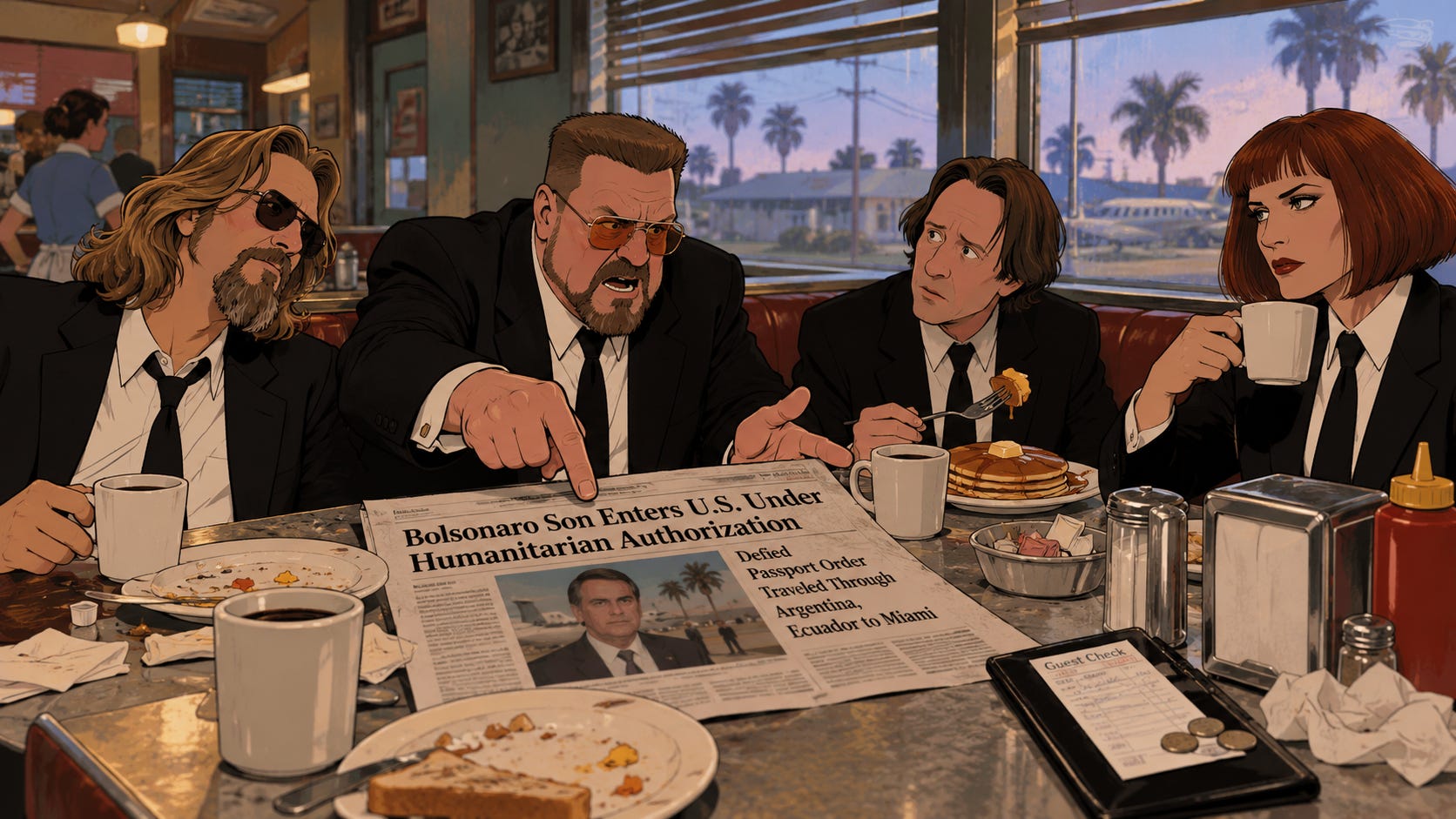
There was a newspaper spread across the table at this little diner off the highway—one of those places with chrome napkin holders, coffee that tastes like it’s been litigated, and eggs that arrive looking like they’ve accepted their fate. Walter had both palms planted on either side of the paper like he was about to arrest it.
“THIS,” he said, jabbing at the page, “is exactly what I’m talking about, Dude. Exactly. Foreign national under investigation for financial crimes, ordered to surrender his passports, slips across an international border, takes a private plane through two countries, and winds up in Miami. Miami, Dude. And we’re just letting him in.”
I was working on my second cup and not really making progress. “Yeah, Walter,” I said. “Sounds like one hell of a border-security lapse.”
“It is a lapse. It’s a total breakdown. You cannot run a serious country this way. Guy’s under investigation for money laundering, some kind of movie-financing racket, light fraud, who the fuck knows what else, and instead of answering questions he hops a jet and gets waved in.”
Donny looked up from a short stack that had disappeared almost to the horizon line. “What movie?”
Maude, who had joined us in this diner for reasons known only to Maude, stirred her coffee once and set the spoon down like she was concluding a minor operation. “A biographical film about his father,” she said. “The financing of it is part of what Brazilian authorities are examining.”
Walter threw up his hands. “See? It’s all right there. And these people spend years telling us we have to be compassionate, we have to be humane, we have to understand the plight of migrants, and then some politically connected grifter from overseas strolls in through the VIP entrance.”
I said, “Who is the guy, Walter?”
He looked at me like I had interrupted a war crimes tribunal. “Flávio Bolsonaro.”
There was a little pause at the table. Even the waitress, who had been topping off coffee two booths over, seemed to sense the material adjusting itself.
“The Bolsonaro?” I said.
“Yes, the Bolsonaro.”
“Son of Jair Bolsonaro?” Donny asked.
“Yes, Donny,” Walter said. “That is generally how sons work.”
Maude took a sip of coffee. “The oldest son, yes. He lost the Brazilian runoff to Lula by a little over four million votes after leading in the first round. Then he disputed the result, refused to accept the loss, ignored an order to surrender his travel documents, and somehow reached Miami by way of Argentina and Ecuador.”
Walter folded the paper over like he’d just presented Exhibit A. “And that, Dude, is what I’m saying. Everybody’s always screaming about due process and the rule of law and respecting democratic institutions, and here’s this asshole making a complete mockery of all three. We are importing a law-and-order problem.”
“Are we importing it,” I said, “or are we just warehousing it in Florida with the rest of them?”
Walter ignored that. “The point is, if some guy from Latin America under criminal investigation can just breeze into the country because he’s got friends in high places, then what exactly are we doing here? What happened to all the tough talk? What happened to the sacred border? What happened to keeping criminals out?”
Donny had been thinking about this.
“Gee,” he said, “I thought we were only taking white farmers from South Africa as refugees. Does Bolsonaro have a farm?”
Walter turned to him in exasperation. “Donny, what the fuck are you talking about?”
But Maude tilted her head. “Actually, Walter, it’s a rather pertinent question.”
Walter stared at her. “How is that pertinent?”
“Because Donald has, in his inimitably blunt fashion, identified the inconsistency. The administration has been highly selective in the kinds of people it imagines as worthy of refuge. The legal channels aren’t identical, of course. The South Africans were discussed as refugees. Bolsonaro reportedly entered under humanitarian authorization. But Donald’s question is more or less the whole question: why is humanitarian concern available so swiftly, so elegantly, and with such excellent routing when the person involved is politically useful?”
Donny nodded. “So he doesn’t need a farm.”
“No, Donald.”
“Does he need to be white?”
Walter slapped the table. “That is not the issue.”
I said, “Seems to be adjacent to the issue, man.”
And that was the thing. Walter wasn’t entirely wrong. He was loud, and his blood pressure was conducting itself without adult supervision, but he wasn’t wrong. A foreign politician loses an election, claims fraud, dodges a court order, boards a private aircraft, and gets welcomed into the United States under the banner of humanitarianism. That is a hell of a sequence of events. If the names were changed, half the people currently defending it would be on cable television using the phrase banana republic every nine seconds.
Which, frankly, is unfair to bananas.
Maude dabbed at the corner of her mouth with a paper napkin. “There is, to be fair, a legitimate argument that prosecutions in Latin America can be politicized. One need not assume every charge is clean merely because it bears the seal of a court.”
Walter brightened immediately. “Exactly.”
She held up a finger. “That does not, however, answer the more embarrassing question of selective American virtue. Marco Rubio built a considerable portion of his public identity on stern pronouncements about authoritarianism in the hemisphere. He now appears, according to Brazilian reporting, to have helped grease the skids for the arrival of a defeated right-wing candidate who refused to recognize an election result.”
Walter frowned. “Well, maybe he’s protecting a dissident.”
“Perhaps,” said Maude. “Or perhaps he has become a concierge for the transnational right.”
Donny looked at me. “What’s a concierge?”
“Guy who gets you a dinner reservation and maybe helps you flee a money-laundering investigation, man.”
The waitress brought the check and laid it on the table between the ketchup bottle and Walter’s newspaper. Nobody reached for it.
I looked back down at the article. The whole trip had a kind of grotesque elegance to it. Slip into Argentina. Hop a private flight. Stop in Ecuador. Land in Miami. Get humanitarian treatment. Start talking about political persecution. It was less an escape route than a premium travel package. Somewhere out there were people trying to get into this country with kids, backpacks, blistered feet, paperwork in a sandwich bag, and no one in Washington returning their calls. Meanwhile this guy gets the whole velvet-rope treatment because he belongs to the right family and says the right things to the right Americans.
There are people in this country who talk about immigrants from Latin America as if each one arrives personally wrapped in cartel tape, carrying plague, fentanyl, and six fake Social Security numbers. They make a whole religion out of suspicion. But let a Bolsonaro show up in Opa-locka after dodging a court order, and suddenly everybody discovers nuance, complexity, regional context, and the healing power of humanitarian discretion.
That’s a hell of a word, humanitarian. It covers such a multitude of conveniences.
Walter was still muttering about sovereignty when the waitress came back and asked if we were settling up.
Walter patted his jacket. “I thought the check was yours, Dude.”
I looked at the little tray, the untouched bill, the coffee rings, the eggs going cold, and the newspaper with the runaway prince of Brazilian grievance politics staring up from the fold.
“Yeah,” I said. “Funny how fast service gets around here when the right guy walks in.”
The Dude abides.