

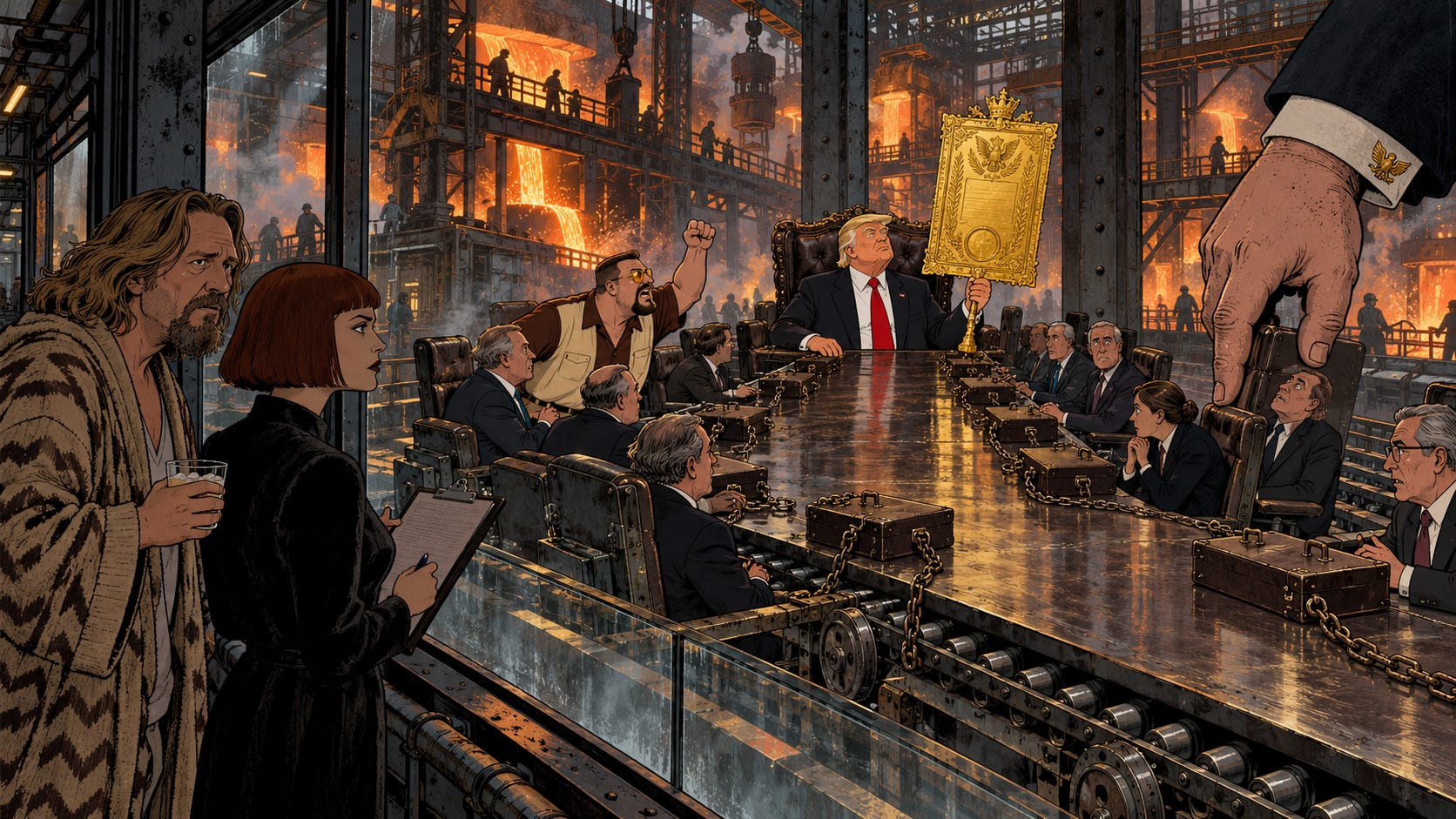
The Dude was reading something on his phone when Walter arrived at the bowling alley carrying a newspaper and looking unusually pleased with himself.
“DUDE, WE’RE FINALLY GETTING SERIOUS ABOUT AMERICAN INDUSTRY.”
“Well, that’s good, Walter.”
“STEEL. SEMICONDUCTORS. RARE EARTH MINERALS. WE’RE TAKING BACK CONTROL OF OUR INDUSTRIAL BASE.”
“Taking back control?”
“YOU’RE GODDAMN RIGHT. NO MORE LETTING THE CHINESE MAKE EVERYTHING WHILE WE SIT AROUND BUYING THEIR CRAP.”
The Dude looked back at his phone.
“Walter, did you know the federal government owns almost ten percent of Intel now?”
“GOOD.”
“Good?”
“STRATEGIC INDUSTRY, DUDE. NATIONAL SECURITY.”
“Huh.”
The Dude wasn’t entirely sure what to make of this. He’d spent a fair amount of his youth around people who believed the government ought to own the means of production. They were usually the ones with the bad coffee, the mimeographed manifestos, and an almost supernatural ability to turn a discussion about bus fares into a three-hour argument about dialectical materialism.
Walter had never been particularly fond of those people.
In fact, Walter had spent much of his adult life explaining, frequently at considerable volume, that government ownership of private enterprise was the first step toward communism, breadlines, and having to ask permission before buying a refrigerator.
Yet here he was, practically celebrating.
“Walter, I thought you hated socialism.”
“I DO HATE SOCIALISM, DUDE.”
“So the government owning part of Intel isn’t socialism?”
“IT’S NATIONAL SECURITY.”
“Ah.”
“Jeffrey, Walter is correct about the strategic importance of semiconductor manufacturing.”
Maude had arrived without either of them noticing. She placed her handbag on an empty chair and examined the Dude’s phone.
“Advanced semiconductors are essential to military systems, communications, and virtually every significant modern industry. Depending on overseas manufacturing capacity creates substantial vulnerabilities.”
“THANK YOU, MAUDE.”
“However, Walter, national security is a justification for an intervention. It does not tell us whether the intervention is well designed.”
Walter’s smile faded.
In August 2025, the Trump administration negotiated a deal giving the federal government a 9.9 percent stake in Intel, the American semiconductor giant.
The government received approximately 433 million shares in exchange for $8.9 billion in federal support, largely funding that had already been awarded under the CHIPS Act and a defense-related semiconductor program.
It wasn’t a seizure. The arrangement was negotiated, and the government’s ownership position was passive, without a seat on Intel’s board.
Still, Washington had become a substantial shareholder in one of America’s most important technology companies.
The same Washington whose Republican leaders had spent decades explaining that government couldn’t possibly be trusted to run a lemonade stand.
“Maude, isn’t this the government owning the means of production?”
“Only a minority interest, Jeffrey. Intel remains privately managed. State ownership of shares does not automatically constitute socialism.”
“SEE, DUDE? IT’S CAPITALISM.”
“I wasn’t finished, Walter.”
Maude adjusted her glasses.
“The administration converted previously committed federal support into equity. That’s a different arrangement from the subsidies originally authorized. It gives the government a financial interest in the company’s performance.”
“Well, Maude, at least the taxpayers might get something back.”
“Possibly, Jeffrey. They also acquire investment risk. The question is whether this arrangement advances semiconductor manufacturing more effectively than the original funding mechanism.”
The Dude considered this. Maude had an annoying habit of making his arguments more complicated without necessarily making them less interesting.
The CHIPS Act, passed under Biden, had already embraced substantial industrial policy. America needed advanced semiconductor manufacturing capacity, and the private market hadn’t built enough of it domestically.
There was a legitimate argument for government involvement.
Trump’s innovation was to convert some of that assistance into an ownership stake.
The government wasn’t merely subsidizing industry anymore. It was getting a piece of the action.
And Walter thought this was terrific.
Then the Dude found the steel deal.
In June 2025, the Trump administration approved Nippon Steel’s acquisition of U.S. Steel, but only after negotiating a National Security Agreement that gave Washington something called a golden share.
Now, a golden share sounds like the sort of thing awarded to a particularly enthusiastic member of the local Rotary Club.
But this one has actual power.
The federal government can appoint a director to U.S. Steel’s board and exercise consent rights over certain corporate decisions, including moving production or jobs overseas, relocating the company’s headquarters, and closing specified American manufacturing facilities.
The government doesn’t own the company outright. Nippon Steel owns the common shares, and the golden share doesn’t entitle Washington to dividends.
What it does provide is a seat at the table and the ability to say no.
The Dude read the arrangement twice.
“Walter, the president can stop a private company from closing a factory.”
“GOOD. KEEP AMERICAN STEEL JOBS IN AMERICA.”
“Even if the company thinks the factory is losing money?”
“ESPECIALLY THEN, DUDE. WE CAN’T LET CORPORATE ACCOUNTANTS DESTROY OUR INDUSTRIAL BASE.”
“Well, Walter, that sounds like something Bernie Sanders would say.”
“THAT IS COMPLETELY DIFFERENT.”
“How?”
“BECAUSE BERNIE’S A FUCKING SOCIALIST.”
Maude looked up.
“Walter, the national-security concern is legitimate. Domestic steelmaking capacity matters. But the mechanism is precisely the sort of government interference in corporate decision-making that Republicans have traditionally opposed.”
“THEY’RE PROTECTING AMERICAN JOBS!”
“Yes. By restricting management’s ability to make certain business decisions.”
“AND?”
“That is the point, Walter.”
Donny looked up.
“Does the factory know which party the president belongs to?”
Nobody answered.
The Dude thought back to the Reagan years.
He remembered the speeches about government being the problem rather than the solution. The lectures about economic freedom, entrepreneurial risk, and the miraculous efficiency of markets. The stern warnings that bureaucrats in Washington had no business deciding which companies should survive and which should fail.
Some of that had always been mythology, of course. American governments had subsidized railroads, protected industries with tariffs, and directed wartime production long before Reagan arrived.
But the mythology had been important.
For forty years, the Republican Party had treated government interference in business as an almost moral failing. Markets picked winners and losers. Government wasn’t supposed to interfere.
Now Washington had negotiated the right to prevent a steel company from closing a plant.
And Walter was applauding.
It didn’t stop there.
The Pentagon had also negotiated an arrangement with MP Materials, an American producer of rare earth minerals used in everything from electric motors to advanced weapons systems.
The government committed $400 million for convertible preferred shares and warrants that could give it approximately 15 percent of the company. It also agreed to a ten-year price floor for certain rare earth products and commitments to purchase future magnet production.
That’s rather more than cutting a check and hoping the market takes care of the rest.
The government was investing in the company, guaranteeing minimum economic terms for its products, and promising to become a customer.
“Walter, now we’re guaranteeing prices.”
“YOU KNOW WHAT CHINA CONTROLS, DUDE? RARE EARTH PROCESSING. YOU WANT THEM CONTROLLING OUR MISSILE GUIDANCE SYSTEMS?”
“No, Walter.”
“THEN WE BUILD THE CAPACITY HERE.”
“Fair enough.”
“Actually,” Maude said, “Walter has a stronger argument here than you appear willing to acknowledge.”
The Dude sighed.
“Go on, Maude.”
“China’s dominance in rare earth processing is a genuine strategic vulnerability. Building an alternative supply chain requires enormous capital expenditure, and investors may be unwilling to finance it without some protection against sudden price declines.”
“So the government’s guaranteeing prices to get the factories built?”
“Essentially. Whether the price floor is appropriate, and whether the public receives an adequate return for the risk, are separate questions.”
“THANK YOU, MAUDE.”
“Again, Walter, I haven’t finished.”
She paused.
“The interesting question is why government-directed investment, price guarantees, and long-term purchasing commitments have suddenly become acceptable instruments of Republican economic policy.”
Walter took a drink.
“BECAUSE WE’RE FINALLY GETTING SERIOUS.”
“That is a political slogan, Walter. Not an economic distinction.”
The Dude smiled into his White Russian.
He was beginning to enjoy this.
And then there was Venezuela.
This was where things got genuinely peculiar.
Following the American operation that removed Nicolás Maduro in January 2026, the Trump administration established arrangements giving Washington control over the handling and disbursement of Venezuelan oil revenues.
Then, in August, it announced an extraordinary agreement involving North American Blue Energy Partners, a private oil company granted century-long concessions covering seventeen Venezuelan oilfields.
Under the announced arrangement, the American government would hold rights to a 35 percent stake in the company’s parent, receive preferential access to twenty percent of its oil production at cost, and have first refusal on the remainder.
The White House claimed the agreement involved approximately 65 billion barrels of oil reserves, although the reserve estimates and the commercial viability of extracting that oil have been questioned.
The actual production, investment, and implementation would be considerably more complicated than an announcement from the White House.
Still, consider the arrangement.
The United States government was negotiating ownership rights and preferential access to oil production in another country, through a selected private company, under an agreement that could stretch into the next century.
The same political movement that had spent decades denouncing Venezuela’s socialist governments for their control of the petroleum industry was now negotiating its own elaborate arrangement for controlling Venezuelan petroleum.
“Walter, isn’t this the sort of thing we used to complain about when Chávez was running Venezuela?”
“CHÁVEZ NATIONALIZED PRIVATE COMPANIES, DUDE. WE’RE OPENING UP THE MARKET.”
“By having the American government take a stake in an oil company?”
“TO KEEP THE CHINESE AND RUSSIANS OUT!”
“And get the oil?”
“YES!”
“So it’s okay when we do it?”
“Jeffrey.”
Maude’s voice was exceptionally calm.
“Hugo Chávez expropriated private assets and expanded state ownership of Venezuela’s petroleum industry. The American arrangements are different in structure, ownership, and legal mechanism. You shouldn’t conflate them.”
“Well, Maude, we’re still getting into the oil business.”
“Yes. And that is the more interesting question. Why is an administration ostensibly committed to free enterprise negotiating preferential access to another country’s natural resources through government-selected commercial arrangements?”
“That’s what I said.”
“Not quite.”
Walter looked pleased that somebody else was getting corrected for a change.
But the Dude wasn’t arguing that government intervention was inherently wrong. His old Port Huron Statement instincts had never entirely disappeared, and he wasn’t about to start pretending that markets were magical creatures that automatically produced socially desirable outcomes.
Industrial policy has a long American history. Alexander Hamilton would have recognized the argument. So would Franklin Roosevelt. Hell, so would Dwight Eisenhower.
The problem wasn’t that the government was doing things.
It was that the people doing them had spent decades insisting that doing those things was practically an act of treason against capitalism.
And there was something else.
Traditional industrial policy often involved legislation, appropriations, tax incentives, loans, and regulations. These newer arrangements included negotiated ownership positions, special governance rights, guaranteed prices, and decisions made company by company.
Washington wasn’t simply establishing rules for businesses to follow.
It was becoming their shareholder, their customer, their price guarantor, and, in some cases, a participant in deciding how they operated.
Which brought the Dude back to a peculiar little object he’d seen the previous year.
In August 2025, Tim Cook, then Apple’s CEO, presented Trump with an elaborate glass disc made by Corning, mounted on a base of 24-karat gold.
It was a unique commemorative gift, presented during an announcement of an additional $100 billion in American manufacturing commitments.
The Dude remembered thinking that it resembled an especially expensive paperweight.
Cook, now Apple’s executive chairman, had long understood the importance of maintaining relationships with the people who regulate his industry and impose tariffs on his supply chain.
There was nothing inherently improper about a corporate executive presenting a ceremonial gift at a manufacturing announcement. Nor was there evidence that the bauble purchased some specific concession.
But it was an interesting little artifact of the relationship between corporate America and the presidency.
One executive brought a piece of glass on a gold base.
Intel exchanged federal funding for a substantial government equity stake.
Nippon Steel accepted a golden share carrying federal veto rights.
And in Venezuela, Washington negotiated access to oilfields halfway across the hemisphere.
Apparently gold was becoming a recurring theme in American industrial policy.
“Walter, when did the Republican Party get comfortable with all this government control?”
“WHEN WE REALIZED THE CHINESE WERE EATING OUR LUNCH, DUDE.”
“That’s a pretty good argument.”
“OF COURSE IT’S A GOOD ARGUMENT!”
“But weren’t the Democrats saying something similar when they passed the CHIPS Act?”
“THAT’S DIFFERENT.”
“How?”
Walter opened his mouth.
Then closed it.
Donny had been studying the little photograph of Tim Cook’s golden gift.
“Hey, Walter?”
“WHAT?”
“If the government owns part of Intel, and it can tell U.S. Steel what to do, does that mean it’s socialism?”
“NO, DONNY.”
“What is it, then?”
“IT’S CAPITALISM.”
“With the government running things?”
“THE GOVERNMENT ISN’T RUNNING THE FUCKING COMPANIES, DONNY!”
“But it’s telling them what they can do.”
Walter stared at him.
Maude considered the question.
“There’s no single threshold of ownership or government control that transforms capitalism into socialism, Donald. The terms describe broader systems of economic organization.”
“So what do you call this?”
“State capitalism would be one description. Economic nationalism or industrial policy would describe aspects of it as well.”
Donny nodded.
“Does Walter know that?”
Maude took a sip of her drink.
“I believe Walter is still deciding.”
The Dude had spent enough time around political movements to know that ideology has a peculiar way of accommodating whatever its leaders decide is necessary. Principles that once seemed sacred become negotiable. Old enemies acquire respectable new names.
Perhaps there was nothing especially new about any of this. The American economy had never been quite as free of government direction as its loudest defenders liked to pretend.
“Maude, I don’t suppose there’s anything inherently wrong with using government power to protect important industries.”
“Of course not, Jeffrey. The relevant questions are what the government is trying to accomplish, whether the intervention is effective, and who bears the cost.”
“Well, there goes forty years of Republican campaign speeches.”
“Not necessarily. They still seem quite attached to the vocabulary.”
Walter was muttering something about China, American sovereignty, and the dangers of letting academics run the economy.
The Dude looked down at the photograph of Tim Apple’s golden paperweight.
Forty years ago, Republicans warned that government ownership and political interference would destroy American capitalism.
Now they were buying shares, guaranteeing prices, appointing directors, and negotiating rights to Venezuelan oilfields.
Maybe they’d finally discovered that the market couldn’t solve every problem.
Or maybe socialism was only socialism when somebody else was doing it.
The Dude finished his drink.
Somewhere, Ronald Reagan was probably looking for the government complaint department.
The Dude abides.