

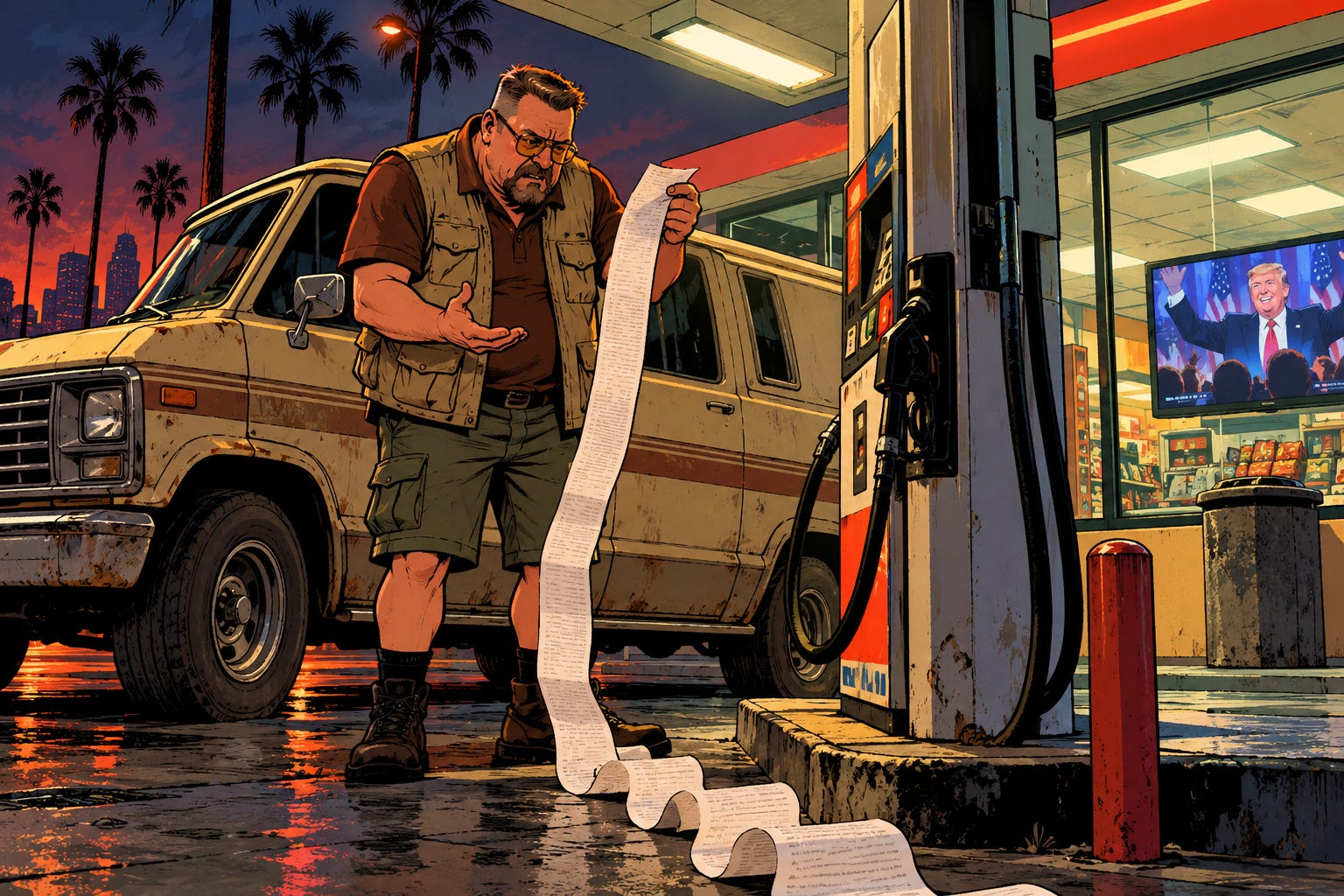
Walter came into the bowling alley looking like he’d just been informed that the Vietnamese had taken over the parking lot.
He dropped a crumpled receipt on the table next to my White Russian.
“Six fucking dollars a gallon, Dude. SIX DOLLARS. Do you have any idea what it costs to fill a full-size American van these days?”
I looked at the receipt. Walter’s van is a magnificent relic of the Reagan administration, back when Detroit figured eight cylinders were the minimum necessary to transport one angry man and a bowling bag across Los Angeles.
“That’s a lot of money, man.”
“YOU’RE GODDAMN RIGHT IT’S A LOT OF MONEY!”
I happened to be reading something on my phone. The New York Times had just reported that American oil companies made more than $130 billion in profits during six months of the Iran war. Almost triple what they’d earned during the same period last year.
“Hey, Walter. Apparently we’re getting rich.”
“Who the fuck is getting rich?”
“America, man. The president says we’re making a freaking fortune.”
Walter pulled out a chair.
“Dude. You have to understand something about the oil business.”
I settled in and took a pull from my White Russian. This was going to take a while.
The American Petroleum Industry
“First of all,” Walter began, “these are AMERICAN companies. American oil fields. American refineries. American jobs. You want the Saudis making all the money? The Russians? You want us dependent on a bunch of foreign assholes every time somebody decides to close a shipping lane?”
“No, Walter.”
“Damn right you don’t. Energy independence is NATIONAL SECURITY, Dude. I’ve been telling you this for years.”
Walter has been telling me a lot of things for years. Some of them are even correct.
And on this one, he had a point. The United States produces more oil than any other country. That’s a genuine advantage. Domestic production means jobs, investment, tax revenue, and a little less vulnerability to the whims of people running governments in distant deserts.
But oil is a global commodity. Being the world’s largest producer doesn’t mean Americans get to buy it at a special patriotic discount.
“Yeah, Walter. But the president says these profits are making us rich.”
“THEY ARE!”
I glanced at his receipt.
“Doesn’t seem like you’re getting rich.”
“That’s a separate fucking issue!”
Which, as it turns out, was precisely the issue.
A Hundred and Thirty Billion Dollars
Maude had stopped by the alley, ostensibly to discuss something with me that I wasn’t particularly interested in discussing. She noticed the newspaper article on my phone.
“The figure is actually rather remarkable, Jeffrey. More than $130 billion in profits from April through September, compared with less than $47 billion in the same period of 2025.”
“See?” Walter said. “AMERICAN INDUSTRY!”
“American consumers, meanwhile, have spent approximately $147 billion more on gasoline and diesel since the war began, according to researchers at Brown University.”
Walter made a noise like a lawn mower trying to swallow a garden hose.
“Those aren’t directly comparable figures,” Maude continued. “The periods differ, and consumer expenditures are not equivalent to corporate profits. But they illustrate the financial consequences of the same disruption.”
“THANK YOU, MAUDE!”
“I’m not finished, Walter.”
She explained that American refiners were doing particularly well. Refining capacity overseas had been damaged by the fighting, and facilities that remained operational were earning extraordinary margins. Some American refineries also benefited from their access to crude delivered by domestic pipelines, rather than expensive ocean shipping.
The oil companies were accumulating cash, paying down debt, and preparing to return much of the windfall to shareholders.
“That’s called responsible management,” Walter said.
“Indeed,” Maude replied. “It is.”
I could see Walter enjoying himself. He had found an ally.
“So they’re not making more oil?” I asked.
“Jeffrey, some companies are expanding production within their existing plans. But they are generally not making dramatic changes to long-term investment programs in response to a temporary price shock.”
“EXACTLY!” Walter shouted.
And then he explained it.
The Oilmen May Be Crude, But They Ain’t Stupid
“Dude, you can’t just turn on a fucking oil field. You know what it costs to develop offshore reserves? BILLIONS. You need drilling platforms, pipelines, equipment, permits, crews. You’re talking years before you get your first barrel.”
“Yeah, Walter.”
“And what happens if the war ends next month? What happens when all that oil comes back onto the market? Prices DROP. You think Exxon wants to spend ten billion dollars developing something that’s going to lose money before it pays for itself?”
“No, Walter.”
“Of course not! And the more oil everybody produces, the more pressure on the price. That’s BASIC ECONOMICS!”
He was getting worked up now, although for once his argument was substantially correct.
Different oil projects have different timelines. Shale wells can come online comparatively quickly. Major offshore developments can take years. But either way, sensible operators don’t commit enormous amounts of capital based on the assumption that a wartime price spike will last forever.
And the oil companies have gotten religion about capital discipline. They remember what happens when everybody chases the same high price, floods the market with new supply, and watches the investment go sideways.
The oilmen may be crude, but they ain’t stupid.
“So they’re taking the money,” I said.
“YES.”
“And paying down their debts.”
“YES.”
“And giving the rest to their shareholders.”
“THAT’S HOW A CORPORATION WORKS, DUDE!”
“Sounds like a pretty good deal.”
“IT IS A GOOD DEAL!”
I pointed at the receipt again.
Walter stared at it.
“Don’t fucking start.”
The Future Is Electric, Man
There was something else about the whole arrangement that interested me.
The oil companies weren’t merely being cautious about how long the war would last. They were looking at a world where high petroleum prices give people powerful incentives to stop using petroleum.
Consider China. The Chinese import enormous quantities of oil. Every tanker passing through a vulnerable shipping lane is another exposure to somebody else’s geopolitical adventure.
Electric vehicles offer a way to reduce that dependence. So do electrified buses, railways, and trucks. And electricity can increasingly come from domestic sources.
Europe has similar incentives.
It isn’t necessary to care about climate change to recognize that reducing your dependence on imported oil might be a good idea.
The International Energy Agency estimates that electric vehicles already displace millions of barrels of potential oil demand every day, with substantially more displacement expected by the end of the decade.
A prolonged oil shock makes that transition more attractive.
“Walter, you know what happens when gasoline gets really expensive?”
“PEOPLE COMPLAIN ABOUT IT!”
“Yeah. But eventually they start buying cars that don’t use gasoline.”
“Dude, people have been predicting the end of oil for fifty fucking years. You still need diesel trucks. You still need airplanes. You still need petrochemicals. You can’t run the whole goddamn economy on batteries!”
“Yeah, Walter. That’s true.”
And it was. Electrification doesn’t mean oil consumption vanishes next Tuesday. Aviation, shipping, heavy industry, and chemical manufacturing aren’t all going electric on anybody’s convenient schedule.
But the companies are planning for three years, five years, fifteen years down the road. They understand that their customers have alternatives, that technologies change, and that today’s extraordinarily profitable supply disruption might help make those alternatives more attractive.
Which is why they’re not building their financial plans around the president’s current enthusiasm for their earnings.
Trump is looking at the cash register.
The oil companies are looking at the calendar.
And Walter is looking at his gas receipt.
Who’s We?
Donny had been sitting quietly through most of this, eating something that looked like it had been purchased from a vending machine shortly after the first Bush administration.
“Hey, Walter?”
“What, Donny?”
“If the oil companies are making all this money, why does gasoline cost so much?”
“BECAUSE THE WAR HAS RESTRICTED GLOBAL SUPPLY! Jesus Christ, Donny, we’ve been talking about this for twenty minutes!”
“Right. But the president says we’re getting rich?”
“YES!”
“So where does the money go?”
Walter looked at him.
“It goes to the companies, Donny. They pay their expenses, service their debt, invest in operations, and return capital to shareholders.”
“Do you own oil company stock, Walter?”
“That’s none of your goddamn business.”
“I was just wondering.”
Walter took another look at the receipt.
Donny wasn’t finished.
“And doesn’t diesel cost even more?”
In California, diesel was running around eight dollars and forty cents a gallon. That’s the stuff that moves the groceries, hauls the freight, runs agricultural equipment, and keeps an impressive amount of the economy functioning. Higher diesel costs don’t just annoy people driving trucks. They work their way into the price of things bought by people who have never been within fifty feet of a diesel pump.
“YES, DONNY. DIESEL IS EXPENSIVE!”
“So the grocery store pays more to get the food delivered?”
“YES!”
“And then we pay more for the groceries?”
“THAT’S HOW COSTS WORK, DONNY!”
Donny thought about this.
“So we’re paying more for gasoline, and more for groceries, and the oil companies are making more money?”
Walter closed his eyes.
“Yes, Donny.”
“Okay. I just don’t understand which part makes us rich.”
Neither, apparently, did Walter.
The Receipt
Now, I don’t begrudge the oil companies their profits. They didn’t invent the laws of supply and demand, and they’re not charitable organizations. They have shareholders, employees, debts, and enormous capital investments to manage. They’re doing what businesses in their position generally do.
Hell, Walter explained it better than I could.
What I find peculiar is the president standing in front of Americans struggling with fuel costs and telling them how wonderful it is that the American oil business is making a fortune.
Because he’s not entirely wrong, either. A profitable domestic energy industry really is valuable to the country.
But there’s a considerable distance between a country having prosperous corporations and the people living in that country feeling prosperous themselves.
And no amount of enthusiastic presidential arithmetic makes those two things identical.
Walter folded his gas receipt, then unfolded it, as though maybe the numbers had changed while we were talking.
They hadn’t.
I looked at the article again. More than $130 billion in profits. Executives talking about strong balance sheets, disciplined investment, and returning excess cash to their owners.
Good for them.
Walter tucked the receipt into his wallet. He was still angry, and still right about most of the economics. He’d just spent the better part of an hour explaining why the oil companies were behaving sensibly.
And now he had to drive his van home.
The oil companies had their balance sheets.
Walter had his receipt.
The Dude abides.