

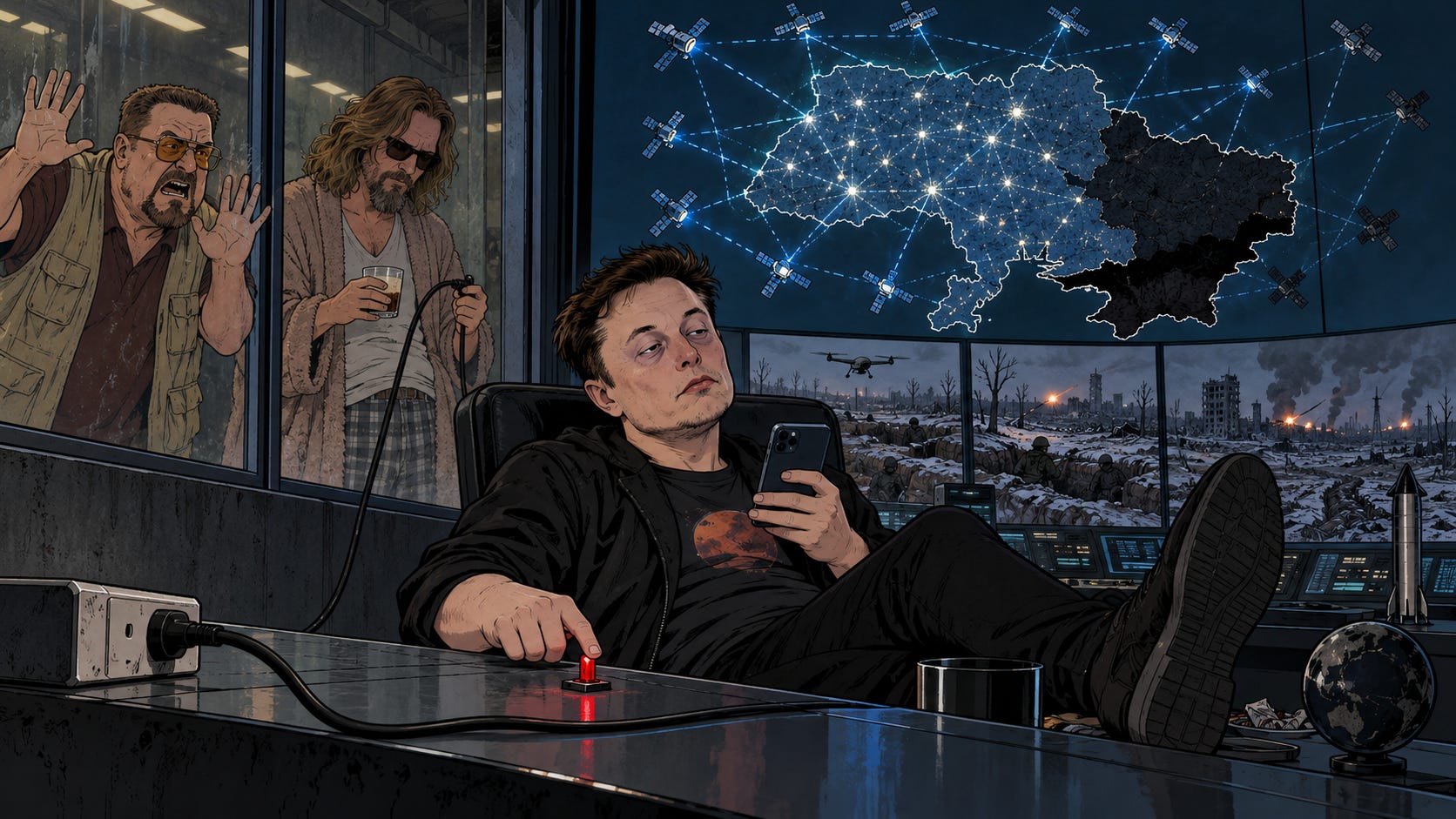
Walter was staring at his phone with the expression of a man who had just discovered somebody had pissed in his bowling bag.
“THAT SON OF A BITCH.”
The Dude looked up.
“What’s happening, Walter?”
“ELON FUCKING MUSK.”
“Oh, man. What’d he do now?”
“THEY’RE SCREWING WITH THE UKRAINIANS’ SATELLITE COMMUNICATIONS. IN THE MIDDLE OF A GODDAMN WAR.”
“Well, that’s not good.”
“NOT GOOD? DUDE, THEY’RE FIGHTING THE RUSSIANS. THEY’VE GOT DRONES, MISSILES, ARTILLERY, PEOPLE TRYING TO STAY ALIVE, AND SOMEBODY DECIDES TO TURN DOWN THE FUCKING INTERNET?”
Walter shoved his phone across the table.
The Dude read the story.
Apparently, SpaceX had restricted access to Starshield, the military version of its Starlink satellite communications system, which Ukraine relies upon for battlefield communications, drone operations, and parts of its air defense.
The restrictions, imposed in mid-October, interfered with terminals mounted on fast-moving objects. Ukrainian military personnel reported disrupted operations at a particularly dangerous moment in their war with Russia.
Who ordered the restrictions was less clear. And it ultimately doesn’t matter much.
One report said the decision originated inside the White House. Another attributed it to Musk himself. Secretary of State Marco Rubio said the matter was governed by a private commercial contract and that SpaceX controlled how its technology could be used.
Trump said Musk had restored the service. Ukrainian officials subsequently reported that restrictions remained.
By October 25, service was reportedly restored, but the explanations of who had ordered the disruption remained a magnificent collection of contradictory statements.
The Dude read the story again.
“Walter, nobody seems to know who made the decision.”
“THAT’S EVEN WORSE, DUDE.”
“Well, somebody knows.”
“THEN FIND THE SON OF A BITCH!”
The Dude had to admit Walter had a point.
The remarkable thing wasn’t simply that a private company could alter access to a strategically important communications network. Private companies operate critical infrastructure all over the world.
It was that the United States government, while providing military assistance to a country fighting for its survival, couldn’t seem to offer a consistent public explanation of who controlled a communications capability essential to that assistance.
And the guy running the company was Elon Musk.
The same Elon Musk who owned Tesla, controlled Twitter (X), operated SpaceX, and had accumulated a personal fortune large enough to make some national economies look like underperforming lemonade stands.
“Jeffrey, there is an important distinction.”
Maude had arrived with a newspaper and a cup of coffee.
“Of course there is, Maude.”
“Starlink and Starshield are not identical services. Starlink is primarily a commercial satellite communications network. Starshield provides specialized capabilities for government and military customers.”
“Right.”
“Musk has argued that civilian Starlink was never intended to support offensive military operations. Ukraine disputes his allegations about how the service was being used.”
“SO WHAT?” Walter demanded.
“So contractual limitations matter, Walter. A commercial service provider is entitled to establish the uses for which its products are sold.”
“PEOPLE ARE BEING KILLED, MAUDE.”
“Yes, Walter. Which is why the question of authority over military communications during an active conflict is considerably more important than an argument about commercial terms of service.”
Walter paused.
He hadn’t expected agreement.
“And we should distinguish disruptions that impair military operations from proof that particular civilian deaths resulted from those disruptions,” Maude continued. “The former has been reported. The latter requires evidence we don’t presently have.”
The Dude nodded.
He’d encountered this problem before.
Back in 2022, during Ukraine’s efforts to attack Russia’s Black Sea Fleet near Crimea, Musk had refused a request to activate Starlink coverage near Sevastopol. He said he was concerned that providing the service would make SpaceX complicit in a major act of war.
Early accounts suggested he’d switched off an existing connection. That part of the story was subsequently corrected.
The distinction mattered. Refusing to expand a commercial network into an area of active combat wasn’t the same as disabling a military capability already operating under a government arrangement.
But it introduced an uncomfortable question.
How had an American businessman become a participant in decisions that could affect the conduct of a war between two sovereign countries?
“Walter, remember when we were talking about Intel?”
“WHAT ABOUT INTEL?”
“Well, the government’s got almost ten percent of the company. And that golden share in U.S. Steel lets Washington stop certain business decisions.”
“STRATEGIC INDUSTRIES, DUDE. NATIONAL SECURITY.”
“Right. And you’ve got rare earth minerals, semiconductor manufacturing, American steel. The government says these things are too important to leave entirely to market forces.”
“YOU’RE GODDAMN RIGHT.”
“So what about satellite communications?”
Walter stared at him.
“WHAT ABOUT THEM?”
“Well, if a Ukrainian drone can’t operate because somebody changed a setting on a satellite network, that sounds pretty strategic.”
“OF COURSE IT’S STRATEGIC!”
“So why is the government buying pieces of semiconductor companies while apparently having trouble establishing who’s responsible for keeping an ally’s military communications running?”
Walter opened his mouth.
Then closed it.
For once, the Dude wasn’t being particularly difficult.
He was simply following Walter’s argument to its logical conclusion.
SpaceX had become an extraordinary company. Its reusable rockets had transformed the economics of reaching orbit, and its launch business had become a dominant force in commercial spaceflight.
The American military depended heavily on it, too.
In April 2025, the Space Force awarded SpaceX a national-security launch contract with an anticipated value approaching six billion dollars, alongside contracts for United Launch Alliance and Blue Origin.
SpaceX wasn’t literally the only company capable of launching American military payloads, but it occupied an enormously important position in the system.
Then there was Starlink, with thousands of satellites providing communications across much of the planet. In Ukraine, satellite connectivity had become essential infrastructure for a country whose conventional communications networks were under constant attack.
To SpaceX’s considerable credit, that capability had helped Ukraine enormously since the Russian invasion in 2022.
Private innovation had delivered something governments struggled to provide at comparable speed and scale.
But success had created a new dependency.
The government could procure rockets from multiple companies, at least in principle. Replacing a satellite communications network woven into an army’s daily operations was a rather more complicated proposition.
“Walter, I don’t think the problem is that Musk built all this stuff.”
“OF COURSE IT ISN’T. THE ROCKETS ARE AMAZING.”
“Yeah.”
“THE ENGINEERING IS INCREDIBLE, DUDE.”
“Right.”
“IT’S THE FACT THAT ONE GUY CAN GET IN THE MIDDLE OF A GODDAMN WAR.”
The Dude considered this.
Maude put down her coffee.
“One should be careful about attributing all operational decisions personally to Musk, Walter. There are contracts, government agencies, military authorities, and corporate personnel involved.”
“THEN WHO’S RESPONSIBLE?”
“That is precisely the question.”
And there it was.
A military service gets restricted. The Ukrainians complain. Reporters ask questions.
One account points toward the White House. Another points toward Musk. Government officials offer different explanations about whose decision it was.
The system is important enough to affect battlefield operations, but the chain of accountability is sufficiently tangled that the public struggles to determine who made the call.
It was a hell of an arrangement.
And that was before you got to the money.
The Dude had recently written a rather fine examination of Musk’s hundred and fifty-eight million dollar contribution to the Republican Senate operation:

He thought it was one of his better efforts.
Walter had suggested that the ransom analogy was excessive.
The Dude had patiently explained that when a single man could contribute the equivalent of more than a hundred Bunny Lebowski ransom demands to a political operation, the comparison was practically begging to be made.
The money had gone to Senate Leadership Fund, which transferred corresponding amounts to a political operation supporting Ken Paxton’s Texas Senate campaign.
Musk’s political involvement went beyond those checks. His America PAC had also poured substantial resources into Republican organizing and advertising.
There was nothing inherently illegal about a wealthy citizen spending money on politics through the permitted channels.
But the scale was astonishing.
“Jeffrey,” Maude said, “the money went through independent political committees. You cannot simply describe it as Musk purchasing a Senate seat.”
“Well, Maude, I didn’t say he bought it.”
“You were about to.”
“Maybe I was getting there.”
“Campaign spending does not guarantee electoral outcomes. Voters still make the decision.”
“Sure. But a hundred and fifty-eight million dollars buys a hell of a lot of opportunities to influence that decision.”
“That it does.”
The Dude thought about the sheer variety of power involved.
Musk could finance political campaigns on a scale previously associated with entire political parties.
His companies could launch national-security satellites, supply critical military communications, operate a global social media platform, and negotiate enormous government contracts.
None of those activities, individually, was necessarily improper.
But taken together, they presented a rather novel concentration of influence.
Most billionaires could write enormous campaign checks.
Most defense contractors depended upon the government for their business.
Most communications companies had obligations to their customers and regulators.
Musk combined all three categories, along with personal control over a communications platform that helped shape public debate.
And unlike elected officials, he didn’t have to face voters.
Unlike military officers, he wasn’t subject to the military chain of command.
Unlike civil servants, he didn’t operate within an ordinary public-service accountability framework.
He was a private executive, acting through corporations and contracts, whose business decisions could have consequences normally associated with government authority.
And the American government had become heavily dependent upon capabilities he controlled.
Donny looked up from his phone.
“Hey, Walter?”
“WHAT?”
“Can the president fire Elon Musk?”
Walter stared at him.
“No, Donny.”
“Can Congress?”
“NO.”
“Can Ukraine?”
“JESUS CHRIST, DONNY, HE DOESN’T WORK FOR UKRAINE.”
“Oh.”
Donny thought about that.
“So who tells him what to do?”
Walter was silent.
Maude answered.
“His companies are subject to law, regulation, contractual obligations, and government procurement requirements, Donald. He is not beyond legal authority.”
“Right,” Donny said.
“But figuring out who can compel which action, under which agreement, and how quickly, is another matter.”
The Dude finished his drink.
It had been quite an education these past few weeks.
First, he’d watched a young congressional candidate present the president with a homemade Man of the Century certificate, apparently because the Nobel Committee had failed to recognize his greatness.
Then he’d discovered that the administration was acquiring corporate equity, negotiating golden shares, guaranteeing commodity prices, and arranging access to Venezuelan oil.
All perfectly explicable, depending on whom you asked, as exercises in national security and economic independence.
And now there was Elon Musk.
A man whose rockets helped launch America’s most sensitive satellites, whose communications networks supported a country fighting Russia, and whose political contributions could transform the financial landscape of a United States Senate race.
Walter had spent the entire afternoon defending the need to protect America’s strategic industries from foreign governments.
And the Dude hadn’t disagreed with him.
There was something reasonable about the proposition that a country should maintain control over capabilities essential to its own security.
But control was turning out to be a slippery concept.
The government owned part of Intel.
It could veto certain decisions at U.S. Steel.
It was underwriting rare earth production.
Yet when a communications system essential to Ukraine’s military operations was restricted, American officials couldn’t seem to agree on who had ordered it.
“Walter, I think we’ve got a problem.”
“YOU THINK?”
“Well, we spent all this time worrying about whether the government should control private industry.”
“AND?”
“Maybe we should’ve spent a little more time worrying about private industry controlling things governments depend on.”
Walter looked down at his phone.
Somewhere in Ukraine, soldiers were trying to do their jobs, relying upon equipment designed by an American company, supplied through complicated arrangements involving governments, contractors, and commercial services.
The people firing missiles at them weren’t particularly interested in the contractual distinctions.
Neither, apparently, was Walter.
The Dude wondered whether anybody had thought to put a service-level agreement on the survival of a country.
Probably not.
The Dude abides.