

This is a sequel to:
If you read that, you might be less lost in this post!

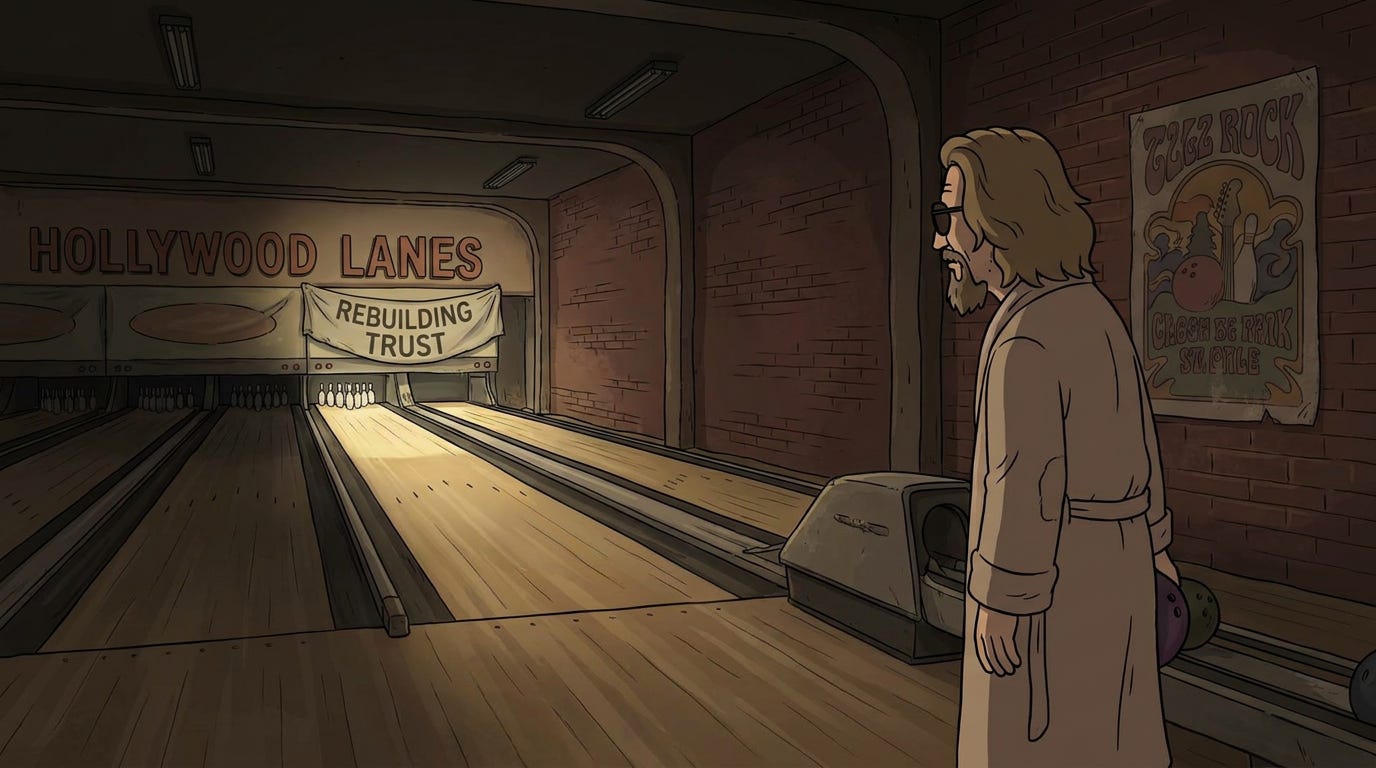
The Dude was at Hollywood Lanes, mid-frame, staring down a 7-10 split that pretty much summed up the whole Democratic coalition, when Walter came stomping over with a newspaper he’d printed out, because Walter does not trust a screen to hold still long enough to be angry at.
“Dude. Maine. Texas. Look at these numbers.”
“I’m bowling, Walter.”
“You’re gonna wanna hear this while you’re bowling, trust me, it’s thematically appropriate.” He slapped the printout down next to the ball return. “Working-class voters, no college degree — Platner’s down almost 20 points with ‘em in Maine. Talarico’s getting smoked 68 to 27 with the same crowd in Texas. Two different states, two completely different candidates — one’s a Marine oyster farmer, other one’s a former middle school teacher who talks about God — and somehow they’re both getting run out of the same exact room by the same exact crowd.”
“That’s a pattern, man.”
“That’s not a pattern, Dude, that’s a structural collapse. This is not two guys havin’ a bad week. This is two decades of a coalition walkin’ out the door, and nobody in Washington’s noticed the room’s half empty.”
The Dude picked up his ball, considered the split, and did not throw it, which is very on-brand.
“See, I remember when the working guy was the guy, man. I was Port Huron. I sat in buildings for this. Union halls, the whole thing — the working class was, like, the load-bearing wall of the entire operation. And now it’s — it’s not there anymore. It’s just gone, man. Like somebody came in while we were out and took the whole wall with ‘em.”
“Nobody took the wall, Dude. We walked away from the wall for forty years and acted surprised when it stopped holding the roof up.”
This is the part where Maude usually shows up, and — right on cue — Maude showed up, wearing a robe that costs more than the bowling alley, carrying a laptop like it was a specimen.
“You’re both being sentimental,” she said. “It’s not a mystery. It’s arithmetic.” She turned the laptop around. “The party spent the last several years pouring industrial investment into exactly these communities — battery plants, semiconductor fabs, grid infrastructure, a great deal of it landing in red and rural districts on purpose — on the theory that voters reward the people who fund the factory. And the factory got funded. And the needle did not move. At all.”
“So the plants didn’t work?” Donny asked, appearing from nowhere with a hot dog, the way Donny does.
“The plants worked fine, Donny,” Maude said, not unkindly, because nobody’s ever unkind to Donny, it feels like hitting a golden retriever. “The theory of gratitude didn’t work. Nobody drives past a construction site and reverse-engineers the appropriations bill. If the local information ecosystem doesn’t credit you, or actively credits somebody else, the investment is functionally invisible. You can build the plant and lose the county in the same news cycle.”
“This is not ‘Nam,” Walter said, apropos of absolutely nothing, but also everything. “This is bowling. There are rules. And rule one is nobody thanks the guy who oiled the lane. They just bowl on it and go home. You think a man’s gonna vote for you ‘cause his cousin’s cousin got hired at a plant he’s never heard of, funded by a bill he’s never read, passed by a party he’s spent thirty years being told hates him? No. He votes on what he *feels* about you, and you cannot buy a feeling with a construction permit.”
The Dude finally threw the ball. Gutter, obviously. Nobody reacted, because at this point it felt on-theme.
“It’s like the rug, man,” he said, watching it happen. “The old rug — that rug really tied the room together. Wasn’t fancy. Wasn’t new. But it made the whole place feel like somebody actually lived there and gave a damn about the room. And somewhere along the way we let some very bad men walk in and take a piss on it, and instead of dealing with the actual guys who did it, we went out and bought a nicer rug from a catalog and got real confused when the room still didn’t feel like home.”
“That’s — that’s actually good, Dude,” Walter said, surprised, the way he gets when the Dude accidentally says something true.
“I have my moments.”
“The rug was never the problem,” Maude said, closing the laptop. “The room was. You can replace the rug as many times as you like. If the people who live there don’t trust you anymore, they’re not looking at the floor. They’re looking at you.”
Nobody had a comeback for that, which is usually how you know Maude’s landed the actual point of the piece.
“So what do we do?” Donny asked, which is the question everybody’s actually been avoiding this whole time, Donny included, since he’s mostly just hungry.
“I don’t know, man,” the Dude said, and for once it wasn’t a bit, it was just true. “I don’t think there’s a bill for this one. I don’t think there’s a candidate for this one either — not one guy, not one cycle. Trust takes about as long to rebuild as it took to lose, and everybody in Washington wants it back by the next election, which is like asking to grow a new rug in a weekend.”
He racked another ball. Somewhere behind the counter, Creedence was playing low — *lookin’ out my back door* — and for a second nobody said anything, which for this crew is basically a moment of silence.
“Anyway,” the Dude said. “This is a bummer of a topic for league night.”
“Nobody fucks with the working class,” Jesus Quintana said, walking by for no reason, licking a bowling ball, entirely unrelated to anything.
“Yeah, well,” the Dude said. “That’s just, like, everybody’s opinion now, man.”
The Dude abides. The lane’s still empty, though.
All of this
The focus-group-addicted, AIPAC and big-business funded, proper lines of succession focused, utterly drab, utterly unaware, and demonstrably clueless DNC allowed this to happen
And they are beyond clueless at how to fix it, and continue to eat their own young, figuratively speaking