

Somewhere in America, a Republican incumbent is being informed that his opponent has rented a room, printed yard signs, and would like to debate him.
He is taking this very badly.
For years, the arrangement was understood: win the primary, say “socialism” three times add a “trans” or two, and return to Washington. The other name on the November ballot was there for decorative purposes. Like parsley.
Now the parsley has a campaign office.
“Twenty years, Dude,” Walter said. “Twenty years bowling with the bumpers up. Now somebody takes them down and these people want to speak to the manager.”
“Well, sure, Walter. But the Democrats still have to—”
“CLOSE. They have to close. These are the Glengarry1 leads, Dude. The man has come into the showroom. He has brought his checkbook. You do not send him home with a questionnaire.”
“I’m just saying there’s an opportunity here.”
“There is an opening in the perimeter, and these people are scheduling a listening session. We saw this in ’Nam.”
“You were talking about a Senate race.”
“It’s an analogy, Dude.”
“It’s always an analogy.”
Walter leaned forward.
“Another consultant. Another focus group. Another photograph of a candidate pointing at a machine. Meanwhile, the other guy is standing there explaining why he shouldn’t have to answer questions.”
“So you think they should try something different.”
“Obviously.”
“Maybe run somebody the leadership didn’t pick.”
“Now hold on. There’s a process.”
Maude, who had been listening with the expression of someone waiting for a leaf blower to stop, set down her glass.
“You’re assuming these candidates were selected for their ability to govern.”
“They’re running for public office,” Walter said. “There are responsibilities.”
“Yes. But to whom?”
The Dude lowered his drink. This sounded like it might take a while.
“Consider the Tea Party,” Maude continued. “Real participants. Real grievances. Alongside wealthy patrons and professional organizations helping supply the infrastructure and shape the agenda.”
“They were angry about the bailouts,” Walter said.
“Among other things. But what brings someone to a rally and what the people financing the rally hope to accomplish are not necessarily the same thing.”
“So the guy in the three-cornered hat—” the Dude began.
“Could sincerely believe he was reclaiming his country while helping advance a donor’s tax and regulatory priorities.”
“An unwitting combatant,” Walter said.
“A volunteer, Walter. Enthusiasm does not necessarily confer control over the enterprise.”
The Dude considered this.
“The people got a rally. The donors got a meeting.”
“Precisely.”
“Well, that’s a pretty sweet arrangement for the donors.”
“It was.”
“And the guy in the hat?”
“Could continue shouting about Obama and socialism while the people with access worked on the details.”
Walter put down his coffee.
“You’re telling me these people spent years yelling about freedom while somebody else was issuing the orders?”
“I’m suggesting you examine who wrote the agenda.”
Donny looked up.
“Were any of the candidates their guys?”
“Of course,” Maude said. “People can sincerely support a candidate who also serves someone else’s interests.”
“So how do you tell?”
For a moment, nobody said anything.
Then Walter straightened in his chair.
“You look at the record, Donny. You examine the man’s conduct. His associations. Whether he delivers.”
“Delivers what?”
“The things he promised!”
“To which people?”
The Dude looked over at Donny.
“That’s actually a pretty good question, man.”
“Thank you, Dude.”
“And now,” Maude said, “some of these officeholders are encountering opponents who intend to ask it publicly.”
That was the uncomfortable part.
And it wasn’t just the new guys. Blackburn. Tuberville. Ron Johnson. The perennials. Leave anything in a safe seat long enough and apparently it qualifies as a statesman.
Spend enough years winning a primary and coasting through November, and you might start confusing a protected position with a personal gift. You might forget how to explain yourself to someone who hasn’t already applauded.
Then an opponent shows up prepared, and suddenly the campaign has a scheduling conflict.
“Credible opposition,” Walter said. “Finally. Make them defend the record.”
“Assuming the Democrats can capitalize,” the Dude said.
Walter closed his eyes.
“The leads, Dude. We have discussed the leads.”
“Yeah, well. Somebody still has to make the call.”
You could hand the Democrats the Glengarry leads, a working telephone, and a customer outside with a cashier’s check, and somewhere a consultant would ask whether “Always Be Closing” alienates suburban moderates.
Donny watched a man two lanes over roll a ball into the gutter.
“Are the Democrats good at that?”
The Dude stirred his White Russian.
“It’s a concern.”
Maude gathered her things.
“You gentlemen keep referring to ‘the establishment’ as though it were simply a collection of incompetent people. Some of them have been quite effective on behalf of the people who put them there.”
“So who owns the bowling alley?” Donny asked.
Walter opened his mouth.
Stopped.
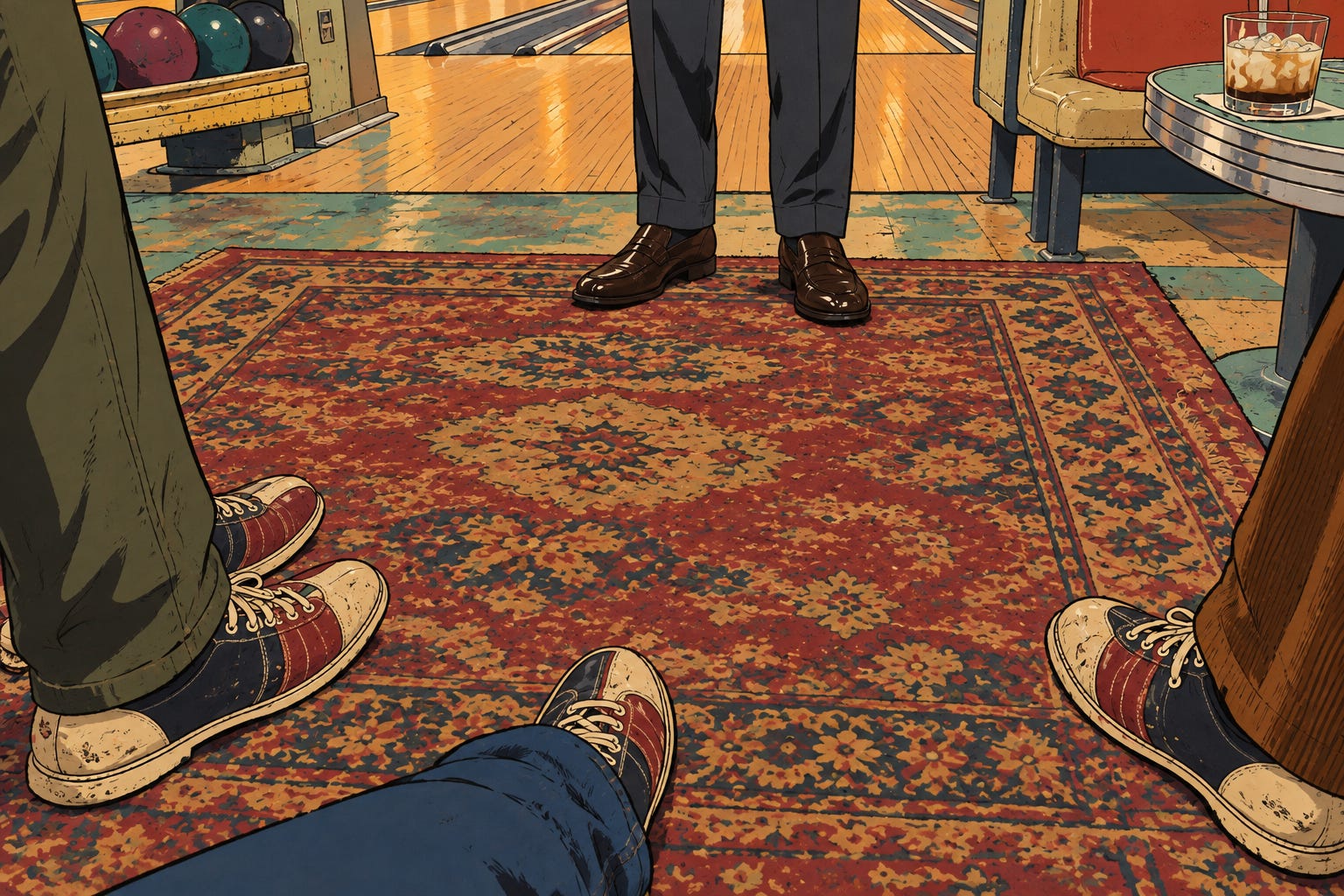
The Dude looked down at the carpet.
“Think we’ve been arguing about the rug in somebody else’s house, man.”
The Dude Abides.
This is a reference to the movie “Glengarry Glen Ross” a movie about the high pressure world of land speculation. Worth the watch!