

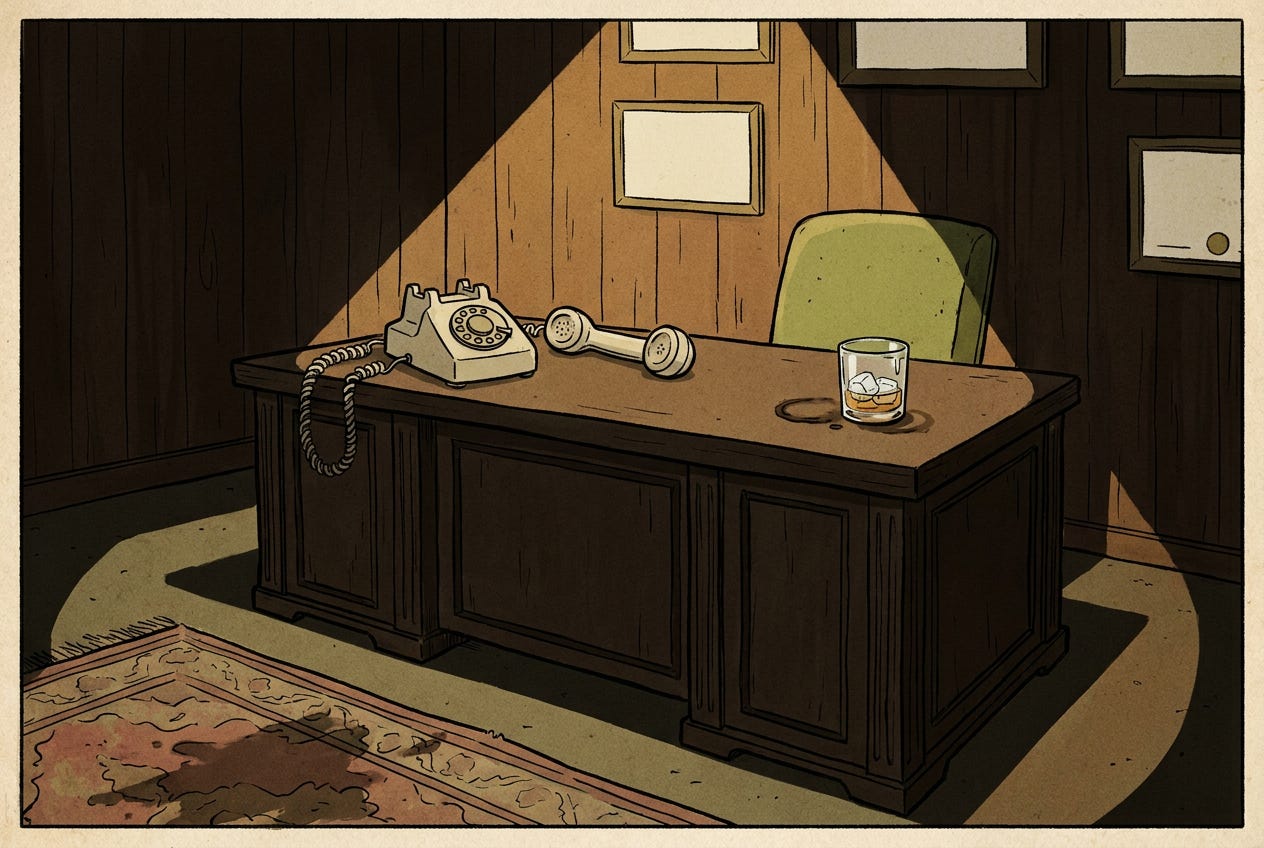
So look. You know the rug story. Two guys come into my house, one of them holds me down, the other one unzips and ruins a perfectly good Persian, and the whole thing is a case of mistaken identity because some other Lebowski owes some other people some other money. Fine. That’s Tuesday.
But imagine there’d been a third guy in the room. Not one of the heavies. A guy in a good suit, standing by the door, hands folded, watching the whole thing happen. Doesn’t hold me down. Doesn’t unzip. Just observes. And then, weeks later, this guy calls up a reporter and says — on background, strictly not for attribution — that he was really troubled by what happened to that rug. That the rug had, in his private estimation, tied the room together. That he had grave concerns about the direction of the whole pissing-on-rugs enterprise.
And then he holds the door for the next two guys with the bucket.
That’s Washington, man. That’s the entire genre.
Right now, as you read this, some Republican senator is telling a reporter that he’s deeply worried. He thinks the president has crossed a line. He fears for the Constitution, the rule of law, the credibility of the party, the republic itself, the whole enchilada. He is anguished. He is losing sleep. He wanted someone to know.
Tomorrow he votes for it.
You’ve read this story a few hundred times since 2016. The details rotate — a scandal, an impeachment, some ghoul of a nominee, an act of self-dealing so brazen it gets posted about in advance — but the shape of it never changes:
Republican senators are privately alarmed. Senior officials describe the president as increasingly erratic. Members of his own party worry he has gone too far. None of them would speak on the record. The vote passes 52–48.
He is disturbed. She is appalled. Pearls are clutched. They are absolutely beside themselves behind closed doors. And then they come out of the closed doors, straighten the jacket, and vote exactly the way the man told them to.
Off the record is where Republican courage goes to die with its reputation intact.
First, the carve-out, because I’m not a barbarian
This is not a brief against anonymous sourcing. I want to be extremely clear about that before Walter shows up and starts explaining the First Amendment to people who did not ask.
Anonymous sources are sometimes the whole ballgame. They expose crimes. They surface things the public would otherwise never know — the retaliation, the buried memo, the order that got carried out quietly at four in the morning. Somebody who risks a career, a prosecution, or a knock on the door to drag hidden misconduct into daylight is doing a public service. Full stop. No notes. That person is a hero and I would buy them a beverage.
That is not what’s happening in the Republican-anxiety genre.
In these stories the conduct isn’t hidden. It’s not buried. Nobody had to sneak it out in a briefcase. The public already heard what the guy said, usually because he said it into a microphone, and then posted about it, and then posted about it again with a picture. The vote’s on the calendar. The nominee’s name is public. The abuse is happening in the middle of the street at noon with a confession stapled to it.
The anonymous Republican is not revealing the misconduct.
He’s revealing that he noticed the misconduct.
Which — fine. Psychologically that’s kind of fascinating. Politically it’s worth roughly a bag of ice. Anonymity protects a person who is telling you something you don’t know. It is not courage when the secret being protected is this man possesses functioning eyes.
Strong men also cry, Mr. Lebowski
So ask the practical question, the one that never seems to get asked: what actually changes because a senator privately admits the president is dangerous?
Well. It reassures the reporter. The reporter walks out of that lunch with proof that responsible Republicans still exist somewhere in the building, which lets the story keep the comfortable two-faction shape — the maniacs over here, the sober grown-ups over there, quietly straining at the leash. Comforting stuff. Implies the machine still has brakes.
Brakes that exist only as anonymous quotations are not brakes, man. They’re a bedtime story with a dateline.
It reassures the reader, too. The respectable conservative gets to believe the old party is still down there under the floorboards, working levers nobody can see, biding its time, waiting for the moment. This belief has now survived about nine consecutive years of observable evidence to the contrary, which is honestly an impressive run for a coping mechanism wearing a press pass.
But mostly it reassures the guy himself. And here is where I have to talk about the other Lebowski.
You remember him. Pasadena. The wheelchair, the wall of achievements, the framed photograph with Nancy Reagan, the whole museum of a life. Strong men also cry, Mr. Lebowski. Strong men also cry. The man wept at me about his burdens. He lectured me — me, in his study, with the fireplace going — about achievement and bums and what a man owes. And it turned out every dollar of it was Maude’s, every achievement was invented, and the only thing he’d ever actually built was the story he told himself on the way to the bathroom mirror.
That’s the anonymous senator. That’s the whole species.
He isn’t just protecting his career when he calls that reporter. He’s protecting the autobiography. In the autobiography he was never an accomplice, he was an adult in the room. He worked quietly. He prevented worse things. He stayed because somebody responsible had to stay. The fact that the worse things kept happening anyway gets filed as an unfortunate production detail, like weather.
You want the purest specimen? September 2018, New York Times, “I Am Part of the Resistance Inside the Trump Administration.” An anonymous senior official assuring the country that the grown-ups were quietly thwarting the president’s worst impulses from inside the house he was actively burning down. Two years later it turns out to be Miles Taylor, chief of staff at DHS, who converted the bit into a book deal and a cable contract.1
The resistance had a book deal. Brandt handled the paperwork.
And this is where the single most load-bearing fiction in Republican Washington gets deployed, the one that holds up the whole ceiling: the president is receiving bad advice. When the guy does something indefensible, these people never — not once, not ever — say he wanted this, because it serves him, because that’s who he is. They say somebody’s whispering to him. Somebody got to him. There are bad people around him.
I’m not paraphrasing. Thom Tillis — the most liberated Republican in the Senate, a man with statistically nothing left to lose — said out loud on CNN this spring: “I don’t criticize him, because I expect these people to protect him.”
Read that again while I roll something. The senator’s theory of his own job is to holler at the staff, so that the staff will do a better job protecting the man, who needs protecting, from the staff.
Blaming the advisers launders the president’s innocence and the senator’s autobiography in the same load. Two-for-one, cold water, delicates cycle.
Walter would like a word about the rules
Now I have to hand this next part to Walter, because it’s a rules thing, and Walter is at his absolute best on rules and at his absolute worst on literally everything else.
The Never Trump crowd — who I read, and mostly like, even while I’m sitting here dunking on them — has this favorite observation. They know what he is. The senators know he lies. The aides know he’s impulsive. The former officials know he’s dangerous. The party leadership knew the election claims were horseshit and said so privately in real time.
This always gets presented as grounds for hope.
It’s an aggravating factor. It’s the opposite of a defense. It’s the prosecution’s exhibit.
If these people genuinely didn’t understand what was happening, they could plead ignorance. Confusion. Bad information. Being lied to. The anonymous quotes take that defense off the table, walk it out back, and set it on fire. They establish that the man recognized the danger and chose accommodation anyway, in full possession of the facts, with time to think it over.
Somewhere along the way “he knows better” turned into an exoneration, which is one of the stranger developments in American public life. A senator who understands the corruption and votes for it anyway is not morally superior to the one who swallowed the propaganda whole. He may be intellectually superior. Congratulations to him. Knowledge counts for something only when it touches conduct, and knowing the truth in private does not count for a damn thing when your public power is being spent on behalf of the lie.
Which brings me to Walter’s actual contribution, and I want to be fair to the man, he’s right about this one.
Smokey went over the line. Eight frame. Smokey’s toe was over, plain as day, and Smokey wanted to mark it an eight, and Walter — in a manner I am not endorsing, involving a firearm in a family bowling establishment — pointed out that this is not ‘Nam. This is bowling. There are rules.
Here’s the thing about the rules. Nobody cares how Smokey felt about the line. Nobody cares that Smokey privately understood where the line was, respected the line as a concept, had grave reservations about crossing the line. The foot was over. Mark it zero.
You don’t get credit for the shot you took in your head, man. The sheet doesn’t have a column for that.
Ve believe in nothing, Lebowski
Which brings us to the current cast, helpfully assembled for us by the political press: the YOLO Republicans.2 Tillis, retiring. Bill Cassidy, who got beaten in his Louisiana primary in May. John Cornyn, who lost to Ken Paxton and became the first sitting Texas senator to lose a primary since 1970. I took my shots at these guys in the Buckley piece and nothing since has moved me an inch.
The theory was clean and appealing. These men were afraid of primaries. Take the primary away — retire them, beat them, cut the cord — and they’d finally say the true thing out loud. Nothing left to lose.
Nothing left to lose. Ve believe in nothing, Lebowski. Nothing!
And then the nihilists turn out to be scared of a dog. A large one, granted. A Lhasa Apso with papers. But a dog.
The theory got it wrong about what these guys actually value. A man can lose his seat and still care enormously about a great many things: staying welcome in Republican society, the donor relationships, the board seat in eighteen months, the conservative media hits, the colleagues, the safety of his family, a legacy that doesn’t get him written up as a traitor to the tribe. And most of all — this is the big one — he can still be completely unwilling to admit what his own last ten years mean.
So Tillis gets “unleashed,” which the press adores as a framing. He demands Kristi Noem’s resignation. He sneers at “30 and 40 somethings like Stephen Miller.” He announces he’s “sick of stupid.” And in the same stretch where federal agents’ conduct in Minneapolis is supposedly the thing that has him furious, he texts the president “Great job” for sending Tom Homan into Minnesota.
Then he says it right out loud, on the record, to anybody listening: “You will see over the next 339 days that I support the vast majority of what the president wants.”
He can criticize the plan. He can criticize the advisers. He can demand better paperwork, a cleaner process, a more professional class of goon.
He cannot say: the president is corrupt and he’s doing this on purpose.
The YOLO caucus turned out to have no elections left to lose and a truly astonishing number of fucks remaining to give.
Now — and I try to be fair here, it costs me, but I try — Tillis has done one genuinely real thing. We’ll get there. It’s the exception, and it proves the entire rule, and it’s more instructive than anything else in this piece.
Maude explains the mechanics
Maude would tell you this part without any of the throat-clearing, so let’s do it her way. Flat, clinical, no jokes. She’s usually right about everything, which is annoying, and she knows it, which is worse.
Political courage is not a personal virtue. It is infrastructure.
One person’s visible refusal lowers the cost of the next person’s refusal. That’s the whole mechanism. When a senator says the thing under his own name, the next senator has cover. Donors who’d back a break can find someone to back. Voters who thought they were alone discover they aren’t. Reporters get to describe a real faction instead of an imaginary one. The price of dissent gets divided among more people, which is the only way the price ever comes down.
Anonymous dissent does exactly none of this. Worse — it does the opposite. It traps every potential dissenter inside the belief that he’s the only one. The senator tells the reporter, on deep background, that many of my colleagues feel the same way. But the public sees no disagreement. The president sees no disagreement. The base sees no disagreement. And the next wavering senator, the one who might’ve gone if somebody went first, sees no disagreement.
Ten private consciences produce the exact same public result as zero consciences.
And that’s not an attack on the reporters, by the way. Those conversations produce real insight into how the machine runs. But the framing needs calling out, because too often the private anguish gets presented as evidence of Republican resistance when it is evidence of the absence of Republican resistance. The story says Republicans privately recoil. The observable reality says Republicans are voting yes. The private reaction is context. The public act is the story. The anonymous quotation should never be allowed to outweigh the recorded vote.
If the hand-wringing has to run — and it will, every time, forever — then run it with the load-bearing word attached: Republicans who say privately that this is dangerous are nevertheless expected to support it.
That “nevertheless” is the whole piece. Everything else is set decoration.
What the real thing looks like
Here’s what I’m not asking for. I’m not asking for martyrdom. Nobody needs a floor speech with a string section and a slow dolly-in. Real opposition is boring and it’s mostly procedural: vote no. Withhold consent. Use the committee. Refuse to confirm the unfit guy. Sign the letter with your actual name on it. Join the lawsuit. Stand next to a Democrat in daylight. Back a primary challenger. Resign instead of carrying out the unlawful order.
The standard isn’t heroism. It’s public conduct with consequences attached.
And now the exception, which I promised, and which I want to give full credit for, because it demonstrates exactly how mundane and how effective the real thing is.
Tillis — same guy, the one who won’t criticize the president directly — sat on the Banking Committee while the Justice Department ran a criminal probe of Fed chair Jerome Powell over cost overruns on a building renovation. Which is, and I say this as a man with no financial training whatsoever, a clown-show pretext. Tillis called it a vindictive prosecution. Out loud. Under his own name. And he announced he would not vote for any Fed chair nominee — including Kevin Warsh, whom he liked, whom he praised — until that probe was done.
Banking is 13–11. One Republican defection deadlocks it. Warsh sat there for months. Powell’s term was running out in May and there was no chair-in-waiting who could get out of committee.
One senator. One hold. One pressure point. And it worked — the probe ended.
Sort of. Here’s the part I have to tell you, because I’m not going to pull the same trick on you they pull on the reporters. The U.S. Attorney’s office didn’t drop the thing so much as hand it to the Fed’s inspector general, with the understanding that it could come back if the IG made a criminal referral. Tillis got his assurances over a weekend, went on Meet the Press Sunday to say he had confidence it was over, and cast the deciding vote to move Warsh out of committee.
So they didn’t drop it, man. They put it in a different drawer. And the senator looked in the drawer, decided he liked what he saw, and moved the president’s guy along.
But I want to be honest about the shape of it: that was still power, exercised in public, against a danger the man had named. It was not a vibe. It was not an emotion shared with a journalist over a nice pinot. It’s the only thing in this entire essay that made a government agency change its behavior, and it was done by a guy who cannot bring himself to say the president is doing any of this on purpose.
Which is the tell. He’ll name the prosecution. He won’t name the prosecutor’s boss.
Because language counts too, when it’s accurate. “The president is getting bad advice” is evasion. “The president is using the Justice Department for personal revenge” is information. The first one is a lullaby. The second one costs the speaker something, and the cost is precisely how you know it’s real.
The ledger
For nearly a decade now, respectable Republicans have asked to be judged on their private intentions rather than their public effects. They were concerned. They worked behind the scenes. They prevented worse things, allegedly, none of which can be verified, all of which are described exclusively by the person seeking credit. They disapproved of the tone.
But these were not guys watching from the cheap seats with a beer and a limited view. These were senators. Cabinet officials. Prosecutors, lawyers, party chairs, the people who write the checks. They had authority — real, sovereign, roll-call authority — and their votes and confirmations and endorsements and silences had consequences, and the consequences are the ledger. That’s it. That’s the whole accounting.
The moral unit in politics is not the private thought. It’s the public use of power. History is not going to footnote every wrecking-ball vote with the senator’s anonymous assurance that he felt just terrible about it at the time.
Their private discomfort proves they weren’t fooled.
It does not prove they resisted.
Put your name on it
There’ll be another one before the weekend. Another scandal, another call, another Republican official explaining that colleagues are alarmed, that a line has been crossed, that it’s worse in there than the public understands.
And the response should be one question, asked every single time, with no follow-up until it’s answered: what are you going to do about it, and may I use your name?
Because there will be an anonymous Republican tomorrow. He’ll be deeply troubled. He’ll understand the stakes better than you do. He’ll assure the reporter that many of his colleagues feel exactly the same way.
Then he’ll vote with the president.
At this point the anonymous confession shouldn’t reassure anybody. It should be entered into evidence.
He knew. He understood. He helped anyway.
Off the record is not opposition. Private courage is not a political act. And a conscience that never once interferes with the exercise of power is just a story a coward tells himself at night, in a nice house, with the lights off.
The rug’s gone, man. It’s been gone a while. And the guy by the door is still telling reporters how much he admired it.
1 Taylor’s follow-up book was called A Warning, and it moved units, because warnings always sell best when they’re anonymous and free. He’s a CNN contributor now, which is where the adults in the room go after the room burns down.
2 NPR, The Dispatch, and Politico have all run the “YOLO” framing on Tillis, Cassidy, and Cornyn. Cornyn rejects the label, which is the single most John Cornyn thing that has ever happened.
3 Credit where it’s due and I mean it: this is the same Tillis who, when a reporter suggested he only talks straight now that he’s not running again, answered “It’s like no shit, Sherlock.” The man is not incapable of candor. He’s rationing it.