

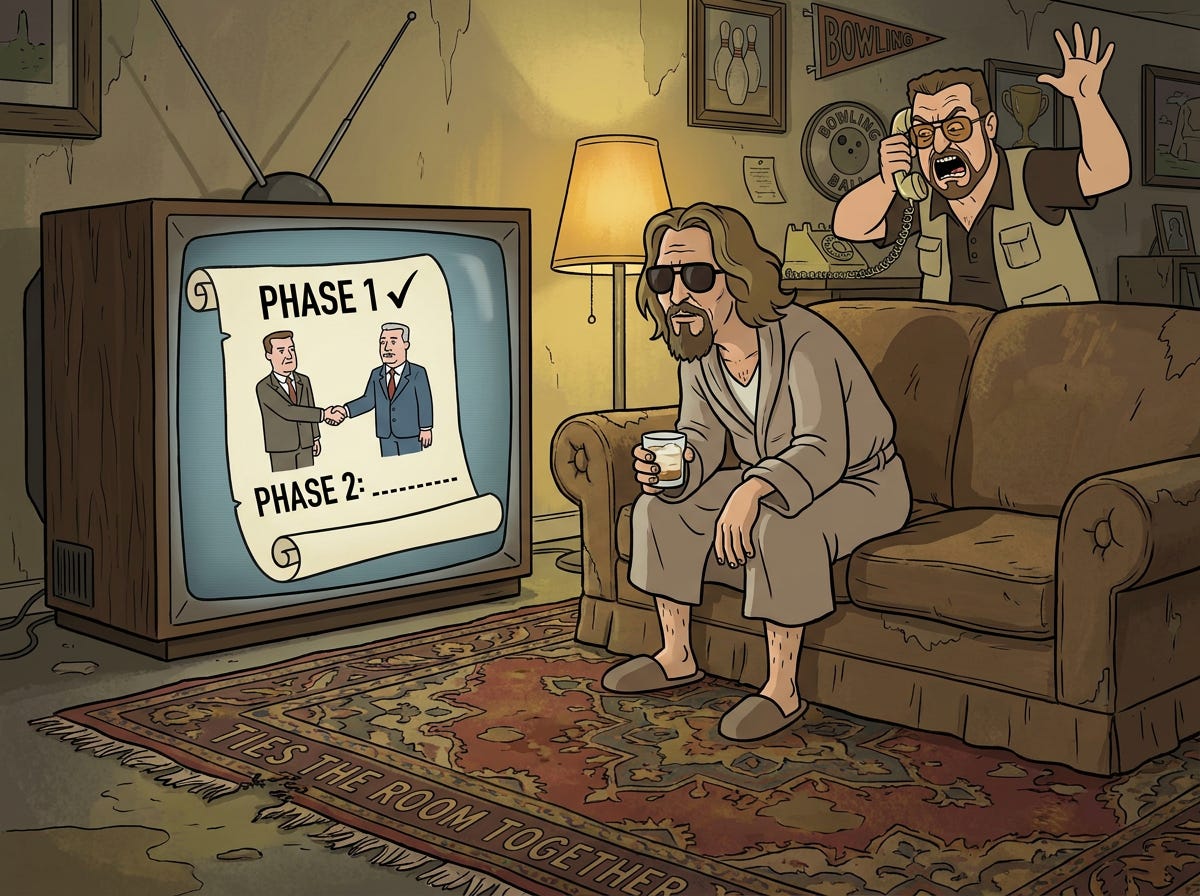
So I’m sitting in my bungalow, right, working on a White Russian — second one, maybe third, the Dude’s keeping it casual — and the news comes on. Trump’s announced a historic memorandum of understanding with Iran. An MOU. Ends the war he started in February. “The Deal with the Islamic Republic of Iran is now complete,” he posts on Truth Social. “Congratulations to all!”
And I’m thinking, man. Man.
I’ve seen this rug before. It was soiled the first time too.
A writer named Jay Kuo — good dude, pays attention — has laid out the pattern [LINK]. And the pattern, once you see it, you can’t un-see it. Trump doesn’t make deals. He makes announcements. Phase 1 is the ceremony: the signing table, the handshakes, the Truth Social post with the exclamation points. Phase 2 is where the actual conflict lives — the stuff both sides couldn’t agree on, which is usually the entire substance of the disagreement. Phase 2 never happens. The check is always in the mail.
The UK trade deal: announced May 2025, “full and comprehensive,” ran to five pages, left the digital services tax — the thing America most wanted resolved — for later. By December, the whole $42 billion Tech Prosperity Deal was frozen over that exact unresolved question. Far out.
Gaza: ceasefire announced January 2025. Phase 1 delivered hostage releases and prisoner swaps — the packageable stuff. Phase 2 was supposed to address the permanent ceasefire and the political future of Gaza. Phase 2 negotiations were supposed to begin during Phase 1. Netanyahu’s own adviser described Phase 2’s implementation as “imaginary, impossible and unacceptable” before the ink on Phase 1 was dry. The bombing resumed. Trump announced a second Gaza ceasefire in October with structurally identical terms. Same result.
So now it’s Iran’s turn at the lanes.
Walter called while I was on my second White Russian. I made the mistake of mentioning the MOU.
“The MOU is a capitulation, Dude. Do you see what happens? You negotiate with the Islamic Republic, you get nothing. This is not how sovereign nations conduct themselves. This is not—”
“Walter—”
“I’m not done. The neocons — and I know you don’t respect this, Dude, I know you think this is all about ‘Nam, but this is NOT about ‘Nam — the neocons have been right about Iran for thirty years. And now we’re handing them a signed piece of paper that says they can keep enriching uranium as long as they pinky-promise not to build a bomb—”
“Walter, they’re not pinky-promising—”
“They signed this exact promise in 2015! And then Trump tore it up in 2018 and called it a disaster! And now they’re signing it again! Dude, am I wrong? AM I WRONG?”
He’s not wrong. He’s just loud about it in a way that doesn’t leave room to finish a thought.
The thing Pete Hegseth offered as the MOU’s headline achievement on Face the Nation — that the document says Iran won’t seek or acquire a nuclear weapon — prompted host Margaret Brennan to note, with admirable composure, that the JCPOA said precisely the same thing. It did. Iran signed that commitment. Violated it after Trump walked in 2018. And is now being asked to sign a recycled version of it as the marquee deliverable of a war that cost God knows what.
“The word ‘recycled,’” Donny offered, from somewhere in the background, “kind of makes you feel like the whole thing is—”
“Donny, you’re out of your element.”
Here’s the thing about the enrichment question, and I want to be careful here because this matters even if the whole conversation makes the Dude want to go bowling and not come back.
Enrichment is the actual substance of every Iran nuclear negotiation for twenty years. The American position, stated by Special Envoy Steve Witkoff — a real estate developer, which is the kind of credential you want in a guy handling the nuclear file — in May 2025: “We cannot allow even 1 percent of an enrichment capability.” The Iranian position, stated by Foreign Minister Araghchi the same day: “Enrichment in Iran will continue with or without a deal.”
A year later, those are still the positions. Recent talks produced specific numbers — the U.S. wants Iran to suspend enrichment for twenty years, Iran has offered five. The MOU left those numbers exactly where they were and pressed forward to the Geneva ceremony anyway.
Now here’s where the Iran deal is categorically worse than the UK deal or Gaza, and I need you to stay with me because this is important even if it’s a little dry.
A frozen UK trade deal produces friction. A collapsed Gaza ceasefire returns the conflict roughly to its prior position. An Iran Phase 2 that produces nothing of substance leaves Iran in a meaningfully better position than where it started. Partial sanctions relief: extracted in Phase 1. International legitimacy: cashed. Strait of Hormuz question: papered over. Enrichment program: continues on whatever schedule Iran prefers. Iran doesn’t exit the 60-day window back where it started. It exits having banked the concessions while the hard questions remain scheduled, deferred, and unresolved.
Iran’s own state media outlet IRNA was helpfully clear about what Tehran thinks it agreed to: the “current draft agreement” states that “Iran undertakes no new commitments” on nuclear weapons, with further negotiations to follow. In other words: Iran signed up to keep talking, collected its gains, and reserved its position on the one question America most needed to resolve.
That’s a ratchet, man. Not a reset.
The IRGC hardliners — the Revolutionary Guard, the institution that actually runs the show in Tehran and has a documented habit of blowing up negotiations right as they approach conclusion — don’t need to dramatically detonate anything. They just need to run the clock. They’ve had twenty years of practice.
Maude called too, which surprised me. She doesn’t usually follow foreign policy unless there’s an aesthetic angle.
“The press consensus is rather unambiguous,” she said, with the calm of someone who is always three analytical steps ahead and wants you to know it. “The New York Times, the Wall Street Journal, The Atlantic. They’ve each independently concluded that the United States lost this war.”
“Yeah, I saw that.”
“The Wall Street Journal, Jeffrey. The institutional voice of Republican foreign policy establishment. And The Atlantic. And the Times. When those three publications converge on the same read of a Republican foreign policy initiative, one is not looking at a partisan pile-on.”
“What about the Economist?”
A pause. “Lukewarm.”
“So when the Economist can only manage lukewarm—”
“One is looking at a consensus that the emperor has no clothes. Yes. The phrasing I would use is that the announcement machine has broken down.”
She’s right. She’s largely right about everything, which is both useful and a little exhausting.
Trump knows the coverage is bad because it’s sticking in his craw. You can tell because of what comes next.
The most revealing tell in this whole episode — more revealing than the recycled nuclear promise, more revealing than Iran’s own state media saying they’ve agreed to nothing new — is what’s being done with the Vice President.
JD Vance is being positioned to take the fall. In advance of the signing.
Think about that for a second. With the UK deal, Trump announced “full and comprehensive” and appeared to genuinely believe his own marketing. With Gaza, he announced the ceasefire twice with visible enthusiasm, seemingly persuaded each time that the fanfare would generate its own momentum. With Iran, the administration is pre-distributing blame before the ceremony has even happened.
That is not triumphalism. That is liability management. When you hand the bag to your VP before the check is even written, you have already priced in the bounce. The announcement machine, which runs on the belief that the act of announcing creates the conditions for implementation, has broken down — and Trump, whatever else you want to say about the man, is not unaware of how badly this is going to land with a general electorate that was never enthusiastic about the war in the first place.
“Who’s Vance?” Donny asked.
“Donny, you’re out of your element.”
The regional endgame has a certain clarifying logic to it, even if it’s clarifying in the way a hangover clarifies the previous evening’s decisions.
The Abraham Accords were premised on a coalition of Sunni states and Israel operating as a U.S.-backed counterweight to Iranian regional power, with American maximum pressure eventually forcing a fundamental change in Iran’s behavior. The 2023 Saudi-Iran normalization deal brokered by China was the Gulf states pricing in that premise’s failure three years ago. The MOU makes official what Riyadh and Abu Dhabi have been quietly hedging toward ever since: Iranian regional presence is a permanent condition to be managed, not a problem to be solved. They can now normalize without having to pretend they’re waiting for Washington’s strategy to work. They’ve been doing it anyway.
The Abraham Accords, in other words, are a historical artifact. A rug that turned out not to tie the room together after all.
For Israel the calculation splits cleanly depending on whether you’re asking about the country or the man currently running it. Israel-the-country gets something genuinely ambiguous: a deferred nuclear threat is better than an active enrichment sprint in the near term, missiles aren’t landing on Tel Aviv. Netanyahu-the-man loses something that may be existential for him personally. The conflict was the political oxygen keeping him airborne above his legal jeopardy and his coalition’s internal contradictions. A U.S.-brokered peace that takes American military backing off the table removes his most important lever. He can’t credibly threaten a unilateral Israeli strike on Iran’s nuclear infrastructure without U.S. logistical support, and an American president who just announced a historic peace deal is not going to provide that support to blow up his own signing ceremony.
Meanwhile, Smotrich and Ben-Gvir are going to be enraged, and Netanyahu can’t give them the war they need to stay satisfied. He is caught between a coalition that requires escalation and a patron who just foreclosed it. That is the tightest corner he has been in yet, and he walked into it because the alternative was admitting earlier that the whole framework was built on a promise America was never going to keep.
So Trump gets the Geneva photo. Truth Social gets the exclamation points. Iran banks the gains and runs the clock. The Gulf states continue the normalization they’ve already been building for years. The enrichment program hums along on a schedule that the agreement agreed not to discuss for sixty days. The legacy press writes “the U.S. lost,” and they’re not wrong. Vance holds the bag. And somewhere in a Pasadena mansion, a man in a wheelchair gives a speech about how the bums lost.
Except this time the bums didn’t lose, man. The bums got sanctions relief, international legitimacy, and a sixty-day clock during which the question they most needed answered will remain politely unasked.
Walter called back. He was calmer — the second-call-Walter, which is a different register.
“Dude. The neocons are finished. The establishment foreign policy apparatus is finished. Cotton can write op-eds. Rubio has gone quiet, which tells you everything. The think tanks will produce papers. None of it matters. We lost the argument in 2016 and we’ve been losing the organizational fight ever since.”
“Are you— Walter, are you okay?”
A long pause.
“I’m calmer than you are.”
The Dude finished his White Russian. Rolled a modest J. Let the whole thing wash over him the way these things do — the announcements, the ceremonies, the recycled promises, the checks always in the mail, Phase 2 always just around the corner, the room never quite tied together no matter how many rugs you drag in from Pasadena.
The deal will be signed in Geneva. The photo will be taken. The sixty days will run.
The Dude abides. He just doesn’t have a lot of illusions about Phase 2.
Thanks to Jay Kuo, contributor at The Big Picture for the foundational receipts work. His analysis of the Trump deal pattern is required reading: The Devil and the Details.
This is what happens when you fuck a stranger in the Levant....
That follow-up that somehow never materializes… yup
And Netanyahu? None of his options are good from here
Which one he personally decides is the least-bad will determine the fates if millions in the region
Time to pour myself another drink