

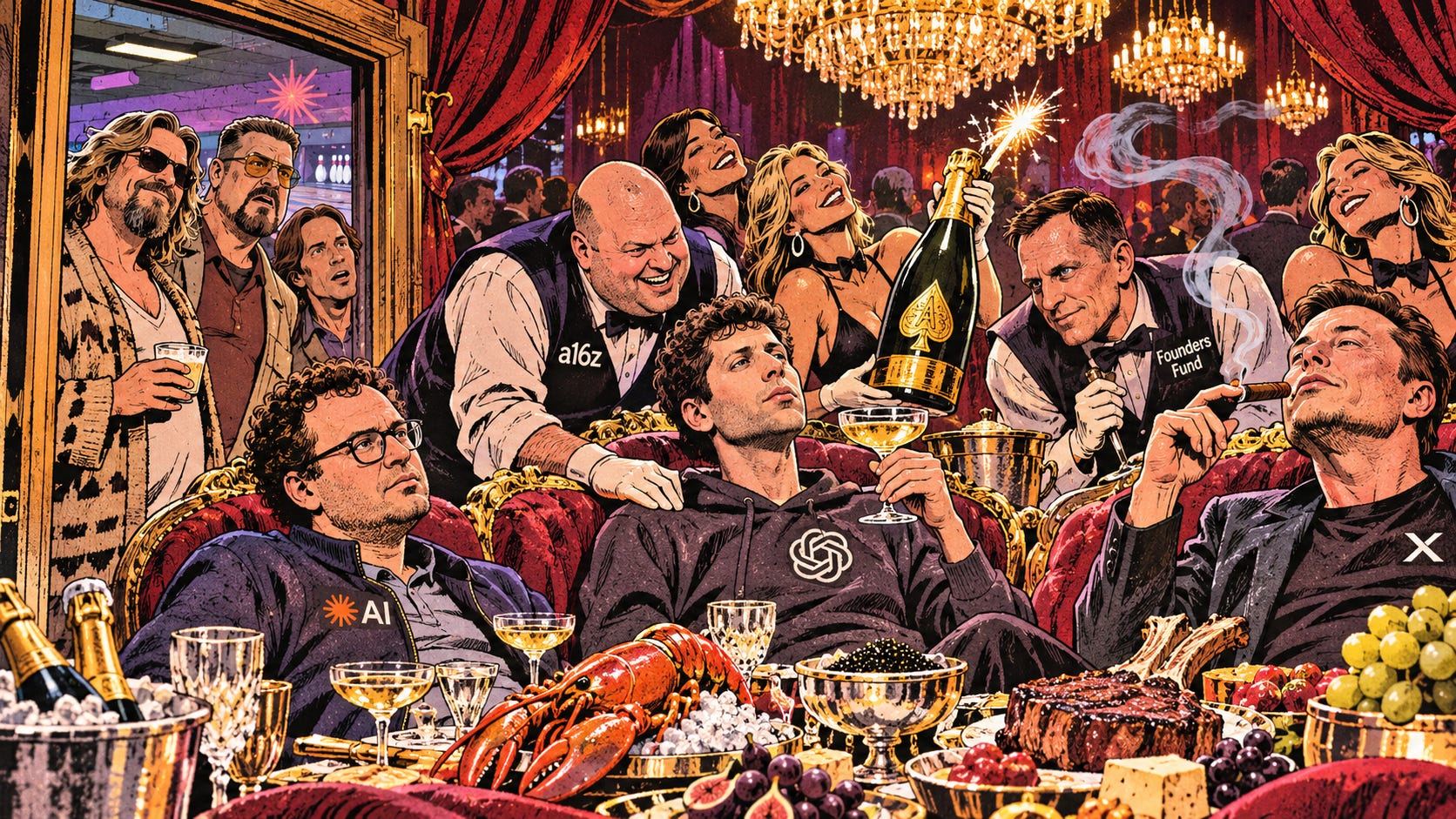
I was listening to a podcast the other day when somebody compared Silicon Valley venture capitalists to bottle-service girls at an upscale nightclub.
I nearly spilled my White Russian.
Not because it was insulting. I’ve heard much worse things said about venture capitalists, usually by other venture capitalists. But because it was so fucking perfect that I was annoyed I hadn’t thought of it myself.
Picture some twenty-eight-year-old tech founder sitting in a velvet booth, surrounded by people telling him he’s a genius. The champagne costs more than Donny’s car. Everybody wants his attention.
A venture capitalist leans over and whispers, “Have you considered raising another hundred million dollars?”
The kid hasn’t figured out what to do with the last hundred million.
But the VC is smiling, the sparklers are coming out, and somebody just offered him a billion-dollar valuation.
Welcome to Sand Hill Road, man.
Venture capitalists like to portray themselves as the gatekeepers of the future. They control enormous pools of money, identify brilliant entrepreneurs, and decide which technologies deserve to exist.
Sometimes they even get it right.
But here’s the funny part. Most VCs aren’t investing their own money. They’re managing money from pension funds, endowments, and wealthy investors called limited partners.
The traditional arrangement is called “two and twenty.” Roughly two percent a year in management fees, at least during the early life of the fund, and twenty percent of the investment profits.
On a billion-dollar fund, that management fee can be twenty million dollars a year, whether the investments succeed or not.
I explained this to Walter.
“YOU’RE TELLING ME THESE ASSHOLES GET PAID TO GAMBLE WITH SOMEBODY ELSE’S MONEY?”
“That’s pretty much investment management, Walter.”
He stared into his beer.
“Fucking brilliant.”
Now, when money is scarce, entrepreneurs come begging. The VC sits behind an expensive desk and decides whether the kid with the PowerPoint presentation deserves a check.
But when markets get hot, the relationship flips.
Every VC in California wants into the same handful of promising companies. One offers a billion-dollar valuation. Another offers a billion and a half. A third promises to stay out of management’s way and introduces the founder to somebody who knows Taylor Swift.
The first two immediately call their assistants to find out whether they know Taylor Swift.
Venture firms call their pipeline of potential investments deal flow. The best deals are fiercely competitive because a handful of enormous winners have to pay for all the startups that go nowhere.
And the founders of those desirable companies get to choose whose money they accept.
Which means the financial geniuses who supposedly control access to capital are competing for the privilege of giving it away.
The founder is the whale.
The VC is trying to get him to order another bottle.
“Your analogy is somewhat defective,” Maude informed me.
Naturally.
“The entrepreneur is selling equity. A higher valuation means the fund receives less ownership for the same investment. And the financing can involve significant contractual obligations.”
“Maude, you’re taking all the fun out of the nightclub.”
“Somebody has to read the bill.”
Fair enough.
Venture capital does serve a purpose. Banks generally won’t lend millions to unprofitable startups with no collateral and a substantial probability of failure. Venture funds take those risks because a few enormous successes can compensate for a lot of losers.
The ridiculous part isn’t the financing.
It’s the mythology.
The VC isn’t merely supplying capital.
He’s a visionary partner. A thought leader. A builder of the future.
The bottle-service girl isn’t selling overpriced champagne, either. She’s curating an exclusive lifestyle experience.
Everybody needs a story about why carrying expensive bottles across a crowded room is a form of genius.
Of course, the party changes when the easy money disappears.
Interest rates rise. Investors get nervous. Suddenly the VCs are very interested in profitability.
Founders who were being courted like Saudi royalty are now being asked awkward questions about revenue, expenses, and whether customers actually want the product.
The billion-dollar valuation becomes six hundred million.
The complimentary champagne disappears.
This is called a down round.
And the VCs have their own problems. The limited partners eventually want actual cash returns, not impressive valuations on paper. If startups can’t get acquired or go public at attractive prices, the money doesn’t come back.
No returns make it harder to raise the next fund. No next fund means the management-fee business eventually starts looking considerably less attractive.
Even the bottle girls have to sell some champagne.
Donny had been listening quietly.
“So who owns the nightclub?”
“Well, the limited partners supply the money. The VCs manage it. And the founders run the companies.”
“Then who’s the customer?”
That’s a pretty good question, Donny.
The LPs are the customers of the investment management business. The founders need the financing. And the VCs need successful investments to keep everybody happy.
But when the market gets hot, the founders become the people everyone is trying to impress.
It’s entirely possible for everyone involved to believe they’re the most important person in the room.
Which explains a remarkable amount about Silicon Valley.
Now, some VCs are genuinely good at what they do. They recognize promising technology, take serious risks, and help build companies that change the world.
Some founders are brilliant, too.
But there’s something wonderfully absurd about a room full of millionaires in thousand-dollar fleece vests competing to tell a twenty-eight-year-old billionaire how extraordinary he is.
I was thinking about this as Walter complained about the price of bowling shoes.
“Forty fucking dollars to rent shoes for a tournament. Highway robbery.”
“That’s for the whole team, Walter.”
“STILL ROBBERY.”
Somewhere in Palo Alto, a venture capitalist was probably leaning toward a young founder, explaining that his firm didn’t just invest in companies.
They invested in people.
And the founder was probably wondering whether the next guy would offer a higher valuation.
I’ve spent most of my life not being a billionaire. It’s an area of expertise in which I’ve achieved remarkable consistency.
But even I know a bottle-service operation when I see one.
And the funniest part is that the guys carrying the champagne think they’re the whales.
The Dude abides.