

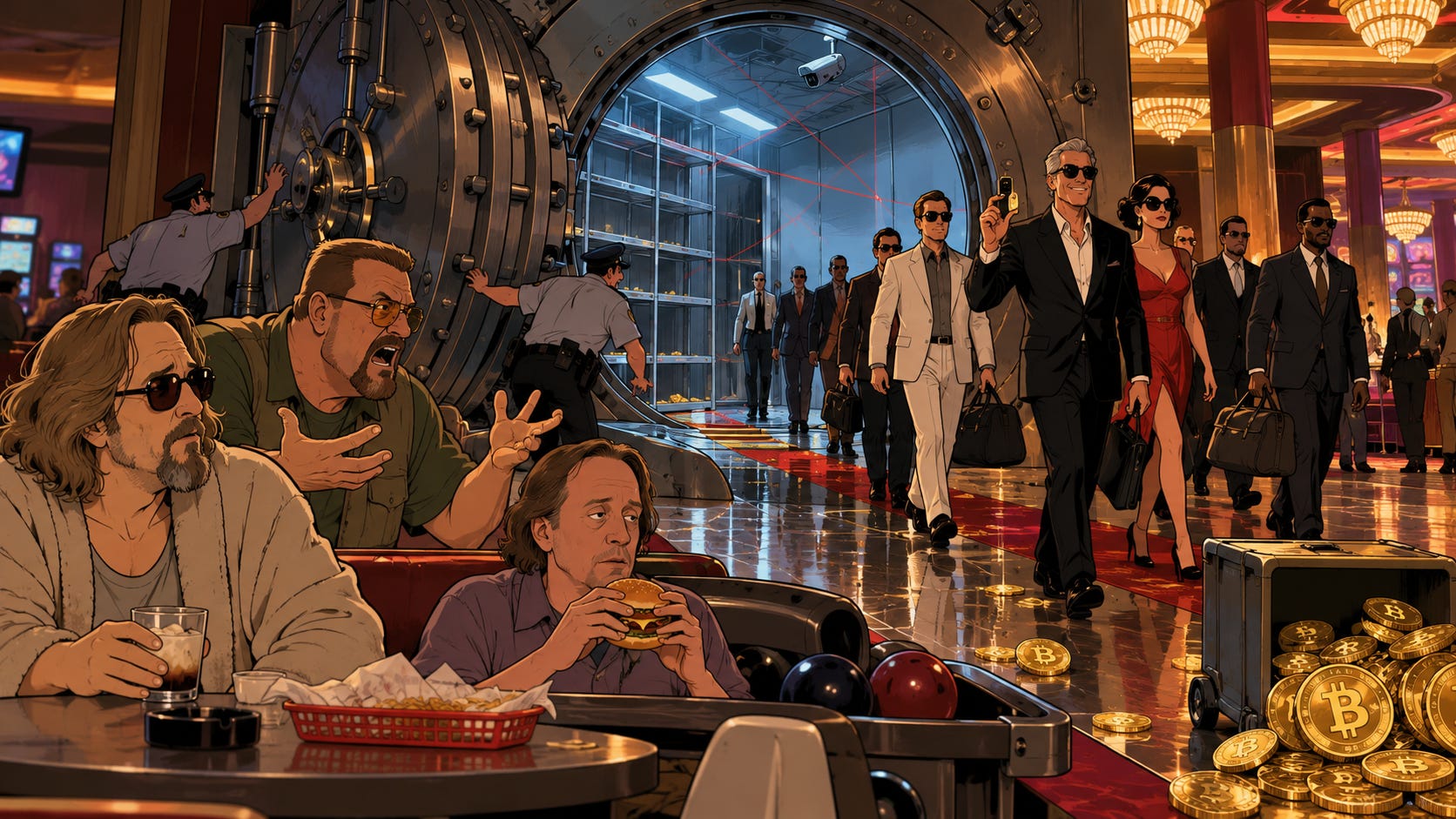
I was sitting at the bar at the bowling alley, nursing a White Russian that Gary had made with something suspiciously close to skim milk, when I came across a number that made me put down my drink.
Six point three billion dollars.
That’s billion with a B, man. Six thousand three hundred million dollars, which is a lot of cheddar no matter how you slice it.
Apparently, somebody had walked into Binance, the world’s largest cryptocurrency exchange, electronically speaking, and walked out with $6.3 billion in digital assets. The whole operation took a matter of hours, with most of the money disappearing in about twenty minutes.
Twenty minutes.
I’ve spent longer than that trying to find a parking space at Ralphs.
“Walter,” I said, “somebody just stole six billion dollars in cryptocurrency.”
Walter looked up from his bowling scores.
“From who?”
“Binance.”
“THE CRYPTO PEOPLE?”
“Yeah, man.”
“THE PEOPLE WHO KEEP TELLING EVERYBODY THEIR MONEY IS SECURE?”
“Those would be the guys.”
Walter stared at me for a moment, then slowly lowered his pencil.
“Jesus fucking Christ, Dude.”
I showed him the article.
Blockchain investigators believe the operation was carried out by a North Korean hacking outfit called TraderTraitor, which has apparently developed a rather impressive specialization in separating cryptocurrency exchanges from their assets. The attribution isn’t official yet, but these are people with a track record.
Apparently, when you’re a heavily sanctioned dictatorship with limited access to the international banking system, stealing billions in digital currency is a pretty attractive business model.
Walter was already getting worked up.
“SIX BILLION DOLLARS? THESE FUCKERS CAN’T EVEN FEED THEIR OWN PEOPLE!”
“Well, Walter, I don’t think the money is going to the school lunch program.”
“THIS IS STATE-SPONSORED FUCKING PIRACY, DUDE!”
“Yeah. Pretty much.”
Donny, who had been quietly eating fries, looked up.
“How many cheeseburgers is that?”
I considered the question.
“Well, Donny, depending on where you eat, probably somewhere around a billion cheeseburgers.”
“That’s a lot of cheeseburgers.”
“It is, Donny.”
Walter was now standing, which is rarely a good development.
“YOU KNOW WHAT THE PROBLEM IS, DUDE? SECURITY! THESE PEOPLE HAVE NO FUCKING SECURITY!”
“Well, Walter, I think they had some security.”
“SIX BILLION DOLLARS, DUDE! THAT’S NOT SECURITY! THAT’S A FUCKING INVITATION!”
He had a point.
Binance’s initial investigation suggested that a compromised engineer’s laptop may have played a role in the intrusion, although investigators subsequently discovered additional points of breach. The company says there’s no evidence the attackers obtained its private keys.
Which is reassuring, I suppose, in the same way it’s reassuring to discover that the burglars didn’t actually have the key to your front door.
They just managed to empty the house.
But here’s where things started getting interesting.
Somebody Call the Authorities
“Actually,” I told Walter, “they’ve already managed to freeze about three billion dollars of the stolen money.”
Walter stopped pacing.
“GOOD! THAT’S WHAT I’M TALKING ABOUT!”
“Yeah. The people who issue some of these cryptocurrencies can freeze them.”
“EXACTLY! SHUT THOSE FUCKERS DOWN!”
“Well, Walter, I thought the whole point was that nobody could do that.”
He looked at me.
“What?”
“Decentralization, man. No central authority. Nobody gets to control your money. Freedom from the banks, the government, all that stuff.”
“THAT’S DIFFERENT, DUDE!”
“How?”
“BECAUSE THESE ARE CRIMINALS!”
“Right. So when the wrong people have the money, we want somebody with the authority to stop them.”
“YES!”
“But when the government wants that authority, it’s tyranny.”
“DUDE, YOU’RE CONFLATING TWO COMPLETELY DIFFERENT THINGS!”
Fortunately, Maude had arrived.
“Actually, Jeffrey, Walter is not entirely wrong.”
Walter looked positively delighted.
“THANK YOU!”
“Certain cryptocurrencies, particularly centrally issued stablecoins, have administrative mechanisms that allow their issuers to freeze assets. Native Bitcoin and Ether do not have the same capabilities. The distinction is fundamental.”
“See, Dude?”
“However,” she continued, “the broader industry has spent considerable effort promoting the absence of trusted intermediaries as a virtue, while simultaneously developing systems that depend upon them.”
Walter’s expression changed.
“WHAT THE FUCK DOES THAT MEAN?”
“It means, Walter, that the architecture of financial sovereignty becomes considerably less appealing when someone exercises it with your money.”
I liked that.
Apparently, roughly three billion dollars had been frozen through the cooperation of token issuers and other participants in the crypto ecosystem. That still left billions in assets that weren’t frozen, including Bitcoin and Ether, which don’t come equipped with an administrator who can simply push the big red stop button.
Some of the stolen assets had already been exchanged into cryptocurrencies that were harder to freeze.
And while blockchain investigators could track much of the movement, knowing where the money went wasn’t necessarily the same as being able to get it back.
Walter seemed troubled by this.
“BUT EVERY TRANSACTION IS RECORDED!”
“Yes, Walter,” Maude replied. “The blockchain provides a persistent record of transactions.”
“SO YOU CAN SEE WHERE THE MONEY WENT!”
“Often, yes.”
“THEN GO FUCKING GET IT!”
“That is not how possession works in a decentralized system.”
Donny looked up again.
“So they can see the money, but they can’t get it?”
“That’s about the size of it, Donny.”
He thought about that for a moment, then went back to his fries.
The World’s Most Expensive Bank Robbery
There’s a peculiar beauty to the whole thing.
For years, cryptocurrency evangelists have told us that traditional financial institutions were obsolete. Banks were inefficient, untrustworthy middlemen. Governments couldn’t be trusted with monetary policy. Centralized authority was the problem.
The blockchain would fix all of that.
No more dependence on banks. No more gatekeepers. No more trusting some institution to safeguard your assets.
The technology would take care of everything.
And then somebody stole $6.3 billion, and suddenly everybody was on the telephone to the very sorts of institutions they had spent years telling us were unnecessary.
Token issuers. Blockchain intelligence firms. Other exchanges. Law enforcement. The FBI. Anybody who might have the power to intervene.
Apparently, central authority is a terrible thing right up until you need somebody to stop a North Korean hacker from taking your money.
And the hackers have their own industry to help them. Mixers, cross-chain bridges, automated swapping services, and professional laundering networks can complicate the effort to trace illicit proceeds. None of this makes stolen funds magically invisible, but it can make recovery considerably harder.
The blockchain is a permanent record, man.
Unfortunately, a permanent record of being robbed isn’t quite the same thing as getting your money back.
Walter had settled down enough to order another beer.
“YOU KNOW WHAT THEY NEED, DUDE? OVERSIGHT. REAL FUCKING OVERSIGHT. PEOPLE WHO KNOW WHAT THEY’RE DOING.”
“Like banks, Walter?”
“NO, NOT LIKE BANKS! BANKS ARE PART OF THE PROBLEM!”
“Right.”
“THEY NEED INDEPENDENT SECURITY PEOPLE! AUDITORS! SOMEBODY WHO CAN SHUT DOWN SUSPICIOUS TRANSACTIONS!”
“Sounds a little like a bank, Walter.”
“WOULD YOU STOP SAYING BANK?”
I decided to let that one go.
Don’t Worry, We’ve Got It Covered
The other fascinating development was that Binance announced it would cover the entire loss.
Not the customers. Binance itself.
The company says it has set aside more than $6.34 billion from its own resources and emergency reserves to replace the stolen assets. It has also promised additional security improvements, investigations, and updated proof-of-reserves disclosures.
Which is commendable, assuming the money and the promises hold up.
But consider what that means.
An enormous financial intermediary takes custody of people’s assets, manages their transactions, suffers a catastrophic security breach, and then promises to make the depositors whole using its own balance sheet.
I don’t know, man.
That sounds awfully familiar.
It’s almost as if, after seventeen years of reinventing finance, we’ve arrived at the remarkable discovery that financial institutions are useful.
Of course, there’s a catch.
Freezing three billion dollars isn’t the same as recovering three billion dollars. And even if Binance can make its customers whole, that doesn’t mean Binance gets back the money the thieves took.
Somebody still has to eat the loss.
The customers may be protected by the company’s resources, but there isn’t a magical blockchain feature that restores stolen funds merely because everybody agrees they were stolen.
And there’s something particularly rich about Binance, which paid billions in penalties in 2023 for violations involving anti-money-laundering controls and sanctions, now depending on cooperation with financial authorities to help recover its assets.
The institution that once had considerable difficulty respecting the traditional financial system’s rules is now discovering their practical advantages.
Walter had been following this part carefully.
“SO THEY’RE GOING TO PAY EVERYBODY BACK?”
“That’s what they say.”
“WITH WHOSE MONEY?”
“Their own, Walter.”
“AND IF THEY DON’T GET THE STOLEN MONEY BACK?”
“Then they’re out a few billion dollars.”
He looked at his beer.
“FUCK.”
“Yeah, man.”
Donny finished his fries and pushed his plate away.
“Did they catch the guys?”
“Not yet, Donny.”
“Did they get the money back?”
“Some of it’s frozen. They’re working on it.”
“But the people who lost it are getting their money back?”
“That’s the plan.”
He nodded.
“That’s good.”
It was, actually.
For all the technological bravado, the most reassuring part of this extraordinary episode wasn’t the blockchain, the cryptography, the decentralization, or any of the other revolutionary innovations.
It was a rather old-fashioned promise from a very large financial institution that it would stand behind its customers.
And, perhaps, the hope that the authorities could recover some of the money.
Walter was still grumbling about security, central banks, and the North Koreans when Donny asked if anybody wanted to go get something to eat.
“Cheeseburgers?” he suggested.
“Sure, Donny,” I said.
Walter reached for his wallet.
“FINE. I’M BUYING.”
I watched him pull out his credit card.
Didn’t seem worth mentioning.
The Dude abides.