

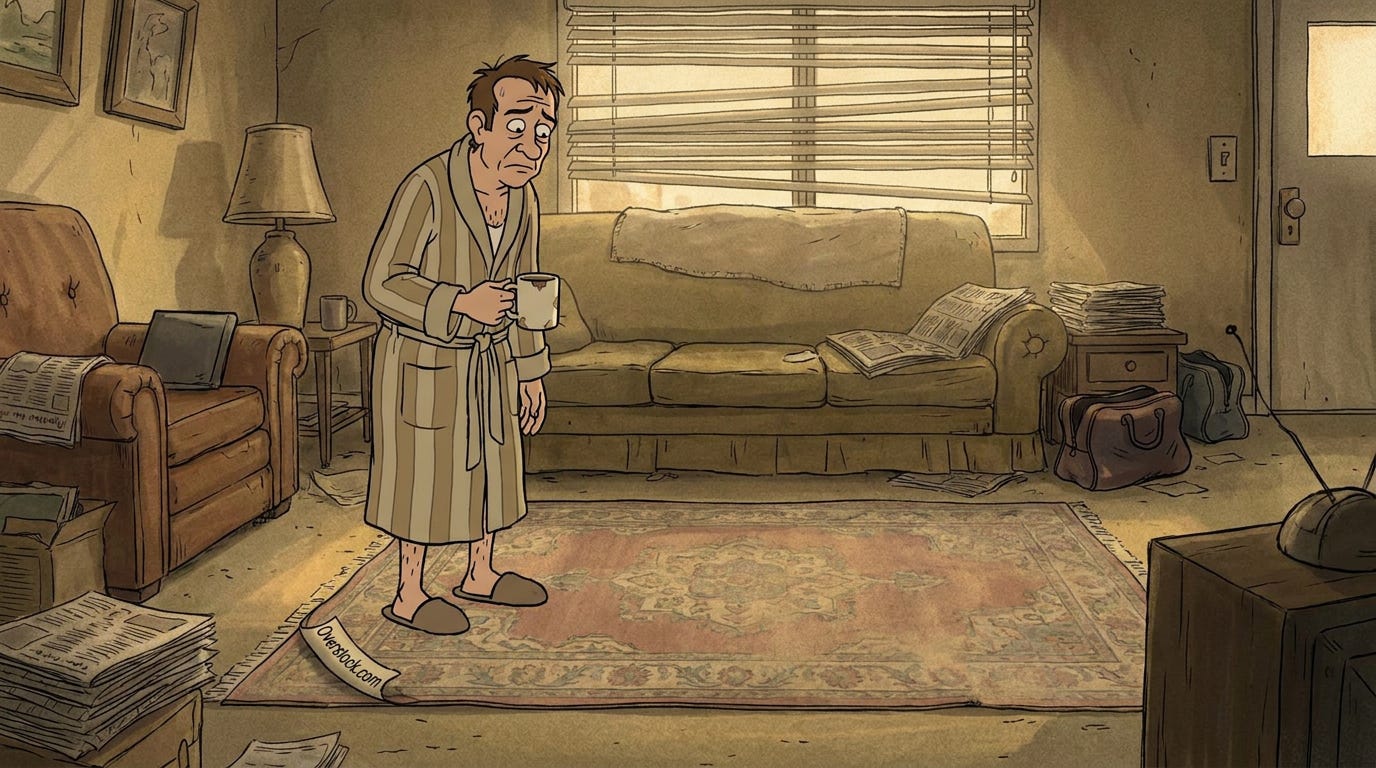
So I wake up Sunday, right, and something’s off in the apartment. Takes me a minute. It’s not the Jesus’s bowling ball I keep finding under the couch, it’s not the pilot light, it’s not — well, it’s not nothing, man, it’s everything, but that’s not the point right now. I’m standing there in my robe, coffee not made yet, and I look down and I go: that’s not my rug.
Not gone. Worse. Replaced. Somebody came in here, took the rug that tied the whole room together, and put down something that’s rug-shaped. Same general area rug energy. Doesn’t abide the same. I flip up the corner and there’s a tag on it, man, and the tag says it came from a warehouse in New Jersey with a website attached to it, and the website has a name like it’s trying to sell you a mattress and a rug at the same time. And the worst part — the actual worst part — somebody’s standing behind me going, “that’s the rug you’ve always had, Dude, don’t be dramatic.” And I’m supposed to just, what, abide that?
This whole line of thinking, I gotta level with you, isn’t originally mine. Credit where it’s due — a lady named Lyz Lenz was noodling on her own version of this a while back, behind a paywall, which, fair, a woman’s gotta eat. But it got its hooks in me, and I’ve been chewing on it since, the way you chew on a joint that’s mostly seeds. So: hat tip to Lyz. This one’s downstream of her.
Here’s the thing that got me going, though. Everybody and their conservative uncle is walking around right now saying the American Dream is dead. There was a poll — CNBC, Survey Monkey, very scientific, very sad — fifty-one percent of people think it’s out of reach. Gone. Buried. Rug pulled.
And normally I don’t get worked up about polls, because a poll is just a bunch of strangers having opinions at you, which, man, that’s just, like, their opinion. But this one’s got a specific move in it that bugged me. It quotes James Truslow Adams — the guy who actually put “the American Dream” into words back in 1931 — like he’s on record saying the dream is a “better, richer, happier life for all our citizens.” Sounds nice. Sounds like a fortune cookie for capitalism.
Except that’s not what the man said. Not the whole of it. Not close.
Adams wrote a whole book, The Epic of America, and when he wants to show you what the American Dream actually looks like, in practice, on the ground — he doesn’t describe a guy in a bigger house. He describes the reading room at the Library of Congress. Rich guy, poor guy, general, private, scholar, schoolkid, all of ‘em sitting at the same tables, reading books that belong to everybody, paid for by everybody, open to everybody. That’s the dream. Shared. Public. Free at the point of use, like a bowling alley that never closes and never charges for shoes.
I told Walter about this one and it did something to him I wasn’t expecting.
“The actual Dream was a library,” Walter says, and he’s not mad exactly, he’s got this look like somebody told him the Port Huron Statement was ghostwritten. “A library, Dude. Say what you want about the man’s Dream, at least it’s got rules. At least it’s a system. Everybody gets a card, everybody follows the same checkout policy, you bring the book back on time or you pay the fine, there’s no —” and here he’s building up to it — “there’s no bullshit about who deserves to be there.”
“Walter, it’s a library.”
“It’s a covenant, Dude.”
Donny, who has once again arrived to the conversation several exits late, goes: “Wait, so the American Dream was... a library card?”
“Donny, you’re out of your element.”
He’s not wrong to be confused, though, because that is genuinely not the dream anybody sold you. Nobody’s running for president on “vote for me, I’ll get you a library card and a reading table.” They’re running on the picket fence. The bootstraps. The guy who did it all himself.
Which brings me to Laura Ingalls Wilder, because if you want the bootstrap myth in its purest form, man, it’s Little House on the Prairie. Pa Ingalls, alone against the elements, alone against the wilderness, a family surviving on grit and a rifle and the Lord’s own stubbornness.
Except — and I did not know this, and once I knew it I couldn’t stop thinking about it — Pa Ingalls was squatting. On Osage land. The land he “settled” wasn’t empty, it was stolen, and it was handed to him basically for free by a federal government that also protected him while he was breaking the law to be there. Railroads dropped him supplies. And in the famous killer winter in De Smet, the one that almost wipes the whole family out — they don’t survive because Pa’s tough. They survive because two other guys ride out into a blizzard to buy sixty bushels of seed wheat off a farmer who has it, and bring it back to keep the whole town alive. That’s not a rugged individualist. That’s a mutual aid society with a bonnet on it. And on top of that — his own daughter, Rose, is the one who took the real, messier record and edited it down into the bootstrap version we all grew up on. The myth isn’t just wrong, man, it’s got a credited author.
Maude heard me going on about this and didn’t even look up from what she was doing. “Self-invention,” she said, “is just plagiarism with better lighting.” Then something about vaginas, which, look, that’s Maude’s whole thing, I’m not going to explain it to you here.
But she’s right, and it’s not just a 19th-century problem. It’s not even a problem confined to guys with covered wagons. Turn on any podcast right now and you’ll find some guy in a quarter-zip explaining how he built his empire through “the grind” — up at 4 a.m., no days off, did it all himself. And every single time, my first question is: okay, but who raised his kids? Who made him dinner? Who kept the house from turning into the inside of my Torino? Because it wasn’t him, man. It was almost never him. Same deal when the finance gurus tell some struggling family to cut back — go down to one car, stop eating out, let the cleaning lady go. Convenient how “let’s tighten the belt” always means somebody, usually a woman, quietly absorbing a second unpaid job so the math works out on a spreadsheet. Same deal with the restaurant owner living his dream on the backs of servers he won’t (or can’t) pay a living wage, or the whole economy running on immigrant labor everybody claims to love the work of and hate the worker for. The Dream’s always had a tab, man. It’s just never been sent to the guy who ordered.
So here’s where I land, and I’m not trying to be a bummer about it, because that’s not really my scene. The actual pioneers, the real ones, out on the actual prairie — they weren’t lone wolves. They couldn’t be. Going it alone out there got you dead. What got people through was neighbors. Shared seed wheat. Shared land, even when the “sharing” was theft with better PR. Community, not conquest. That’s the original rug, man, before anybody swapped it out for the Overstock.com version and told us it was always this thin.
I don’t need the old Dream back exactly the way it was — I’m not asking for a shrine to the Library of Congress reading room here, I just want a coaster and a decent record player. But I’d like everybody arguing about the Dream to at least agree on what it originally was, and who’s been quietly picking up the tab while somebody else gets the toast at the dinner. That seems fair. That seems, dare I say, abide-able.
The Dude abides. He’d just like his actual rug back, or at minimum, an itemized receipt for whoever swapped it.