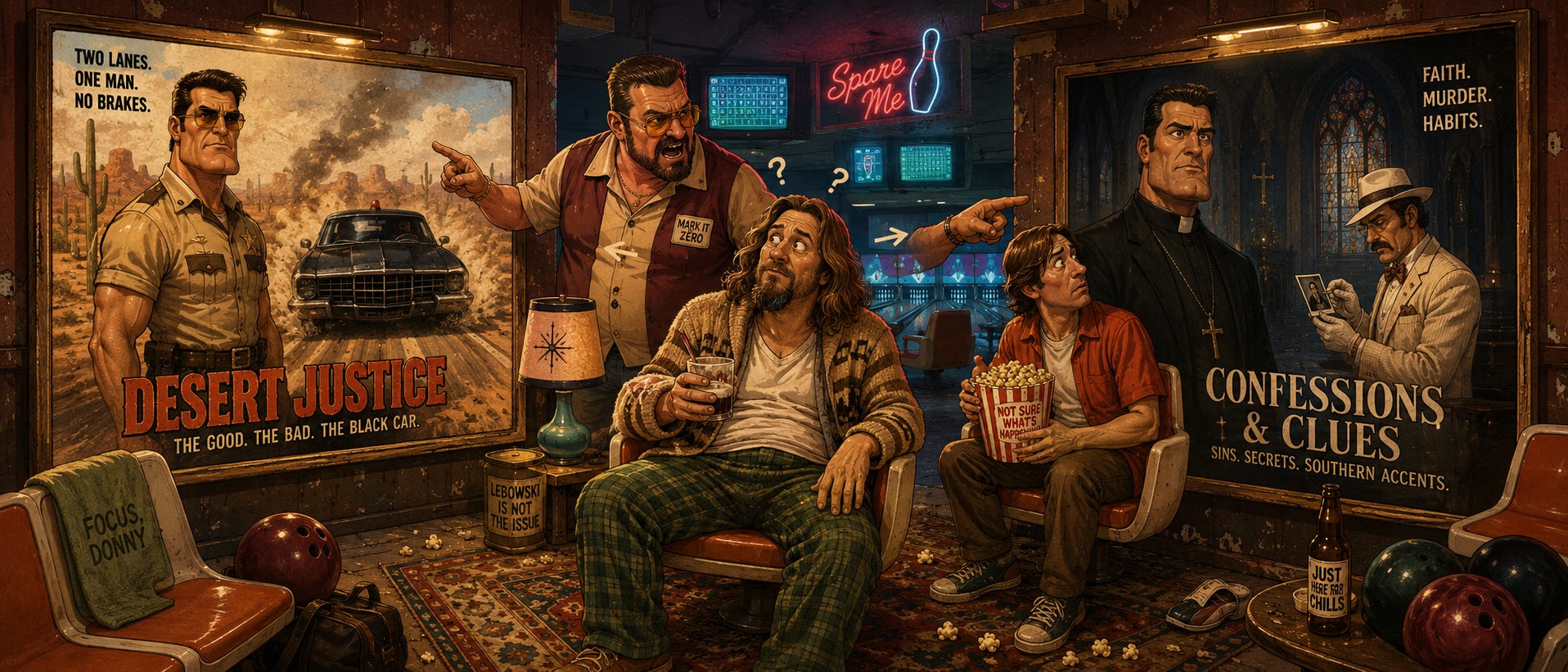
The Dude had just witnessed one of the longest and most impressive acting careers in Hollywood history.
Forty-eight years.
Same square head. Same heavy brow. Same general expression of a man who has seen some shit and does not intend to discuss it before the second drink arrives.
In 1977, Josh Brolin was a rugged desert lawman defending a small town from a giant satanic automobile in The Car. Then, almost half a century later, he appeared in Rian Johnson’s third Benoit Blanc mystery, Wake Up Dead Man, as Monsignor Jefferson Wicks, a brusque, domineering clergyman who inspired the sort of warm community feeling usually associated with contested wills and unattended arsenic.
The Dude sat back, took a sip of his White Russian, and thought:
Man, Josh Brolin has really taken care of himself.
Then Maude entered the conversation, metaphorically speaking, and explained with the clinical precision of someone correcting a child’s understanding of human reproduction:
“That was James Brolin.”
Josh Brolin’s father.
Different Brolin entirely.
Walter rejected this immediately.
“They have the same face, Dude. This is clearly a continuity issue.”
Donny looked up from the popcorn.
“Was James Brolin Thanos?”
“Donny, you’re out of your cinematic universe.”
In the Dude’s Defense, Man
Now, the Dude is not claiming innocence here. The cast list was available. The internet was functional. The names “James” and “Josh” are, under ordinary conditions, distinguishable from one another.
But come on, man.
Older Josh Brolin looks remarkably like James Brolin. They share the same granite-jawed presence, the same compact physical authority, and the same basic appearance of a man who could end a bar fight simply by standing up slowly.
The surname was right. The face was spiritually right. The only errors involved the first name, the generation, and the actual identity of the human being.
So the Dude had not, strictly speaking, discovered one extraordinary career.
He had accidentally programmed a Brolin family film festival.
And here is the thing: the mistake turned out to be more interesting than the truth would have been.
James Brolin Versus the Satanic Lincoln Continental
The Car is one of those wonderful 1970s movies built around a premise so beautifully stupid that the only respectable response is total commitment.
This is not a haunted car. There is no tormented driver. There is no malfunctioning computer or government experiment gone wrong.
The car itself is an asshole.
It rolls into a desert community, murders people, honks with demonic enthusiasm, and generally behaves like Satan decided horseback transportation lacked sufficient trunk space.
James Brolin plays Chief Deputy Wade Parent, and he plays the entire thing completely straight. That is why the movie works.
He does not wink at the camera. He does not behave as though he is too sophisticated for the material. He treats the deaths, the terror, and his responsibility to the town as entirely real.
Wade is decent, competent, protective, and human. He is not an indestructible action figure. He is a small-town lawman trying to keep people alive while confronting a vehicle that appears to have come directly from Hell’s fleet-management department.
The film arrived in the post-Jaws era, when Hollywood executives looked around the natural and manufactured world and asked which everyday object could be turned into an unstoppable killing machine.
The shark had been taken.
The skyscraper had been taken.
Someone looked into the parking lot and said, “How about a Lincoln?”
And yet, for all its cheese, The Car has atmosphere. The desert feels isolated. The horn is genuinely unnerving. The black automobile has real physical presence. James Brolin gives the movie the solid center it needs.
It is earnest cheese, man.
Earnest cheese ages much better than smug cheese.
Josh Brolin Versus the Human Monster
Josh Brolin’s Monsignor Jefferson Wicks in Wake Up Dead Man is almost the moral opposite of Wade Parent.
Wade’s authority exists to protect a community.
Wicks’s authority exists to control one.
He is brusque, domineering, self-certain, and easy to dislike. He has the presence of a man who has never entered a room without assuming that everybody else’s job is to become quieter.
Brolin is very good at this kind of character because he does not need to advertise the menace. He simply occupies the space. The voice stays controlled. The posture stays firm. The certainty does most of the violence for him.
Wicks understands how to turn cruelty into moral clarity, domination into leadership, and resentment into a kind of spiritual loyalty program.
In The Car, evil arrives from outside town with tinted windows and no license plate.
In Wake Up Dead Man, evil has a congregation and knows exactly where to stand for the lighting.
James Brolin’s Wade becomes more sympathetic as pressure reveals his humanity. Josh Brolin’s Wicks becomes more repellent as the story reveals what his authority is actually doing to the people around him.
One man stands between the town and the monster.
The other man may be why the town needs protection in the first place.
Walter considered this for a moment.
“So one Brolin saves the community, and the other Brolin is a community standards violation.”
Crude, but essentially accurate.
Two Brolins, Two Versions of the American Man
The fascinating part is that both actors use roughly the same physical instrument.
They are broad, restrained, square-jawed men who look immediately authoritative. Neither needs to shout to establish control. Both can suggest stored force simply by remaining still.
But the moral meaning of that authority has changed.
James Brolin’s solidity tells the audience: this man may save us.
Josh Brolin’s solidity often asks: should we have trusted this man in the first place?
That is partly a difference between the actors, but it is also a difference between eras.
A 1977 genre thriller could present a fundamentally decent lawman with relatively little irony. The modern mystery is more suspicious of the patriarch standing at the center of the room. It wants to know where his authority came from, who benefits from it, and how many people had to keep quiet so he could continue appearing righteous.
Maude would probably describe this as a generational shift in the semiotics of masculine power.
The Dude would describe it as one guy protecting the rug and the other guy peeing on it while delivering a sermon about personal responsibility.
The Josh Brolin Career for People Who Skipped the Capes
The Dude is largely ignorant of superhero cinema. Somewhere along the way, Josh Brolin became a large purple labor-management dispute with a magic glove, but this publication is not qualified to comment on intergalactic jewelry.
Fortunately, his career outside that genre is rich enough to keep a person occupied for quite a while.
The essential starting point is No Country for Old Men, where Brolin plays Llewelyn Moss, a capable, stubborn man who finds drug money and makes the sort of decision that seems reasonable for approximately nine minutes.
It was the role that showed what mature Josh Brolin could really do. He could look like an old-fashioned hero while allowing arrogance, fear, intelligence, and fatal miscalculation to coexist underneath.
From there, he became one of the great screen interpreters of compromised American masculinity.
In Milk, he played Dan White as a man collapsing under grievance and humiliation. In American Gangster, his authority became institutional corruption. In Sicario, he turned casual clothing and conversational manners into something deeply sinister.
Then there is the comedy.
In Hail, Caesar!, Brolin is a studio fixer attempting to impose order on a business populated almost entirely by lunatics. In Inherent Vice, he plays a detective who is threatening, ridiculous, hungry, wounded, and possibly operating in a completely different movie from everyone else.
He also brings weathered authority to True Grit, Dune, and Outer Range.
The remarkable thing is that his most interesting career did not arrive through a smooth child-star ascent. It emerged in middle age, when filmmakers realized that his heroic appearance was most useful when complicated, compromised, or turned slightly rotten.
The Mistake That Tied the Double Feature Together
Had the Dude correctly read the cast list before watching the movies, these would have been two unrelated films.
One would have been an enjoyable piece of 1970s techno-horror cheese about a demonic automobile.
The other would have been a modern murder mystery featuring Josh Brolin as a human being far less likable than the car.
But by getting it wrong, the Dude noticed something else.
The resemblance.
The inherited screen presence.
The changing meaning of masculine authority across two generations.
The difference between reassurance and menace.
The error tied the two movies together.
It was the rug.
So no, Josh Brolin did not begin his career in 1977 by fighting a satanic Lincoln Continental. The Dude regrets the error.
But James Brolin played the man who stood between the town and the monster. Nearly fifty years later, his son played the man everyone in town might reasonably want dead.
Different Brolins.
Same jaw.
Opposite moral direction.
Sometimes you throw a gutter ball and it still tells you something about the lane, man.
The Brolins abide.
Love this sentence- The Dude would describe it as one guy protecting the rug and the other guy peeing on it while delivering a sermon about personal responsibility. The latter part describes the GOP to a tee .