

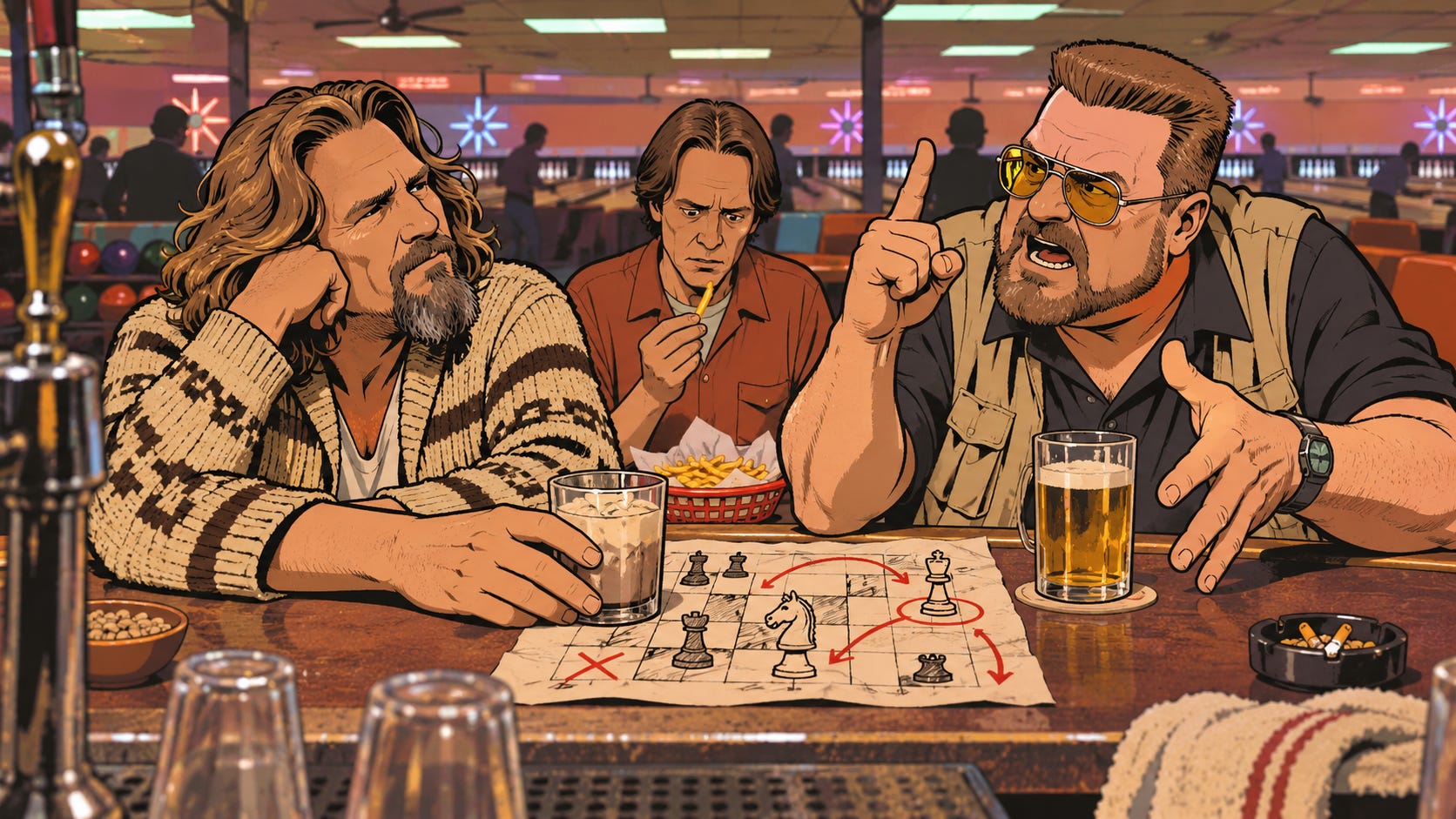
I was sitting at the bar at the bowling alley, reading about Jensen Huang, the Nvidia guy. You know, the one with the leather jackets who sells the chips that everybody needs to build artificial intelligence. Makes a hundred-billion-dollar company look like a neighborhood electronics store.
Turns out he’s been having an affair with a Chinese businesswoman named Alice Huang. No relation. Which is probably the least complicated part of this whole fucking story.
American intelligence reportedly believes Alice was working for China’s Ministry of State Security. The people who handle the espionage stuff. Apparently the relationship had been going on for years, and the intelligence community had been sufficiently concerned to write classified reports and warn senior officials.
Including the president.
More than once.
I was trying to absorb this when Walter sat down with a plate of nachos.
“Five-dimensional chess, Dude.”
“What?”
“Trump. China. Nvidia. This is a brilliant strategic maneuver.”
“Walter, the guy was apparently sleeping with a Chinese spy.”
“ALLEGED spy, Dude. Alleged. We have a system of laws in this country.”
“That’s very conscientious of you, Walter.”
“You’re missing the larger picture.”
I looked back at my phone. There was a picture of Jensen Huang in a leather jacket, smiling like a man who had recently sold somebody forty billion dollars’ worth of computer equipment.
“Yeah, Walter. I’m getting that impression.”
The Art of the Chip
Walter explained that Nvidia makes the most advanced AI chips in the world. This much I knew. What I hadn’t fully appreciated was his theory that selling some of those chips to China was actually a way to maintain American dominance.
“You see, Dude, the Chinese need our hardware. They need our software. They need CUDA. You keep them dependent on our technology, you control the battlefield.”
“Okay.”
“You cut them off completely, they build their own. Huawei. Domestic production. Their own software ecosystem. Suddenly you’ve created your own competition.”
“That makes some sense.”
“OF COURSE IT MAKES SENSE. It’s called strategic leverage!”
Walter was getting worked up, which was impressive because I hadn’t disagreed with him yet.
“And Trump understands this. He lets Nvidia sell the older chips while keeping the best stuff here. China stays dependent on American technology. American companies make billions. We maintain the advantage.”
There was a legitimate argument buried in there. The Trump administration had relaxed some restrictions on Nvidia’s exports, allowing certain H200 chips to be considered for sale to approved Chinese customers while keeping newer technology restricted.
Jensen Huang had been lobbying for greater access to China for quite a while. The Chinese market was worth billions to Nvidia. You didn’t need a spy to persuade the guy that selling chips was a good idea.
“Okay, Walter. But what about the woman?”
“What about her?”
“Well, she was an executive at one of Nvidia’s customers. A company called MAGAspeed.”
“Megaspeed.”
“Right. MAGAspeed.”
“MEGASPEED, DUDE. Singaporean company. They operate data centers.”
“Well, apparently they were also under investigation for possibly getting restricted chips into China.”
Walter stared at me.
“That’s a separate issue.”
“Is it?”
“YES.”
I ordered another Caucasian. This was going to take a while.
That’s a Lot of Fucking Chips, Walter
The latest reporting was pretty remarkable.
According to The Information, Alice Huang and a network of companies associated with her family had helped move approximately 240,000 Nvidia chips into China, worth at least $7.5 billion.
That’s an allegation, not an established finding. The espionage accusations are disputed, Megaspeed has denied violating export restrictions, and investigators are still sorting through the whole mess.
But 240,000 GPUs is a hell of a number.
For perspective, that’s enough hardware to populate something on the order of half a gigawatt of H100-era data-center infrastructure, depending on the mix of chips and how they’re deployed. Not a few servers falling off a truck. We’re talking about an industrial-scale computing operation.
“Two hundred and forty thousand,” I said.
“Allegedly,” Walter reminded me.
“Right. Allegedly. Seven and a half billion dollars.”
“Allegedly.”
“That’s an awful lot of chips to misplace.”
“Nobody said they were misplaced, Dude. There are distributors. Resellers. Cloud operators. International commerce is complicated.”
“Sure. But this MAGAspeed outfit was an official Nvidia cloud partner, right?”
“MEGASPEED.”
“And the lady who was involved with the Nvidia CEO had been running it?”
“She was formerly associated with it. Details matter, Dude.”
“Well, according to the reporting, she was also connected to companies getting restricted chips to Chinese customers.”
Walter took a long drink.
“You’re conflating commercial relationships with intelligence operations.”
He wasn’t entirely wrong. We still didn’t know whether Huang had knowingly helped anyone evade export controls, whether Alice Huang had actually performed the intelligence activities attributed to her, or whether any American secrets had been compromised.
But the collection of coincidences was getting fairly crowded.
“That’s a lot of moving parts, Walter.”
“GLOBAL COMMERCE HAS MOVING PARTS, DUDE.”
“Yeah, but most of them don’t usually involve the CEO’s girlfriend and the Ministry of State Security.”
The President Has Been Briefed
Then there was the business with Trump.
According to the New York Times, American intelligence had warned the president about the suspected relationship in late 2025.
In May 2026, Marco Rubio reportedly briefed him again aboard Air Force One, shortly before Jensen Huang joined the presidential trip to China.
Trump later said he hadn’t known about the situation at the time.
Which left a rather peculiar discrepancy between the president’s recollection and the accounts of people familiar with the intelligence briefings.
“Walter, apparently Rubio told Trump about this before they went to China.”
“Presidents receive intelligence reports constantly. You think every unverified allegation is supposed to stop American foreign policy?”
“No.”
“Exactly. Intelligence assessments aren’t convictions. You can’t let Beijing dictate who gets invited on Air Force One by spreading accusations.”
“Fair point.”
Walter leaned back, satisfied.
“So what’s the problem?”
“Well, what did they do about it?”
“About what?”
“The suspected spy.”
“You can’t just arrest people because somebody writes a classified memo!”
“I didn’t say arrest anybody. I’m wondering whether they warned Jensen. Or investigated whether she was getting access to information she shouldn’t have.”
“There’s an FBI investigation.”
“Now there is. I’m asking about before.”
Walter looked annoyed.
“You’re demanding a level of operational detail that isn’t publicly available.”
“Yeah. That’s sort of why I’m wondering.”
Donny, who had been listening while arranging french fries by length, looked up.
“Wait. Did Jensen know she was supposed to be a spy?”
“He’s said he didn’t,” I told him.
“And the government knew?”
“According to the reporting, intelligence officials believed she was.”
“So did they tell him?”
There was a little silence.
“Well, Donny, that’s one of the things we don’t know.”
He thought about that.
“That seems like something you’d want to know.”
Walter picked up another nacho.
The Indispensable Man
The other thing that struck me was Nvidia itself.
Here you’ve got one of the most valuable companies on Earth. Its chips are central to the global AI business. Its CEO meets with presidents, prime ministers, and executives running enormous technology companies.
You would think protecting a guy like that from foreign intelligence operations would be fairly high on somebody’s list.
Maybe it was. Nvidia has security people, and we don’t know what warnings or procedures were in place. But whatever protections existed, they apparently didn’t prevent a relationship that American intelligence reportedly considered a serious vulnerability.
And who exactly tells Jensen Huang that he has become a security problem?
Nvidia has a board of directors, naturally. Most are formally independent. Some have worked alongside Huang for decades, watching him build one of the most successful companies in history. He’s the founder, the chief executive, the public face, and, by all appearances, a substantial part of the company’s identity.
The board has opened an independent investigation. Which is appropriate.
But I couldn’t help wondering how easy it would have been for those same directors to confront him before the whole thing became public.
“Walter, who’s supposed to tell Jensen no?”
“What?”
“Suppose somebody at Nvidia figures out the boss is involved with a person who might be connected to Chinese intelligence. Who tells him to knock it off?”
“The board of directors, Dude. Corporate governance.”
“Okay. And suppose Jensen doesn’t like that?”
“Then the board exercises its fiduciary responsibilities.”
I looked at Walter.
“You’re telling me the board is going to bench the guy who built the whole franchise?”
“YOU DON’T BENCH YOUR STAR QUARTERBACK IN THE SUPER BOWL, DUDE!”
There it was.
We sat with that for a moment.
Because it occurred to me that Walter had just explained the whole problem rather nicely.
Nvidia can’t afford to lose Jensen Huang. The administration values Nvidia’s technological dominance and Huang’s cooperation. China wants Nvidia’s chips. Nvidia wants China’s money. And somewhere in the middle of this arrangement is a suspected intelligence operation that apparently wasn’t enough to stop everybody from conducting business more or less as usual.
None of that proves a conspiracy. None of it proves Huang betrayed anybody, or that Trump changed export policy because of Chinese intelligence.
But it does leave some interesting questions about what happens when the people responsible for managing risk become dependent on the very people creating it.
Donny had finished organizing his fries.
“So if everybody needs Jensen, who gets to tell him no?”
Walter opened his mouth.
Then he closed it.
“That’s a complicated question, Donny.”
“Seems pretty simple.”
I looked down the bowling lanes. Somebody had left a single pin standing at the far end, and the machine was waiting to clear it.
Walter was still talking about strategic leverage, semiconductor architecture, and the importance of maintaining American technological leadership.
He might even have been right about some of it.
But I kept thinking about that single pin.
Everybody could see it standing there.
Nobody had knocked it down.
The Dude abides.