

The final drop of this look at the infrastructure of the Democratic party consultancy world. The Dude woke up way too early, and before his first Caucasian whipped out almost 4K words on why the Dems are such sad sacks. A lot of it goes to structural changes that began once Obama won in 2008, and his inner circle rebuilt the infrastructure that is now the Achilles Heel of the party, and a barrier to them taking it back from MAGA and Trump.
Part 1, Part 2
There’s a bar the Dude goes to. Not a fancy place — a place where they know what he drinks, pour it without being asked, and don’t make him feel bad about the bathrobe. He goes there to think. Sometimes Walter comes. Walter always has opinions. Donnie usually shows up in the middle of something and gets talked over.
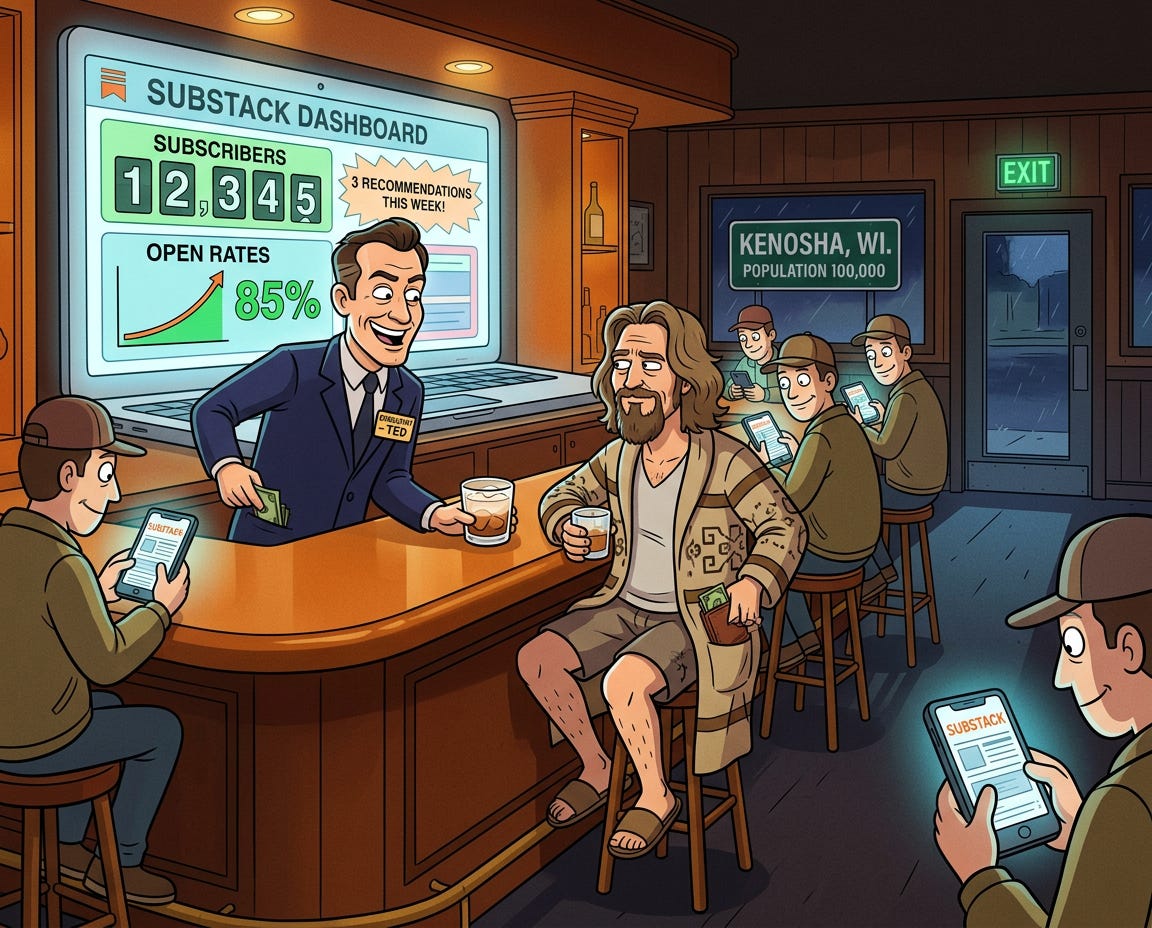
The bartender, it should be noted, is not the Dude’s friend. The bartender is a person who profits from the Dude’s continued presence at the bar. The bartender will always tell him the White Russian tastes great. The bartender will always agree the Eagles suck. The bartender’s livelihood depends on the Dude coming back tomorrow, and the day after, and feeling good enough about the experience to keep doing it.
I want you to hold that thought for a minute, man. We’re going to come back to it.
The Great Migration (Going Nowhere)
Starting around 2022, a very specific type of person began announcing their departure from Twitter. Political consultants. Former operatives. Pundits of the prestige-adjacent variety. Never Trump Republicans who had built their entire post-Republican identity on the platform. They were leaving, they said. Twitter was toxic. The algorithm was broken. Elon had ruined everything. They were going somewhere better. Somewhere real. Somewhere you could have an actual conversation.
They were going to Substack.
And they were absolutely still on Twitter, posting about how they were leaving for Substack, through 2023, and 2024, and right now, today, this morning, before you read this. Every single one of them. Still there. Still posting. Still furious about the platform they cannot quit, while also publishing a newsletter about why they quit the platform.
This is not a minor irony. This is the whole thing in miniature. The content changed. The behavior didn’t. The platform changed. The pathology didn’t. They packed up the echo chamber, taped the boxes, hired a van, drove across town, and unpacked the echo chamber in a slightly nicer apartment with a paid subscription tier.
Walter would call this out of their element. He would not be wrong.
The Economics of Preaching to the Choir
Here’s where it gets interesting, man, because there are actually two separate mechanisms making this worse than Twitter, and they work together in a way that’s worth slowing down to look at.
The first is subscriber retention. On Twitter, the algorithm occasionally threw a brick through the window — ratio’d you, surfaced a reply from someone who violently disagreed, forced a reckoning with a perspective you hadn’t encountered. It was chaotic and often terrible, but chaos has an accidental virtue: it occasionally introduced friction. Friction is how you find out you’re wrong about something.
Substack has no such mechanism. A subscriber who disagrees with you cancels. A subscriber who agrees with you upgrades to founding member and leaves a comment saying this piece really resonated. The financial model of the platform actively punishes content that challenges your existing audience and rewards content that makes them feel validated, energized, and understood. The consultant class, which already had a catastrophic persuasion problem, has relocated to a platform where persuasion is economically irrational. They are now being paid, directly, to stop trying to convince anyone of anything new.
The second mechanism is subtler and more insidious, and this is the one that doesn’t get talked about enough: Substack itself has an engine, and the engine has incentives.
Substack takes 10% of subscription revenue. Which means Substack is financially motivated to maximize paid subscriptions across its entire ecosystem, not just yours. The recommendation algorithm — the “you might also like” that shows up at the bottom of every newsletter — doesn’t push readers toward writers who will challenge their assumptions. It pushes them toward writers in the same ideological cluster who have demonstrated the ability to convert free readers into paying ones. It is doing, in other words, exactly what Spotify does with genre playlists: keeping you in a room you already like, because that’s what keeps you subscribing to things.
But here’s the part that really gets me, man. The paying subscriber filter is itself a sorting mechanism, and a brutal one. Free readership on any platform skews diverse — people find you through search, through shares, through idle curiosity. Paid readership self-selects hard. The people willing to put a credit card down for political commentary on a given ideological newsletter are, almost by definition, the already-converted. The true believers. The people who were nodding along before they hit the paywall.
So as Substack’s engine optimizes you toward paid subscriber growth — which is the entire pitch of the platform, “sustainable revenue from your true fans” — it is simultaneously optimizing you toward a narrower, more homogeneous, more thoroughly sealed audience. The exhaust-huffing cycle this creates is more airtight than Twitter’s, not less. On Twitter you were chasing dopamine. On Substack you are chasing dopamine and building what feels like a legitimate media business, which means the self-deception now has a spreadsheet attached to it. The consultant who believes their newsletter is a vehicle for political persuasion isn’t just wrong. They have monthly recurring revenue confirming they’re right.
Remember the bartender, man. The bartender always tells you the drink tastes great.
The Ego Architecture (Same Hit, Slower Drip)
Twitter was a slot machine. Pull the handle, wait for the likes and retweets to cascade, feel the hit, pull again. The dopamine was instant, unpredictable, and volumetric. Everyone understood this. There were articles about it. Ted Talks about it. Documentaries. The slot machine metaphor became so ubiquitous that it stopped landing, which is its own kind of problem.
Substack is a different delivery mechanism for the same drug. Slower, more sustained, packaged differently. The status markers have been rebranded but not replaced. Follower counts became subscriber counts. Retweet velocity became open rates. The quick hit of a viral tweet became the slower satisfaction of a piece that “really traveled this week” and got recommended by three other newsletters in the same ecosystem that your readers are also subscribed to.
The social graph, crucially, has not changed. The Never Trump Substack world — the Bulwark crowd, the Atlantic-adjacent explainer class, the former Republican operatives who have built their entire post-Republican identity on being the adults in the room — these people are reading and recommending each other’s work, appearing on each other’s podcasts, and citing each other’s Substacks in their own Substacks. It is a closed loop that feels like a conversation and functions like a mirror.
Substack even built Twitter directly into the platform. It’s called Notes. Notes is exactly Twitter, but only for people who already subscribe to things on Substack, which means it is Twitter with the interesting strangers surgically removed. Just your people, talking to your people, about the things your people already believe, forever.
Donnie would ask what Notes is. Walter would tell him he’s out of his element. Neither of them would be entirely wrong.
The Insularity Ratchet
The thing that makes this a ratchet and not just a static problem is that it gets tighter over time, not looser.
Here is the mechanic. Substack’s recommendation system sends readers from one newsletter to aligned newsletters. You subscribe to one Never Trump Substack, you get recommended three more. You subscribe to those, you get recommended the podcasts those writers appear on. You subscribe to those podcasts and you are now, within about six weeks of arriving on the platform, living inside a fully enclosed ideological terrarium that has been algorithmically constructed to feel like a diverse information diet because the writers occasionally disagree about tactics while agreeing completely about everything that matters.
The people inside this terrarium are, in many cases, genuinely talented writers producing genuinely intelligent work. That’s not the issue. The issue is that the audience for this work is not the persuadable voter in Waukesha County who used to vote Democrat and now doesn’t. The audience is the already-persuaded professional in a major metro who wants to feel like they’re doing something by reading about politics over coffee. That audience will never move a single election. The newsletter that serves them will keep growing its subscriber count and open rates and cited-by-others metrics, and none of those numbers measure the thing that’s supposed to matter.
Political persuasion requires encountering people who disagree with you and making a case anyway. Substack, as currently constituted and algorithmically incentivized, makes this nearly impossible and financially counterproductive. The platform has taken the media ecosystem’s existing tendency to self-sort and added a monetization layer that rewards you for accelerating it.
This aggression will not stand, man. This particular aggression is, however, extremely profitable for Substack Inc.
The Dude Looks in the Mirror (Briefly, It’s Uncomfortable)
Here is where I have to say something, man, and I want to say it straight.
This newsletter is on Substack. You are reading it on Substack. The Dude is, technically, a political writer on the platform he has just spent several hundred words eviscerating. The irony is not lost on me. I’ve been sitting with it since the second paragraph and I think I owe you a clean account of how I’m thinking about it.
There is an honest version of writing political commentary on Substack and a dishonest version. The honest version goes like this: I have some things to say about American politics. Saying them helps me think. Some people find it entertaining or useful or at least mildly cathartic (The Dude definitely finds it cathartic, man). This is a reasonable way to spend time and a fine use of a platform. It is not a substitute for organizing, canvassing, donating, or doing any of the things that actually move political outcomes. It knows what it is.
The dishonest version is the consultant who genuinely believes — or performs believing — that their $15-a-month newsletter is a meaningful vehicle for political change. That their open rates represent persuasion. That being cited by three other Substacks is reach. That the founding members leaving comments constitute a movement. It is not. They are not. It does not. None of this is happening.
The Dude does not have a theory of change. The Dude has a White Russian and some observations. That is an honest position. The consultants have a White Russian, some observations, a slide deck about subscriber growth, and a pitch for why all of it adds up to saving democracy. That is a less honest position.
Knowing the difference matters, man. That’s all I’ve got.
Abiding, With Eyes Open
The Dude is not leaving Substack. The Dude is not going back to Twitter, where the Eagles still play on the radio and the algorithm will eventually put something terrible in front of him. The Dude is going to keep writing these things because the thinking-out-loud is worth doing and the conversation, when it happens, is genuinely good.
But the Dude is not going to pretend the bowling alley is a campaign office.
The consultants who migrated from Twitter to Substack did not upgrade their political impact. They upgraded their furniture. They found a platform that charges their readers instead of their advertisers and calls it independence. They found a recommendation algorithm that flatters them instead of trolling them and calls it community. They found a way to get paid for the thing they were doing for free, which is talking to the people who already agree with them about the people who don’t.
The voter in Kenosha is not on their list. The voter in Kenosha is not going to be on their list. The voter in Kenosha does not know the newsletter exists and would find it, if encountered, roughly as relevant to their actual life as a dispatch from a foreign country with good Wi-Fi.
That’s the whole problem, man. In one newsletter.
The Dude abides. The Dude is also, if we’re being honest, talking to a pretty specific slice of the population from a barstool in Reseda. The difference is the Dude knows it.
This concludes infrastructure week. Three pieces, one theme: the Democratic Party built a beautiful rug, pissed on it, hired consultants to explain why, and is now paying those consultants to Substack about it. The Dude abides. Barely.