

So there’s this guy on the television, day after some Democrat loses a special election nobody outside three counties has ever heard of, and he does that thing they do — gets all solemn, like he’s delivering a eulogy for a guy he never much liked in the first place. Says the party “strayed too far from the center.”
Nobody asks where the center is. Nobody asks which issue. Nobody asks whether these mythical center-voters switched sides, or stayed home to watch the Lakers, or just didn’t care for the candidate’s tie. The center gets invoked like some kind of secular saint you pray to when you don’t feel like examining why your guy ran a bad campaign. It’s the political equivalent of blaming a wrecked Torino on insufficient respect for the moon.
I made myself a White Russian over this one. Then another, because it’s a two-drink question, man: how many voters actually live in this center, and what in the hell do they believe?
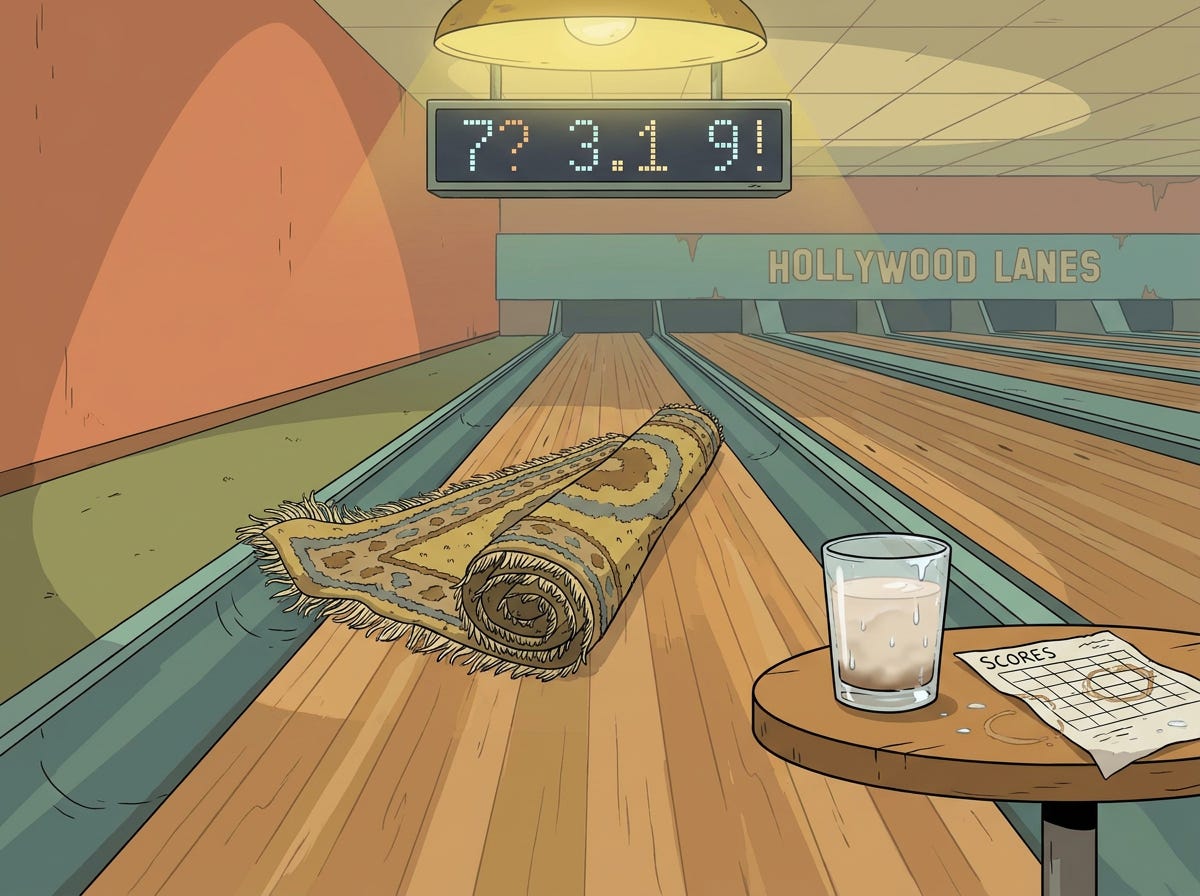
I. The Rug That Doesn’t Exist
Depending on who’s counting, “the center” is either everybody who calls themselves independent, or just the ones who don’t lean either way, or the mixed-belief types, or the genuinely undecided, or the people who hate both candidates but’ll vote anyway, or the ones who might just stay home. That’s six different rugs, man, and the pundits keep pointing at whichever one happens to be on sale that week.
Maude: The category is not a person, Jeffrey. It is a container. You are describing several incompatible containers and calling them one rug.
She’s not wrong. She’s usually not wrong, which is its own kind of aggravating. Maude doesn’t do vibes — she looks at a room full of “moderates” the way she looks at everything else, clinically, like she’s cataloguing specimens for a very expensive gallery show. And what she’ll tell you is that the “center” that wins you an argument on cable news is never the same “center” that wins you an election. Commentary grabs the big, generous definition when it wants a mandate, then swaps in the small, actually-persuadable definition when it’s time to write a strategy memo. Same word. Different rug. Nobody tells you they switched it out from under the coffee table.
II. The Airline You Hate But Keep Flying
A lot of “independents” aren’t floating around in some ideological Switzerland. They’re partisans who are pissed off at their own side and don’t want the loyalty card. “I don’t like these people, but the other people are worse” — that’s not centrism, man, that’s negative partisanship with the label torn off.
It’s like hating an airline — the legroom, the change fees, the guy reclining into your knees in 14C — and flying it every single time anyway because the other airline’s worse and you already have status. You didn’t become neutral about air travel. You just stopped wearing the sweatshirt.
Walter: You think these “independents” are neutral? Nobody’s neutral, Dude. I didn’t agree with every clause when I converted, but I didn’t go around calling myself a moderate Jew. You’re either in the covenant or you’re not. Three thousand years of tradition doesn’t come with a comment card. You can’t offer notes.
Say what you want about Walter — and I generally do — but the man does not do things by half measures, and he’s accidentally onto something. A lot of these “independents” are exactly like Walter: fully committed to a side, furious about specific line items, still showing up every single time. Different receipt, same pew.
III. Six Opinions Don’t Average Into a Seventh
Donny: So if I’m for healthcare and I’m for guns, that makes me a moderate?
Walter: NO, DONNY. SHUT THE FUCK UP.
Donny’s actually circling something here, which is rare, and Walter shutting him down is, as always, extremely on brand. Because no — six real opinions don’t average into a seventh, moderate opinion. A spreadsheet can average a guy’s positions into a tidy little dot on a chart. His ballot cannot. He doesn’t get to send an averaged government home with him. He picks a coalition, one of them, and the rest of his opinions go along for the ride whether they like it or not.
Which is its own kind of selective devotion, and Walter, ironically, is the league’s foremost expert. Man carries a piece to bowling night over a foot fault but doesn’t seem to sweat the actual legal system nearly as hard. Everybody picks which of their own rules get enforced. The question was never how many opinions a guy’s got scattered across the political map — it’s which ones he lets cost him a vote.
IV. There Is No Center Lane
Ask a pundit to “move to the center” and ask him center on what, exactly. Immigration? Abortion? Healthcare? Guns? Taxes? Foreign policy? The median voter on one issue isn’t the median voter on the next one over. Candidate moves right on the border and left on drug prices — is that toward the center or away from it? Nobody can tell you, because there’s no center lane at Hollywood Lanes, man. There’s a gutter on each side and some wood in the middle, and the wood doesn’t care about your feelings.
“Moderate” mostly describes a costume anyway. A guy can run genuinely hard-right policy, wear sensible shoes, talk softly about “process,” and the panel calls him a moderate. Another guy runs broadly popular economic positions but raises his voice doing it, and suddenly he’s the extremist. That’s not measuring a position. That’s judging a jumpsuit.
V. This Is Not ‘Nam, This Is Electability. There Are Rules.
Walter: TOO FAR LEFT ON WHAT, THOUGH? Too far left among WHOM? In WHICH district, compared to WHICH opponent? Did the voters switch sides or did they just stay home? DID THE POSITION ALSO MOTIVATE ANYBODY? You want to invoke a rule, Dude, you cite the rule. This is not Vietnam. This is electability. There are rules.
Which would carry more weight, honestly, if Walter had ever once cited an actual rule instead of just yelling that one exists. But that’s the whole racket, man — “too far left” gets treated as an objective diagnosis when ninety percent of the time it just means “this candidate drifted from the politics I personally find respectable,” laundered through a focus group and repackaged as neutral electability advice. Call it the Electability Vibes Department. No mailing address. Big budget.
VI. The League Doesn’t Need to Agree. It Just Needs to Show Up.
Here’s the better way to think about it, man. The center isn’t a bloc that shares a program. It’s Thursday night at the lanes — a room full of people who don’t agree on politics, religion, or the correct way to treat a rented shoe, and who show up anyway, keep score, and go home. Nobody there voted for a shared platform. They just all had their own reason to be in the building.
Same with an election. A candidate doesn’t lose because some unified center rejected him. He loses because enough different people had enough different reasons to say no — one hated the position on the border, one hated the tone, one thinks the guy’s a crook, one’s just tired, one didn’t care for the tie. Different scorecards. Same final number on the board.
So look. The center’s not a country with a capital and a passport office. It’s not a rug you go buy and have delivered. It gets assembled fresh, every single election, out of people who agree on almost nothing except that this time, one of the candidates gave them a reason to say no.
That’s not a coalition. That’s not an ideology. That’s a margin of error wearing business casual, and it changes its shoes every two years.
The operatives will keep hunting the cryptid anyway, because the cryptid’s useful — it justifies the candidates they already liked, it disciplines the ones they didn’t, it comforts the donors, and it means nobody has to sit down and look hard at why the campaign actually lost. Easier to blame the rug for not tying the room together than admit you never had a room to begin with.
Me, I’m going bowling. The lanes have actual rules. Somebody go explain that to Walter.
The Dude abides.
You know something genuinely, unironically funny?
I am, personally, what I refer to as an “Eisenhower Conservative”
Some genuinely *notable* foreign-policy snafus (Iran, Vietnam, Cuba) aside, I admire the man and his policies, from back in the days when the difference between the Dems and GOP were differences in the ways they approached governance
So here’s the genuinely funny thing:
Looked at through a modern political lens, the was actually to the *Left* of the current DNC, and the GOP would call him a Socialist at best
This shows you just how far the political environment in the US has drifted - mostly driven by the culture war narrative that really started to build up steam under the Reagan/Gingrich partnership
Eisenhower represented what you might call “Centrist” politics today
And that center? It’s now actually to the *fucking left* of the DNC
Fucking hilarious