The Dude has been reading science fiction.
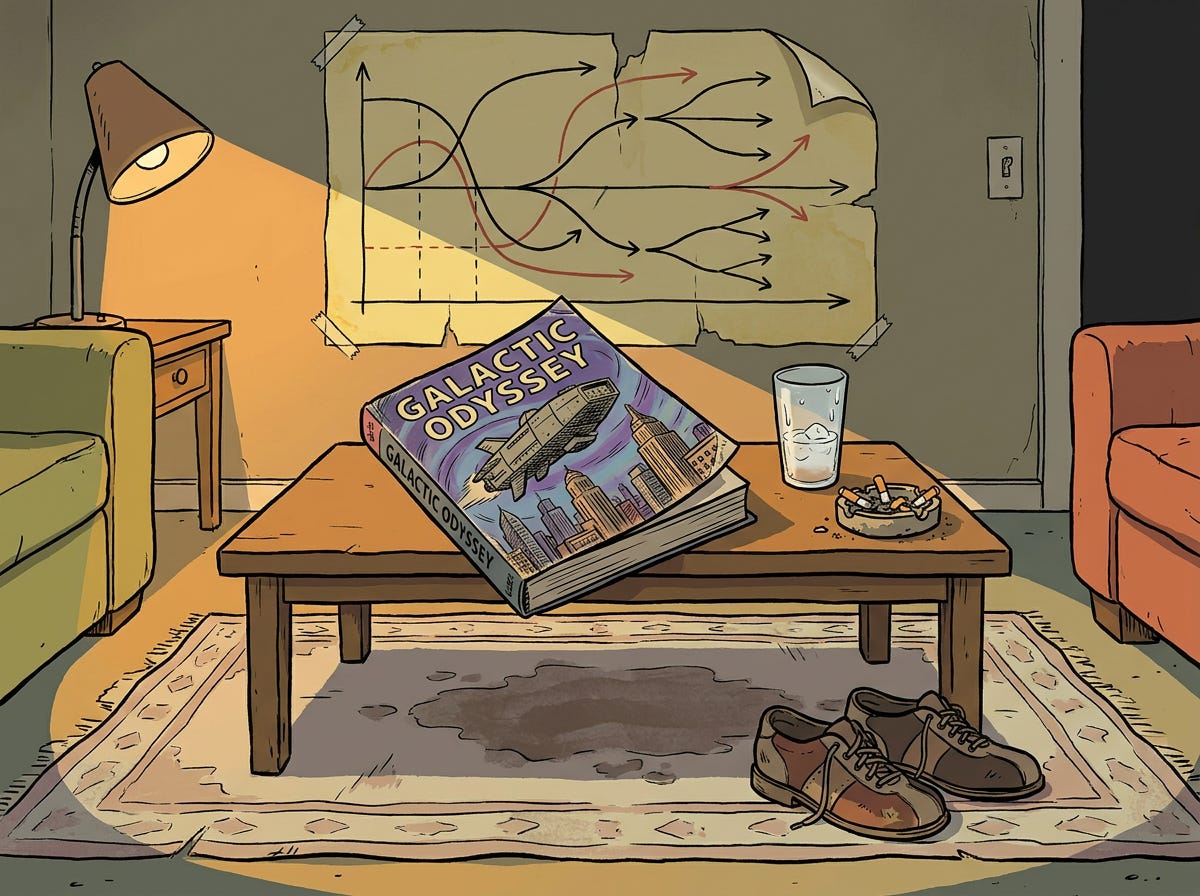
This is not especially unusual. There are only so many hours a man can bowl, and eventually you find yourself horizontal at home with a White Russian and an Isaac Asimov paperback whose cover features a gigantic spaceship hovering over something that looks suspiciously like the Chrysler Building on Tatooine.
Foundation, man.
Good shit.
The premise, for those of you who spent your formative years doing healthier things: a mathematician named Hari Seldon invents psychohistory.
Psychohistory cannot tell you whether Larry from Sector Seven is having the chicken or the fish on Tuesday. Individuals are noise. What it predicts is the behavior of enormous populations across enormous stretches of time. Empires. Revolutions. Civilizational collapse. And it’s right.
Seldon runs the numbers and has some bad news.
The Galactic Empire is fucked.
He can’t prevent the collapse. Nobody can. What he can do is compress the ensuing dark age from something like thirty thousand years down to about a thousand.
Still a shitty millennium. But take the win, man.
So Seldon builds a Plan.
And for a few hundred years, the Plan works. Crisis after crisis arrives right on schedule and resolves exactly the way the math said it would. People stop worrying. Why wouldn’t they? The future has been notarized.
Then the Mule shows up.
Walter Has Read This Book
Walter puts down his bowling ball.
This is never a good sign.
“The problem,” Walter says, “is that psychohistory assumes individual actors are statistically irrelevant.”
Walter has apparently been waiting four decades for somebody to bring up Asimov in his presence.
The Dude takes a drink. “Okay, Walter.”
“The Mule violates the assumptions of the fucking model, Dude.”
Annoyingly, Walter is right.
The Mule is not just another warlord. Seldon’s equations already account for warlords. Empires come with warlords the way bowling alleys come with a guy who has his own shoes and strong opinions about them.
The Mule is different because he is a mutant who can reach into a human mind and rearrange the emotional furniture.
Fear. Loyalty. Despair. Devotion.
One individual with enough leverage over enough people that the assumptions underneath the entire model quietly stop being true.
And this is where the Dude, several inches into a White Russian and possibly one other thing, had an uncomfortable thought.
Donald Trump is kind of the Mule.
Not literally.
Donald Trump Cannot Control Your Brain
“Wait,” Donny says. “Trump has psychic powers?”
No, Donny.
But here’s the thing worth knowing, and it’s the part everybody skips when they reach for this analogy: the Mule does not broadcast.
He doesn’t hypnotize a galaxy. He works one person at a time, and only the people who matter. Generals. Ministers. Administrators. Asimov calls it Conversion, and the horrifying detail — the detail that makes the books stick to your ribs — is that a Converted man keeps everything.
His intelligence. His competence. His memory. His whole personality, more or less intact.
He just cannot bring himself to oppose the Mule. Ever. About anything. He is exactly the man he always was, minus the capacity for resistance, and he will explain his own devotion to you at length in complete, articulate sentences.
Now.
The Dude is not saying anything happened to anybody’s brain.
The Dude is only saying that in January 2021, ten House Republicans voted to impeach Donald Trump. Four retired rather than face a primary. Four were beaten by Trump-endorsed challengers. By late 2025, two were left, and one of those two — Dan Newhouse, who had beaten Trump-backed challengers twice — announced he was going home with, in his words, no reservations or remorse.
That leaves David Valadao, currently the last one standing, and we’ll see about that.
Seven Republican senators voted to convict. Three remain.
Ten to one. Seven to three. Five years.
You don’t need mutant powers, man. You need a primary electorate and a lot of patience.
There Were Rules. Or Everybody Thought There Were.
American politics rolled into 2016 hauling an enormous collection of assumptions that everyone treated as laws of nature.
Parties control their nominations. Scandals damage politicians. Republican voters care about deficits. Evangelicals care about personal morality. Insulting prisoners of war is disqualifying. Attacking your own party’s leadership carries a price. Losing a presidential election means you’re no longer president. Trying to overturn one complicates the comeback tour.
There were rules, man.
Trump walked through them like the velvet rope outside the bowling alley bar — the one nobody has ever unhooked, that everybody walks around anyway, that is functionally a suggestion made of nylon.
And the remarkable thing was not that he broke the rules.
It was watching everyone discover how many of them were never rules.
They were conventions. Norms. Expectations. Things nobody did because everybody believed the price would be unbearable.
Trump started checking the tags.
Turns out a lot of it was on clearance.
Because here’s the part that should have been obvious and wasn’t: most of those prices were denominated in shame. And shame is the one currency where the transaction requires the customer’s consent. You cannot charge a man who declines to be embarrassed. The entire enforcement mechanism of American political life turned out to run on a payment system that only works if the guy at the register agrees it’s real.
Once one person demonstrates that the forbidden thing is survivable, it isn’t forbidden anymore. It’s just unusual. Then it’s a tactic. Then it’s Tuesday.
Maude Has A Correction, And It’s A Big One
Maude has arrived.
This is unfortunate, because Maude has facts.
“The Mule,” she says, “is an exogenous disturbance.”
The Dude looks at Walter. Walter looks at the Dude. Nobody is entirely certain whether “exogenous” is a bowling term.
But she’s right, and it’s the load-bearing objection.
The Mule is a mutation. An accident. Nothing in the preceding history of the galaxy produced him or predicted him. He is an asteroid.
Donald Trump is not an asteroid. Trump was assembled on the premises, over decades, by people who are still walking around giving interviews about how surprised they are. The Religious Right. Talk radio. Gingrich. Fox. The Tea Party. Birtherism. Thirty years of escalating rhetoric about how Democrats aren’t wrong so much as illegitimate.
So the analogy has a hard limit, and the limit matters, because treating Trump as an inexplicable freak accident quietly excuses every single person who poured the foundation and paved the runway.
The Dude has a whole separate rant about this involving a barbecue and three gallons of liquid oxygen. Another time.
Because there’s a piece of this that survives Maude’s objection completely intact, and it’s the piece nobody wants to look at.
We Were The Ones With The Plan
Everybody wants to argue about whether Trump is the Mule.
Nobody wants to ask who we are in this story.
Man, we’re the Foundation. And the defining characteristic of the Foundation, across several books, is not courage or ingenuity. It’s complacency.
They know the Plan exists. They know it’s mathematically sound. So they stop straining. Every time a crisis arrives, some reasonable person stands up and explains that Seldon anticipated this, that the resolution is already baked in, that the correct posture is patience. History is on our side. The math says so. Relax.
Then a guy shows up who wasn’t in the math, and it turns out several generations of relaxing has consequences.
Now count how many times you heard this one:
The Republican establishment will stop him. The primary voters will stop him. The convention will stop him. The general election will stop him. Mueller will stop him. Impeachment will stop him. The second impeachment will stop him. The courts will stop him. The bureaucracy will stop him. The generals will stop him. The market will stop him. The midterms will stop him.
Surely this will stop him.
That’s not analysis, man. That’s a Seldon Plan. That is the specific belief that the system contains a hidden mechanism that resolves crises on your behalf while you wait.
Some institutions held. Some bent. Some folded like a cheap second-hand lawn chair.
But the assumption underneath all of it was that institutions have agency.
They don’t. People inside institutions do.
A rule constrains somebody only when a specific human being decides to enforce it and accepts what enforcement costs them. Norms are not laws of physics. They’re a bunch of people all agreeing, continuously and at personal expense, to keep doing something inconvenient.
The Constitution does not climb out of the National Archives at night carrying a baseball bat.
And Asimov Knew It, Which Is The Part That Kills Me
Here’s the detail that makes the whole comparison worth the trouble.
Seldon didn’t actually believe in a self-executing plan either.
He built a second Foundation. A hidden one. Its entire job — its only job, across a thousand years — is to sit there in the dark, watch the Plan drift, and shove it back into alignment by hand. Over and over. Forever. Unrecognized, unthanked, and mostly unnoticed by the people they’re saving.
Even in the fictional universe with the actual working equations, the math didn’t run itself.
It needed a maintenance crew.
America does not have a Second Foundation. There is no room of quiet mentalists making small corrections while you sleep. There are election clerks. County judges. Inspectors general. Career civil servants. Beat reporters at papers that just cut their newsroom in half. Poll workers who took a Saturday training course. State legislators nobody can name.
People. Doing tedious jobs. Occasionally at real cost. Every single time, by choice.
That’s the maintenance crew. That’s all of it. That’s the whole thing.
History does not owe liberal democracy a happy ending. It has not signed anything.
One More Thing About The Mule
The Mule could Convert anybody. Generals, ministers, entire planetary governments. Absolute loyalty on demand, delivered on contact.
There’s exactly one person he never touches.
A woman named Bayta, who was kind to him back when he was going around disguised as a pathetic little court jester and she had no idea who he was. He leaves her alone on purpose. He wants one person — one, in a galaxy of quadrillions — who likes him for real rather than because he made them.
The most powerful individual in the known universe. Can manufacture devotion at industrial scale. Cannot manufacture the only version of it that counts.
And that’s what gets him, in the end. Not an army. Not the math. He spares the one person whose regard he actually wants, and she is the one who stops him.
Asimov named him the Mule for a reason. A mule is sterile. He builds an empire out of borrowed loyalty and leaves nothing behind that can outlive him.
The Dude will let you sit with that one. Take your time.
So Is Trump The Mule?
Not exactly.
He didn’t come from outside history and he doesn’t have mutant powers, and anybody selling you either of those is selling you comfort.
What he did was discover that the forces already loose in the country were far stronger than the people operating the machinery understood. That a lot of political laws were only customs. That shame was the enforcement mechanism, and that it stops working on a man who doesn’t feel it. And that a whole nation of otherwise capable people had quietly outsourced their agency to a Plan they’d never actually read.
Hari Seldon’s problem was never that history stopped having causes.
His problem was that one asshole showed up who wasn’t in the model, and everyone else had spent three centuries assuming they’d never have to do anything.
The Rug, Man
Look.
The Plan was the rug.
Not because it was valuable. Because it tied the room together. It made a pile of unrelated furniture — a couch, a chair, a coffee table, a guy — feel like a place where somebody lived. The Foundation’s real inheritance from Seldon was never the equations. It was permission to stop worrying.
And then somebody walked in and pissed on it.
You’ll notice the movie is not about getting the rug cleaned. It’s about the fact that there is no recourse, that the guy with the money isn’t going to make you whole, and that everybody who offers to help has their own thing going on.
The Dude abides.
The rug does not. The rug has to be replaced by somebody, out of pocket, on a Tuesday, with no reimbursement and no applause.
That’s the job, man.
Sorry.
(oh, and for the record, the Foundation show on Apple TV+ sucks. Read the book(s))
I guess I’m not the only one who has been thinking about the Mule lately.