

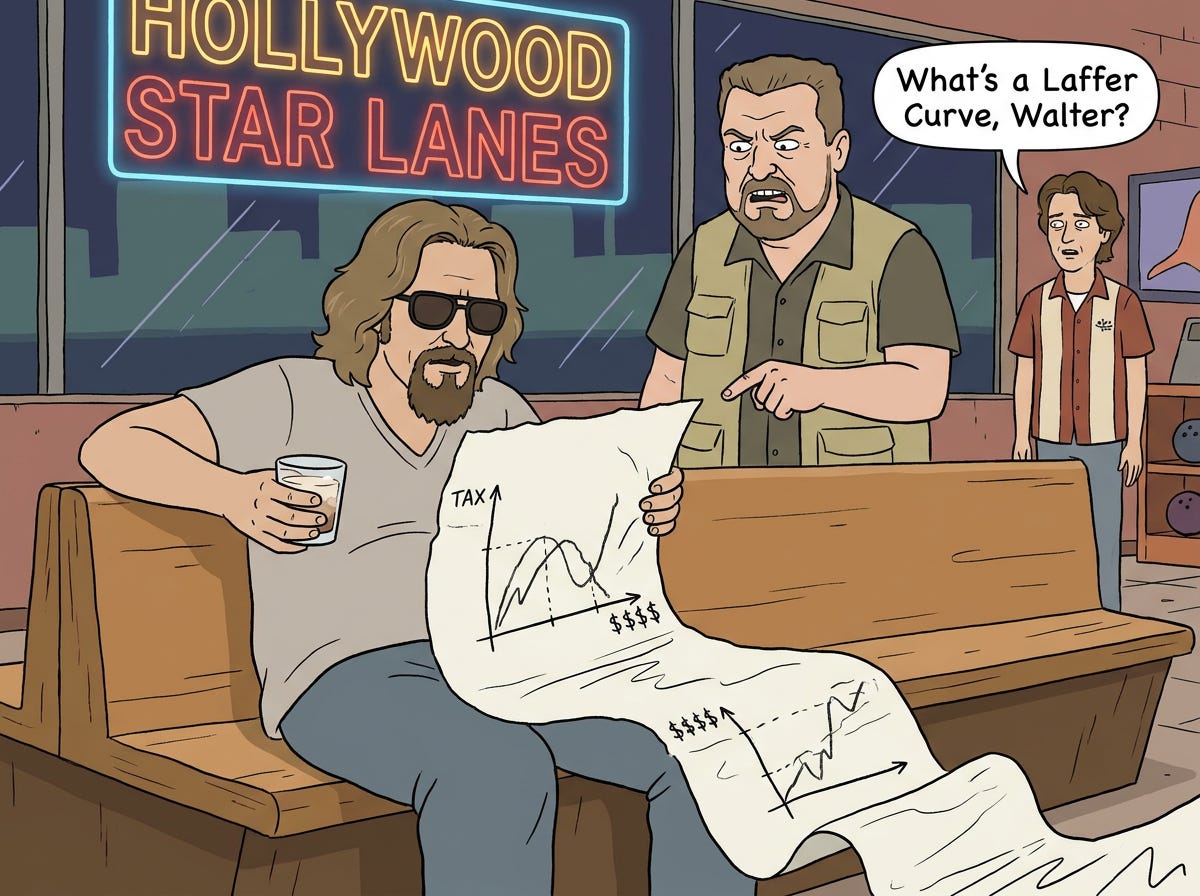
Man, I want to tell you something. I spent most of my adult life operating on this assumption — ambient, you know, like weather — that the Republican Party was the fiscally responsible party. The adults. The green-eyeshade guys who gave a damn about deficits and the grandkids and all that. Democrats spent money. Republicans kept score. I mean, everyone knew this, man.
Then I started checking the actual numbers.
And someone had peed on my rug.
The rug, obviously, was the idea that GOP fiscal conservatism was a governing philosophy rather than a branding exercise. And the people who peed on it — enthusiastically, repeatedly, over fifty years — were the exact same people who built the brand. Sit with that. Have a White Russian. Maybe two.
Let me walk you through it.
What’s a Pederast, Walter? (Or: The Theory That Sounds Better Than It Is)
The basic idea behind what got called supply-side economics — “trickle-down,” “Reaganomics,” or as George H.W. Bush memorably put it during the 1980 primary, “voodoo economics” — is not, like, insane on its face. Tax at zero percent, you collect nothing. Tax at a hundred percent, nobody works and you still collect nothing. Somewhere in between is the sweet spot. This is true. It is also approximately as profound as observing that you can’t finish a White Russian that doesn’t exist.
The sleight of hand — and it is a sleight of hand, man — is the additional claim that America was operating on the wrong side of that curve, meaning tax cuts would increase revenue by juicing enough economic activity to more than offset the lower rate. That part has never been proven. Wasn’t proven in 1974, wasn’t proven in 1981, has been substantially disproven by every budget scoreboard since.
But without that claim, “cut taxes on rich people” is a genuinely tough sell in a democracy. With it, cutting taxes on rich people becomes an act of almost saintly generosity toward the unborn.
How this went from “a thing Arthur Laffer believed” to “the foundational economic doctrine of the Republican Party” is a story that requires a hotel restaurant near the White House, a journalist with an agenda, and a party desperate enough to believe in magic. Walter, you are out of your element.
The Dude Did Not Abide: The Napkin Origin Story
December 4, 1974 — or thereabouts. The Two Continents Restaurant at the Hotel Washington, one block from the White House. Arthur Laffer sits down with Wall Street Journal editorial writer Jude Wanniski and a youngish Dick Cheney, then deputy chief of staff to Gerald Ford.
Ford had just proposed raising taxes to fight inflation. Laffer thought that was exactly wrong. To explain himself, he reportedly grabbed a napkin and drew a curve — tax rate on one axis, revenue on the other — to show how past a certain point, higher rates produce less, not more. Wanniski pocketed the napkin.
He would spend the next several years making it famous.
Here’s the thing though, man. Here’s the thing. Laffer himself has said he doesn’t actually remember drawing on any napkin that night. The famous cloth napkin now displayed at the Smithsonian’s National Museum of American History — the one they put behind glass like it’s the goddamn Declaration of Independence — is almost certainly a later recreation. It’s inscribed to Don Rumsfeld and dated September 13, 1974, even though the dinner is remembered as having happened in December. The original was paper; the Smithsonian’s is cloth. The date is wrong. The inscribed recipient may not have been at the dinner.
The foundational document of fifty years of Republican tax policy is, in all likelihood, a prop. Someone made it after the fact to commemorate a moment that probably happened differently than the legend says.
If that doesn’t tell you everything about supply-side economics, I don’t know what else to offer you, man.
The Man Behind the Curtain: Irving Kristol
“This is a very complicated case. You know, a lotta ins, lotta outs, lotta what-have-yous.”
The napkin — real or reconstructed — stays a curiosity without two guys who understood its political utility far better than its economics.
Jude Wanniski was the hype man. A Journal editorial writer with the instincts of a promoter, he spent years turning a footnote in monetary theory into a movement. In spring 1975, he published the first extended public treatment of what he called the “Mundell-Laffer Hypothesis” — the piece that put supply-side economics on the map for a political audience.
He published it in The Public Interest. The journal edited by Irving Kristol.
Now, Irving Kristol is not a household name — his son Bill Kristol is, the Weekly Standard guy, the Bush-era neocon warhorse who now spends his time explaining principled conservatism to anyone who’ll listen. The elder Kristol died in 2009, lauded as the “godfather of neoconservatism,” Presidential Medal of Freedom, the whole thing.
What Irving Kristol actually did is considerably more interesting and consequential than his reputation suggests. Because Kristol understood, with unusual clarity, that the GOP’s economic ideas in the mid-seventies were a political loser. The party stood for austerity, belt-tightening, responsible suffering. He wanted an affirmative economic agenda — something that promised growth and prosperity rather than root canals.
Supply-side economics was that something. Critically, Kristol’s support for it was explicitly political, not primarily economic. After platforming Wanniski’s article, he became a Journal columnist in 1976 and spent years advocating for supply-side ideas with a candor about his reasoning that is, in retrospect, remarkable — and kind of ballsy, man, I’ll give him that.
He argued that the political advantage tax cuts would provide Republicans was so historically imperative that they should be pushed through — and here I’ll just quote him directly, because paraphrase does not do this justice — “whatever the effect on the budget.” He wrote: “The neoconservative is willing to leave those problems to be coped with by liberal interregnums. He wants to shape the future and will leave it to his opponents to tidy up afterwards.”
Read that again, man. The guy who platformed supply-side economics, gave it its first major public audience, championed it in the Journal for years — he wrote explicitly and publicly that it didn’t matter what it did to the budget. That was the other team’s problem to clean up.
He also helped Wanniski publish The Way the World Works in 1978, the book that gave the whole project the appearance of serious intellectual grounding.
The Laffer Curve wasn’t discovered. It was deployed, by people who understood exactly what they were doing and were candid enough to write it down. The Big Lebowski had nothing on these guys — at least Lebowski kept the fraud mostly internal.
A Brief Word on Bill Kristol, Who Is Not Wrong But, You Know
“The bums lost.”
The Never Trump movement has produced some genuine intellectual honesty about what the Republican Party became and why. Bill Kristol has been consistent in his opposition to Trump in ways that cost him professionally, and I’m not here to take that away from him.
But Bill Kristol built his career editing The Weekly Standard, which enthusiastically championed the Bush tax cuts of 2001 and 2003, the Iraq War, and the broader apparatus his father spent decades constructing. The elder Kristol built the vehicle and wrote openly about not caring what it did to the national balance sheet as long as it delivered political results. The younger Kristol drove that vehicle for decades and is now expressing principled horror that someone else is behind the wheel.
He’s not wrong about Trump. But man — the inheritance deserves acknowledgment.
The Scoreboard (Because the Chinaman Is Not the Issue, the Numbers Are the Issue)
I’m going to dispense with further debate and just read the scoreboard, because at some point the numbers are the argument.
Reagan cut taxes in 1981 and again in 1986. The national debt tripled on his watch, from roughly $994 billion to $2.9 trillion. Revenues did not surge. Greenspan’s 1983 Social Security fix — a regressive payroll tax increase on working people — quietly patched part of the hole while nobody was looking at the rug.
George H.W. Bush, confronted with the actual fiscal consequences of Reaganomics, raised taxes in 1990. He was pilloried for it and lost his reelection partly as a result. The lesson the Republican Party drew from this experience was that fiscal reality must never again be permitted to intrude on fiscal fantasy.
Bill Clinton raised taxes in 1993. Republicans unanimously predicted economic catastrophe. The economy proceeded to generate four consecutive budget surpluses. Clinton left office with a projected ten-year surplus of $5.6 trillion. That rug really tied the room together.
George W. Bush converted that surplus into deficits with two tax cuts, two wars funded off-budget, and a Medicare drug benefit passed without a dollar of corresponding revenue. The structural deficit handed to Barack Obama was approximately $1.4 trillion.
Obama was lectured incessantly about fiscal responsibility by the people who created the deficit. The deficit fell every year of his second term.
Donald Trump signed a tax cut in 2017 that added an estimated $1.9 trillion to the national debt over ten years — in a growing economy, at full employment, when nobody needed stimulus. The deficit concern that had been deafening during Obama’s years went silent, man. Like someone flipped a switch.
The pattern is not ambiguous. Fiscal concern is a weapon deployed against Democratic spending on things that benefit working people and suspended for Republican tax cuts that benefit capital. This has happened so consistently across so many administrations that calling it coincidence requires a credulity I am simply unable to bring to the table.
The God, Guns, and Gays Rug-Pull
Here’s the thing the scoreboard alone doesn’t explain: why did it work?
Supply-side economics was always, at best, elite self-interest dressed up in the language of public benefit. “Cut taxes on wealthy individuals and corporations and the prosperity will trickle down to everyone” should not resonate with voters who are not wealthy individuals or corporations. And yet it became the dominant economic doctrine of a party that wins elections.
The answer is coalition architecture. The donor class — the capital class, the country club Republicans who wanted lower taxes on their investment income — needed votes they couldn’t win on the merits of their preferred tax policy. So they assembled single-issue constituencies around entirely separate motivating concerns. Evangelical voters who cared about abortion and school prayer. Gun absolutists. Social conservatives who felt America was slipping away from them culturally.
None of these people voted for supply-side economics. They voted for God, guns, and national identity. The tax policy rode along as cargo, transferring wealth upward with each legislative cycle while the base was focused on the culture war.
“Fiscal responsibility” served a specific function in this arrangement — it gave the donor class and the suburban professionals an identity marker that felt principled rather than self-interested. We’re not just cutting our own taxes, man. We’re the responsible adults. The branding was essential precisely because the underlying policy was indefensible without it.
The tell — the moment you can see the whole machinery for what it is — came with the Tea Party. A genuine grassroots movement, animated at least partly by real deficit anxiety, that directed its outrage entirely at Obama’s spending and then went completely silent when Trump ran deficits that made Obama look like a miser. The fiscal concern was never principled. It was tribal. It activated against the wrong team and suspended for the home team, just as it always had.
Walter, I think you’re wrong. But also, kind of, you’re the whole problem.
This Aggression Will Not Stand, Man. Also, Nobody Is Cleaning Up.
The intellectually honest response to fifty years of supply-side failure would have been a reckoning. The economics profession largely delivered one — mainstream economists across the political spectrum have concluded the revenue-neutral tax cut is a myth at the rates the United States actually operates. The empirical record is brutal.
What happened instead is the intellectual scaffolding quietly rotted away while the political conclusions stayed in place. The 2017 tax cuts were nominally sold on supply-side grounds, but the revenue projections were embarrassing even by the standards of previous supply-side promises. Nobody serious believed them. The argument had quietly shifted from “this will pay for itself” to something closer to “tax cuts are good, always, because they are, shut up.”
Irving Kristol said the quiet part out loud: the fiscal consequences were a problem for the other party to sort out. What came after him was the same policy minus the self-awareness — just the cuts, the deficits, and the convenient amnesia.
The rug really did tie the room together. The thing is, the room it tied together was built on the explicit understanding that somebody else would eventually have to clean it.
The Dude abides. The deficit, less so.
A description of supply side economics(“trickle down”) in the Gilded Age was the horse and sparrow or horse and oats theory/joke. The theory was that if you fed a horse enough oats, eventually the birds or the flies got some. I think it’s rather amusing. It might be better understood by much of the public.