

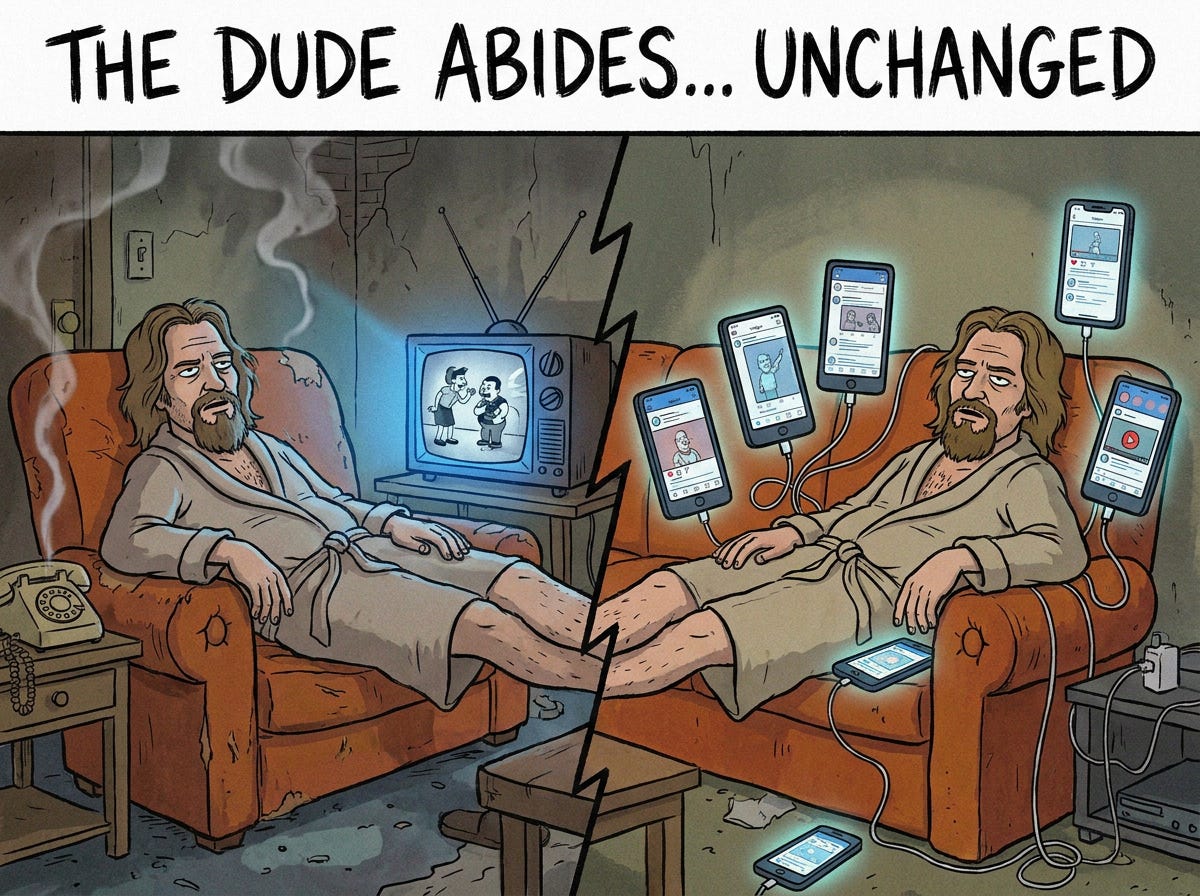
Guy at the gas station is going on about media literacy. Not to me, just out loud, to the pump, the way people process podcasts now. Somebody with a mic and a take had him rattled. Everybody’s dumber than they used to be, apparently. Can’t separate spin from fact. There was a time, supposedly, before all this, when the electorate had its shit together.
I’m standing there with a squeegee thinking, man, when.
Because I’ve read some history, and the American public’s relationship with the truth has never once resembled a functioning marriage. It’s always been more of an arrangement. Hamilton had a paper. Jefferson, annoyed, went and bought his own paper specifically to call Hamilton a liar in print, which is a genuinely baller use of early republic money. That’s not bias slipping into the news. That’s two guys paying to have the news say what they already believed, on purpose, in public. Yellow journalism helped talk the country into a war over Cuba because it moved copies. “Objectivity” as a journalistic value didn’t arrive because Americans demanded fairness. It arrived because the wire services needed copy that Republican and Democrat papers alike would pay to run without either one canceling the subscription. Neutral tone was a distribution hack wearing a trench coat and calling itself an ethic.
So the golden age everybody’s nostalgic for, Cronkite, the Big Three, the fairness doctrine, wasn’t the public getting sharp. It was the public getting a smaller menu. Three networks run by roughly the same eight guys in roughly the same building told you roughly the same story every night, and when there’s only one story on offer, not falling for spin doesn’t require any skill at all. It requires attendance. That’s not literacy. That’s a captive audience mistaking consensus for competence, and mistaking Walter’s voice for the sound of being informed. It’s the same move as looking at somebody’s art, being told it’s about something bigger than what’s literally in front of you, and nodding along because the person explaining it seems awfully sure of herself. Doesn’t make the art dishonest. Doesn’t make you wrong to nod. Just means “objective” and “curated by people with a very specific idea of what mattered” turned out to be the same rug the whole time, and nobody checked underneath it.
Lippmann figured this out in 1922, before television existed, arguing that expecting regular people to track world affairs directly instead of through a middleman’s summary was never a reasonable ask. Forty years later some poor political scientist actually surveyed the electorate and discovered most people’s political opinions don’t even connect to each other in any coherent way. Not new information. Just repeatedly rediscovered, like a rerun nobody remembers watching.
Here’s the part that’s actually bad news, and I mean the actual news, not the guy at the pump’s version of it. The public’s discernment was never good. It was subsidized. Three gatekeepers did a first pass on the information before it ever reached you, and however compromised that pass was, it was still a pass. Now there’s no pass. Everybody’s an outlet, the algorithm doesn’t care if it’s true, it cares if you stayed, and the exact same mediocre, historically unremarkable level of public discernment that always existed now has to do the whole job alone, with no wire service quietly filtering upstream. It’s not that the guy got dumber. It’s that they took the training wheels off a bike he was never actually that good at riding and called the resulting crash a character failure.
Anyway. Man’s out here mourning an era that mostly worked because there was nothing else on.
The Dude abides.