

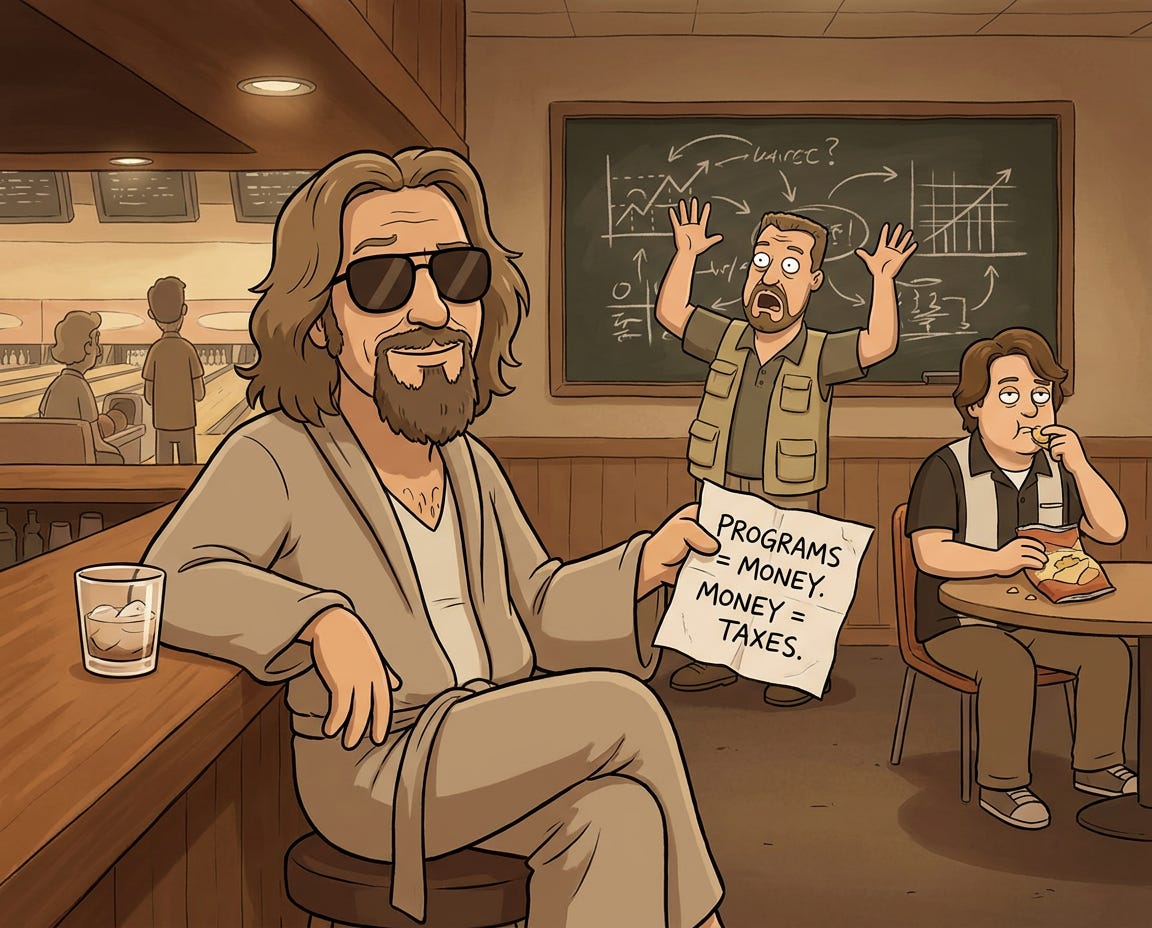
Okay so this one’s been rattling around in my head for a while and I need to get it out before I forget it, because I had a genuinely good thought and that does not happen every day and I want to honor it.
It’s about the rug.
Stay with me.
The Rug
My rug tied the room together. You know this. Everybody knows this. It was the organizing principle of the whole space — it didn’t do anything flashy, it didn’t make a statement, it just made everything else in the room make sense. Things cohered because the rug existed.
And then someone peed on it.
And I spent the entire rest of the movie trying to get a new rug from a guy who turned out to be a fraud.
This is basically the story of fiscal responsibility in American politics. Just swap out the rug for the idea that your government should roughly pay for what it spends. Not exciting. Not ideological. Just the thing that makes everything else cohere. And then a series of people peed on it. And now we argue about the pee instead of getting a new rug.
The Confusion Begins
Here’s where I want to be careful, man, because I spent years calling myself fiscally conservative and I thought I knew what that meant. I wanted robust social programs — healthcare, education, the whole thing — AND I was willing to pay more taxes to fund them. That seemed conservative to me, in the small-c sense. Responsible. Sober. Don’t spend what you don’t have.
What I did not realize is that literally nobody on the actual fiscal right meant anything like this. And I mean nobody.
When Republicans say “fiscal conservative,” they mean: cut taxes, and also the deficit is bad. These two positions are held simultaneously without apparent distress, which requires either not doing the math or being extremely committed to the Laffer Curve1, which is the economic theory that says cutting taxes actually raises revenue, which is the kind of thing that sounds great on a cocktail napkin and has been, let’s say, uneven in practice.
The tell — the thing that reveals the whole game — is what happens to deficit concern when a Republican president signs a tax cut. It just... evaporates. Disappears completely. Poof. And then a Democrat gets elected and suddenly we are gravely concerned about what we are leaving our grandchildren.
They do not care about the deficit. They care about spending. Specifically, spending on things that help people who aren’t already doing great. That’s the actual position. The deficit is just the rhetorical delivery mechanism.
The Libertarian Thing
Donny wanders over at this point, bowl of chips in hand.
“What about the libertarians? They’re consistent, right?”
And honestly, points for showing up with an actual question, Donny.
The libertarians are at least honest about their premises. Taxation is theft, the state is force, and the whole edifice should be burned down or at least radically shrunk. I don’t agree with this — I think it’s kind of unhinged, man, I’m sorry — but it’s at least a coherent position you can argue with.
The problem is that the taxation-is-theft position tends to have some very selective blind spots. Defense spending, fine. Police, fine. The court system that enforces your property rights and makes your contracts mean something, fine. The legal and regulatory infrastructure that makes your business worth owning, fine. But the part where your tax dollars might pay for someone else’s insulin — TYRANNY.
It’s freedom philosophy that somehow always ends with the same people keeping their money.
Walter, who has been loudly drinking a beer throughout this conversation, says: “Three thousand years of beautiful tradition, from Moses to Sandy Koufax, and you’re telling me these guys think roads are theft?”
I tell him to calm down and he says he is calmer than I am.
Why Democrats Are Always On Their Heels
So here’s the thing that really burns my hash browns, man.
Democrats are actually better on this. Like, empirically. Democratic administrations have better deficit records than Republican ones, historically. Clinton ran surpluses. Obama inherited a catastrophe and brought the deficit down. The Reagan deficits were massive. Bush cut taxes and started two wars without paying for either. Trump cut taxes and blew it up again.
This is not obscure information. It’s just sitting there.
And yet somehow the Republicans own the “fiscal responsibility” brand, and Democrats are perpetually on defense, explaining themselves, apologizing for spending, accepting the terms of the argument as if they were handed down from the mountain.
How does this happen?
I’ve thought about this a lot. Possibly too much for a guy whose main hobby is bowling.
Part of it is that Republicans are completely unashamed. They run up the debt, then point at the debt, and somehow it sticks. Brazenness is underrated as a political tool. Democrats keep bringing careful policy documents to a vibes fight.
Part of it is that Democratic politicians genuinely internalized the Republican frame during the nineties. The Clinton triangulation era wasn’t just strategy — some of them actually started believing the deficit hawkishness as a moral position. So when Republicans attack, some Democrats start nodding along, which is a hell of a look.
And part of it is that paying for things is a harder sentence to say than cutting taxes. “We’re going to spend money on this and here’s where the money comes from” is a longer, more complex, less satisfying statement than “we’re giving you your money back.” The bumper sticker problem is real, man. I don’t love it, but it’s real.
The Position That Has No Home
But here’s what really gets me.
My position — I want the programs, and I’ll pay more taxes for them, and I believe those are two halves of the same sentence — has no political home in America.
It’s too demanding for the right (you want to actually fund things, which means taxes don’t only go down). And it sometimes creates friction with parts of the left, because “we need to pay for this” has been used in such bad faith for so long by people who just wanted to kill the program that even the reasonable version of the argument smells suspicious.
So you end up rhetorically orphaned. Calling yourself fiscally conservative because it’s the closest available label, even though what you mean is something closer to accountable. Or honest. Or just someone who can do fractions.
I don’t know, man. I’m going to make another White Russian and think about it.
The Dude’s Bottom Line
The Republicans do not care about deficits. The evidence for this is abundant and recent and they don’t particularly try to hide it. The concern appears exactly when Democrats hold the presidency and disappears like smoke when Republicans do.
The Democrats, meanwhile, have spent thirty years accepting a frame that was designed to hobble them, fighting on terrain they didn’t choose, apologizing for wanting a society that works.
Someone peed on the rug of honest fiscal argument a long time ago. The Democrats keep asking politely for a new rug from people who are just going to pee on that one too.
At some point you gotta stop asking the Pasadena Lebowski for a rug.
He didn’t even have the money. It was Maude’s all along.
The Dude abides.
it should be noted that Irving Kristol, father of Never Trumper icon Bill Kristol, gave a platform to Arthur Laffer in the late 1970s, and helped usher in that fucking insane “trickle down” bullshit.
Yup
Across the board
I truly don’t understand how and why the Democratic Party - broadly, with some notable exceptions - ceded this argument so completely
It’s like they’ve become utterly terrified of their own shadows.
They *know* the case, they can *make* the case - they just seem some combination of unwilling or unable to *make* the case
The last time we really even came close was under Clinton, until that whole blue-dress thing shut him down
Obama had great instincts, but didn’t have people on the ground or in Congress who could explain or defend it at the grass-roots level
My take? They play waaaayyyy too nice, against an opposition who not only pees on the carpet but then looks you dead in the eye and says “nope, wasn’t me, and even if it *was* me, whatchagonnadoboutit?”