

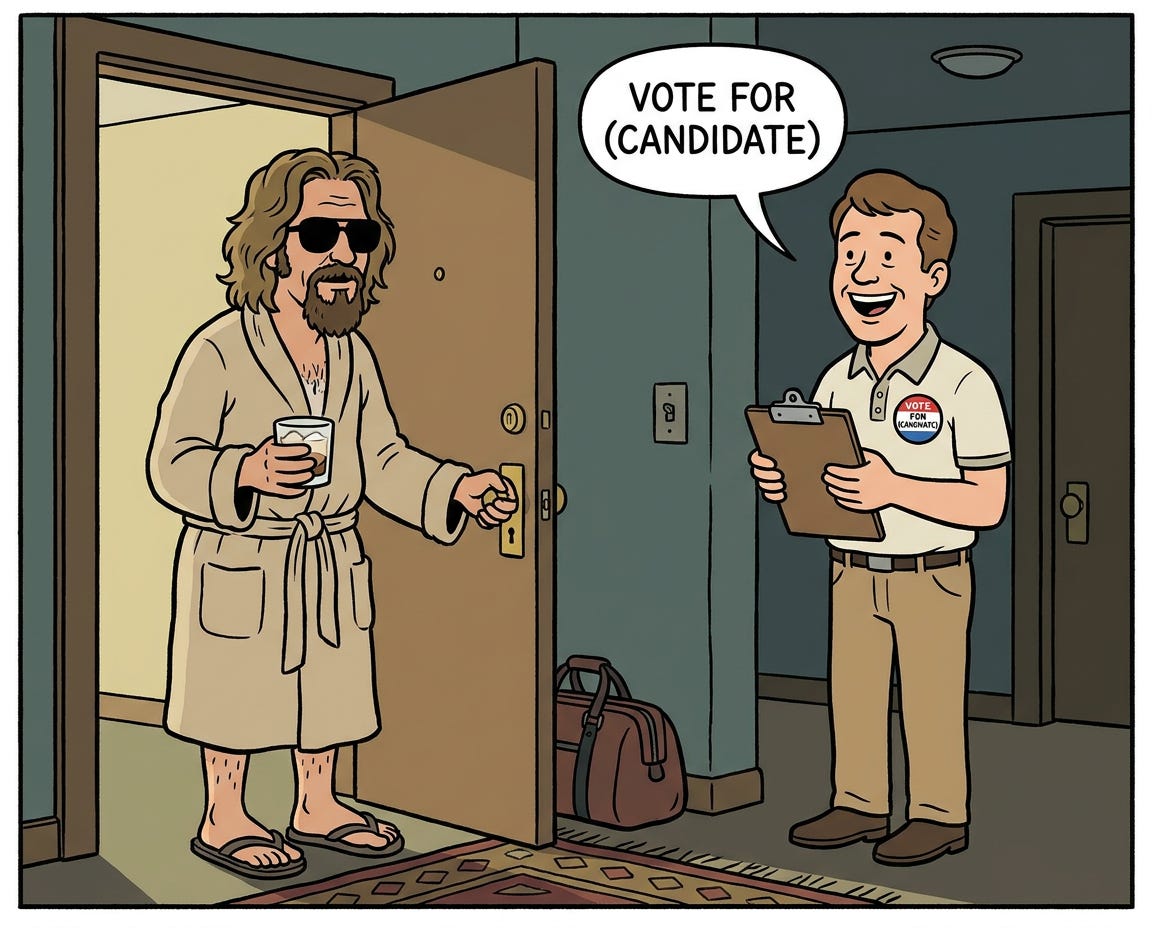
So there’s this observation going around — and I want to get into it, man, I really do, just let me, uh, just let me find my... okay. So a reader dropped a comment on the brand repair thing — bees are back on the lavender, which, far out — and the argument is basically: Democrats do better when they reject corporate money and run clean. Small dollar. Grassroots. The whole thing.
And look man. I want that to be right. That argument really ties the room together.
But, it doesn’t tie the room together.
The Data, Man. The Data Does. Not. Care.
Let’s talk about Amy McGrath and Mitch McConnell, 2020, because this is like... this is the cleanest test case available and it is, if you’ll pardon the expression, a real bummer.
McGrath outraised McConnell — twelve point eight million to his seven point eight in the first quarter. Sixty-three percent of her money came from small donors. McConnell, that human bowling ball, was over there leaning on PACs and his colleagues’ piggy banks, with small donors at like sixteen percent. She raised a record ninety-four million dollars. Ninety-four. For Kentucky.
She lost by twenty points.
Twenty. Points.
McConnell — and the Dude ain’t making this up — said on election night, “at the risk of bragging, it wasn’t very close.” The man totally bragged about it. That’s like... that’s like your opponent ordering a White Russian at your wake and pissing on the flowers, man. And he got to do that because the rug — the whole beautiful small-dollar-grassroots rug — did not tie the room together. The room was Kentucky. The rug was from California. Ninety-six percent of her donations came from out of state.
Beto, Man. We Gotta Talk About Beto.
The Beto/Cruz thing in 2018 is a little more complicated because Beto actually came close. No PAC money. Thirty-six point eight million more than Cruz through mid-October. Did the 254-county tour. Got Beyoncé. Got Willie Nelson.
Lost by two point six percent.
Which is, in Texas terms, like rolling a 299. You’re so close, man. And it’s still a loss.
And here’s where it gets weird, because that near-miss has been claimed as evidence for three completely contradictory lessons, and the partisans of each one will absolutely come at you in the comments.
The Bernie Bro read: Beto proved grassroots energy can compete anywhere, and if he’d just been more progressive instead of like, centrist-in-a-Whataburger-hat, he would’ve won.
The Lincoln Project / Rick Wilson read: Beto proved the exact opposite. Democrats in red states need to not scare the squish voters, man. The Never Trump theory of everything: Democrats are always too liberal and the solution is always drift right until you find the crossover voters. Wilson wrote a whole book about it. Brass knuckles. Very confident. Possibly wrong.
Beto’s own read, on PBS of all places: the progressive-versus-moderate frame is the wrong axis entirely. Voters want a party that fights. Spine versus capitulation, not left versus center.
All three of these have something real in them. All three are also, in their pure form, a way to avoid saying the quiet part out loud: in Texas in 2018, no Democrat was probably going to win, and the lesson is mostly about geography. That’s it. That’s the lane.
And here’s the thing that really fries the brain, man — O’Rourke was rated a centrist Democrat, more centrist than three-quarters of his own caucus. So if a moderate fucking Democrat, running on principles without PAC money in a state genuinely in demographic flux still couldn’t close it, what exactly is the Wilson camp’s prescription? Drift further right until you’re functionally a Republican? That’s not a theory of winning. That’s a theory of, like, ceasing to exist as a party. That’s the Dude giving up bowling, man. What’s even left?
The Door-Knock Problem Is Not a Small Problem
There is this belief — call it the Bernie Bro Axiom, and I say this with some affection — that progressive ideas are broadly popular, that voters respond to them one-on-one, and the only thing standing between Democrats and a durable majority is the cowardice of party leadership and the corrupting influence of corporate money. You’ve seen it argued on political Twitter. Caps lock. Very confident. Sometimes correct about the wrong things.
There’s even data for part of it. Medicare for All has shown majority support in national polls. Minimum wage increases poll well even in red states. Paid family leave polls well everywhere. You knock the door, you walk through the policy, the voter nods. The conversation goes fine.
The ballot box is a different universe, man. A different universe.
A Third Way1 poll of Blue Wall states found that in no state did a Medicare-for-All Democrat beat Trump — down four in Michigan, down one in Pennsylvania, tied in Wisconsin. A Democrat running on building off the ACA won Wisconsin by six and Pennsylvania by two. Those are the states. That gap is not a rounding error.
Now yes, Third Way is a centrist outfit with its own institutional lean, and you can frame poll questions to get different answers, and I get it, man, I get it. But here’s what isn’t debatable: Sanders ran on Medicare for All in 2020 and lost the primary badly to a guy who explicitly opposed it. In a Democratic primary. Which skews younger, more educated, more progressive. He could not close it. His post-2024 statement was that a party that abandoned working people would find working people had abandoned them. That’s a coherent critique. It is not a coherent explanation for why he specifically couldn’t win the primary, which is the inconvenient part that tends to get quietly rolled away like a body in a rug nobody wants to look at.
The uncomfortable truth: the door-knock and the ballot box are measuring different things. The door-knock measures what people say they want when a real human being who clearly gives a shit is standing in front of them. The ballot box measures what people do when they’re alone in the booth and nobody’s watching. Those diverge. They diverge most on policies that sound great in the abstract and feel risky when you actually have to pull the lever.
Medicare for All is the canonical example. “Government covers everything” — people nod. “You give up your employer plan and pay more in taxes” — support drops. “Government runs it” — drops further. The policy is popular in the version that lives in people’s heads. The actual policy, with transition costs and tax implications and coverage disruption, is more complicated, and complicated things lose elections when your opponent has unlimited money to make them sound scary. He’s not wrong. He’s just an asshole. But also the money matters.
The 2024 ballot measures make this concrete, man. Alaska and Missouri — both went for Trump — approved minimum wage hikes and paid sick leave. Blue Massachusetts voted down a measure to raise the minimum wage for tipped workers. Florida had 57 percent for abortion rights in the state constitution, which would’ve been a landslide anywhere else, but fell short of the 60 percent threshold. Voters will check the box for fifteen bucks an hour and then vote for the guy who opposes it. “Run on the right policies” and “win with the right candidate” are not the same operation. Conflating them is how you stay in the comfortable loop: knocking doors, winning conversations, losing elections, smoking a bowl, and blaming the wrong things for it.
The Small Dollar Fantasy Is, Uh, a Fantasy
The math problem here doesn’t get enough scrutiny, man.
McGrath. Again. You can flood a Kentucky Senate race with ninety million dollars from fired-up Democrats in California and New York — and she did, with 96 percent of donations from out of state — and the structural dynamics of a state Trump won by 26 points do not give a damn. The people donating were not Kentucky voters. The enthusiasm was real. The enthusiasm was just not located in the right zip codes.
Voters in Kentucky are not withholding their support from Democrats because Democrats take PAC money. They’re withholding it because they don’t like Democrats. That is a different problem. It requires a different solution. And no fundraising philosophy — however pure, however principled, however many small donors roll a strike — closes that gap.
So What Actually Works
Honestly? Locally. Incrementally. Things that look nothing like national movements and make terrible soundbites.
The 2025 Virginia and New Jersey governor’s races offered something worth noting. Swing voters who backed Trump in 2024 crossed over for Abigail Spanberger and Mikie Sherrill — both ran as deliberate moderates who consciously transcended the national Democratic brand. The consistent voter refrain: reject the extremes, give us someone who can actually do the job. That’s not a progressive vision. It’s not a Never Trump vision. It’s a candidate quality argument. Boring. Correct. Impossible to nationalize. Makes for terrible TV.
Beto came close because Texas was actually already in motion. The demographic shifts were real, the suburban realignment was happening, and he caught a wave.
The small dollars came because it was close. The closeness didn’t come from the small dollars.
McGrath raised more money from more people in a state going the other direction, and it didn’t matter because the state wasn’t in play.
The comforting fiction is that running principled on campaign finance is a strategy. It isn’t. It’s a preference. A legitimate one — I’m not here to tell you it’s wrong to want clean money in politics. But mistaking a preference for a path to electoral success is how you feel good about losing.
And Democrats, man — and I say this with love — have gotten dangerously good at feeling good about losing.
The Dude abides. The structural disadvantages, unfortunately, also abide.
Drop a comment. Or don’t. That’s just, like, your opinion.
those fuckers need to be a focus of a shitpost… Third Fucking Way my ass
Nailed it again - I’m lifting a glass to you as we speak (G&T, in my case, though)
What I hope to see in upcoming elections are candidates who can speak candidly and directly on both “umbrella goals” and the nuts-and-bolts of actual governance *in ways that fucking resonate with the people doing the actual voting*
Who are willing to not cede the rug - the terms of the discussion - to their opponents
Who can get nose to nose, be direct, be rude if they have to, again in ways that matter *locally*
Ffs