

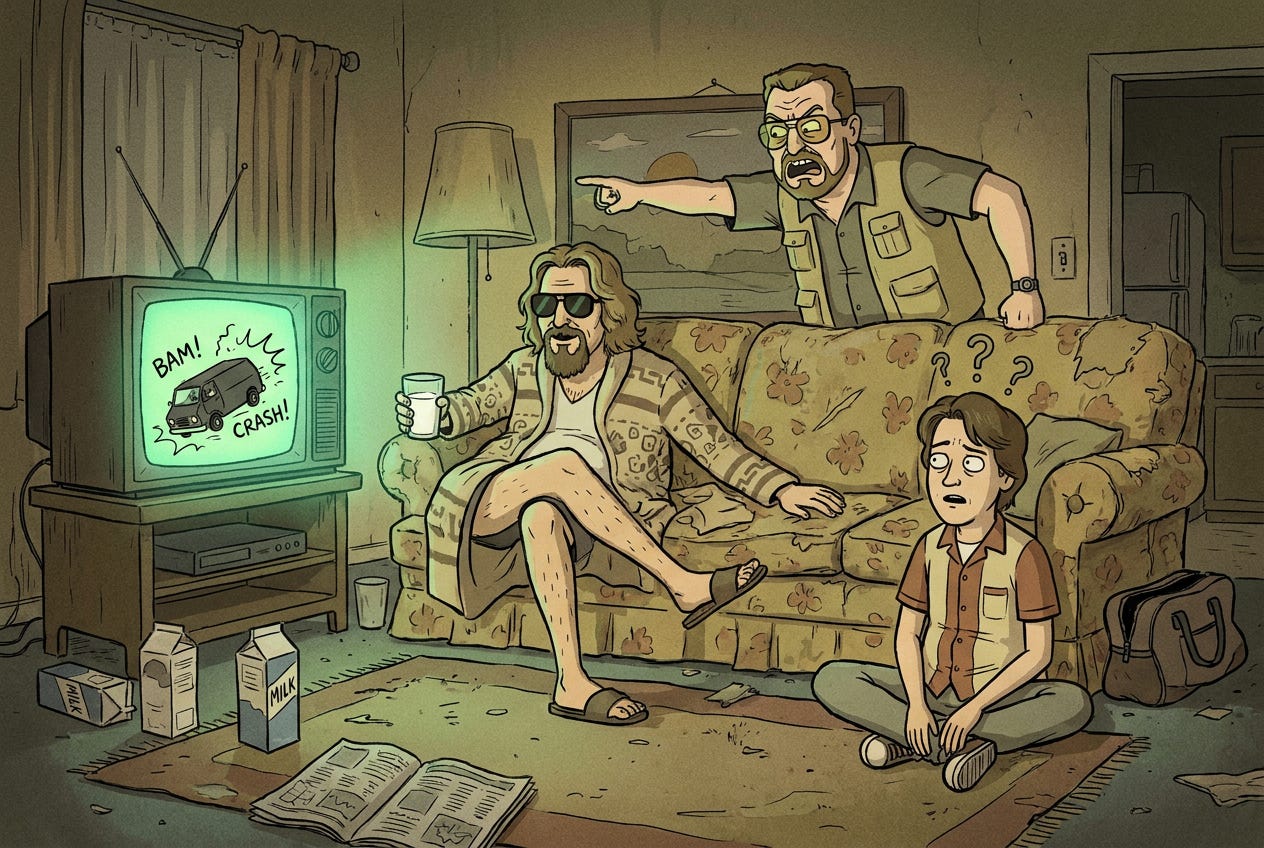
So it’s a Thursday afternoon, right, and I’ve got a White Russian going, and I’m not going anywhere, and Amazon Prime just sort of... offers you The A-Team. Seasons one and two. Right there. Like it’s nothing.
And look, man. The rug is gone. We’ve been over that. But the TV ties the room together now, and sometimes that’s enough.
I put it on. I’m not proud. I’m also not not proud. It’s just television, man — the kind that doesn’t ask anything of you. It doesn’t want you to feel things. It doesn’t want to interrogate your assumptions. It wants you to watch a van full of mercenaries improvise a mortar launcher out of a drainage pipe and some old tractor parts, and it wants you to enjoy that, and then it wants you to go to bed.
There is a place in the ecosystem for that.
Stephen Cannell Cracked The Code And Did Not Give A Single Damn
Here’s the thing about The A-Team that took me maybe forty-five minutes of horizontal viewing to fully appreciate: the formula isn’t laziness. The formula is the product.
Stephen Cannell had already figured this out with The Rockford Files. He understood something that a lot of television people never learn, which is that audiences don’t actually want innovation. They want competence. They want to sit down, know what they’re getting, and get it. Delivered on time, no assembly required.
So here is what you get, every single episode, without variation or apology:
Someone has a problem with malefactors. They track down The A-Team. Hannibal Smith appears in a disguise that would not fool a golden retriever — we’re talking a hat, maybe some glasses, possibly a fake mustache that is doing its absolute best. There’s usually a pretty woman involved in the setup, which we’ll get to. The mission gets accepted. Hijinks ensue at volume. Gunfire erupts — so much gunfire, man, so much — and through some miracle of television physics, nobody actually dies. There’s a MacGyver moment involving available materials and implausible engineering. Everybody’s happy. Face doesn’t get the girl.
Roll credits. Next episode. Same thing.
Cannell ran this for eight seasons. Eight. He was not embarrassed. He was, if anything, correct.
Walter Has Thoughts About The Weapons
Walter had been sitting in the corner for about two episodes. Silent. Watching. I could feel something building.
It broke loose somewhere in the middle of Season One.
“The Mini-14s are stainless, Dude.”
I told him I didn’t know what that meant.
“Stainless steel. You know what’s stainless steel? Cookware. A kitchen sink. Not a military-pattern rifle. Not something a combat unit would carry. You know what the military uses? Blued steel. Flat. Dark. Doesn’t catch the light. Because if your rifle is catching the light, Dude, someone is shooting at the light.”
He was not wrong. The A-Team’s prop department was running Ruger Mini-14s as stand-ins for military M16s — similar enough silhouette to pass in a medium shot, cheap enough to source in the early ‘80s when surplus M16s were floating around but not exactly lining up at the prop house door. And they are, in fact, deeply, obviously stainless. Shiny. You could cook eggs on the aesthetic.
“Anyone who has ever been in a field environment — and I mean anyone, Dude, I’m not asking for much here — looks at that rifle and immediately knows. This is not ‘Nam. This is not even a serious attempt to represent ‘Nam. There are prop budgets.”
“Donny, you’re out of your element!” he added, even though Donny had not said anything yet.
“What’s wrong with stainless steel?” Donny asked.
Walter turned very slowly.
We moved on.
The Roll Cage That Launched A Thousand Episodes
Here’s another thing you start to notice if you’re watching with any level of attention, which I’ll admit is a variable proposition from my end of the couch.
Cars flip in The A-Team. Constantly. Jeeps, trucks, vans, various military-adjacent vehicles — they go airborne, they roll, they land on their roofs, everybody climbs out fine. Very cathartic.
What you eventually clock is that it’s the same roll cage. One reinforced stunt rig, shot from different angles, at different speeds, dressed up differently depending on what the scene nominally requires. The stunt team found their easy button somewhere around episode three and pushed it with confidence for the remainder of the series.
And man, I can’t even be mad about it.
You build a thing that works. You use it until it stops working. You don’t overthink it. That’s not corner-cutting — that’s a philosophy. That’s the show abiding. If the stunt rig photographs as “vehicle doing something dramatic,” then the stunt rig has done its job, and what more do you want from a stunt rig.
Modern television would spend six months in pre-production on that stunt and deliver something that looks worse because everyone was too worried about being impressive to just let the thing roll.
George Peppard Understood The Assignment
Let’s talk about the cigar.
George Peppard — who was, for the record, a legitimate working actor before all this, in Breakfast at Tiffany’s opposite Audrey Hepburn, in The Dirty Dozen with Lee Marvin1, in a bunch of other things that people have mostly forgotten — understood something fundamental about playing Hannibal Smith.
The cigar is business. It’s something to do with your face and hands while you’re delivering a line. It’s a visual signature that reads across the room, across a thirty-inch 1983 television screen, across forty years of syndication. You are always watching a man who has a cigar. You always know which man that is. The cigar does not require explanation.
The disguises are a companion piece to this. Hannibal’s covers — a different hat, sometimes glasses, on ambitious episodes a fake accent — would not deceive a mildly attentive child. The show knows this. The show does not care. The disguise is a ritual, a formal beat in the episode structure, a moment where everyone agrees to pretend. Peppard plays them completely straight, which is the only correct choice.
By the time The A-Team came along, Peppard was in his mid-fifties and Hollywood doesn’t have a lot of parts for men in their mid-fifties that don’t involve dying meaningfully in the third act. Seven years of steady work as the lead of a hugely popular show, playing a character with a great cigar and a catchphrase about plans coming together?
Man. That’s not settling. That’s landing.
Maude Has Notes On The Rotating Babe
Maude had been in the doorway for a while. I hadn’t noticed. I was on my second White Russian.
“The female character exists in one of two states,” she said, without being asked. “She is either the client — a narrative object whose function is to present the problem and then be grateful for its resolution — or she is briefly competent, at which point the show becomes visibly uncomfortable and resolves the discomfort by having Face attempt to flirt with her.”
I said that seemed about right.
“The episodes where a woman is integrated into the team as a functional member are interesting precisely because the format doesn’t know what to do with her. The hierarchy is disrupted. Hannibal has to manage instead of just lead. The implicit social contract of five men in a van is suddenly negotiable. The show finds this alarming and resets at the end of the episode.”
She was not wrong. The A-Team runs a rotating guest babe — client, client’s daughter, journalist, occasionally someone who can actually fight — and the show’s relationship with that character is always the same anxious dance. She’s there. She’s useful. Face is interested. The episode ends and she evaporates, because a permanent female presence would require the show to actually reckon with its own dynamics, and nobody in 1983 was paying Stephen Cannell to do that.
Maude went back to her studio. Walter started to say something. Thought better of it. Took a handful of chips.
B.A. Will Not Get On The Plane, Man
The first time B.A. Baracus refuses to fly, it’s character. You understand this man. His fear is real, his dignity is intact, and the team’s elaborate scheme to get him on the plane anyway is funny because it’s unexpected.
The fourth time, it’s furniture.
By mid-Season Two, the B.A. won’t fly gag has calcified into a format obligation. The show isn’t doing it because it’s funny. The show is doing it because B.A. not flying is now a contractual commitment to the audience, like Hannibal’s cigar or Face not getting the girl. You check the box, you move on.
Donny wanted to know why B.A. couldn’t just drive to wherever they were going.
Walter explained, at length, why that was not the point.
“But it seems like it would solve the problem,” Donny said.
There was a pause.
“Donny,” Walter said, very quietly. “You are out of your element.”
Donny nodded like this answered his question. Maybe it did.
A Brief Note On Mr. T And The Epistemology Of Campus Mythology
I went to school. I knew people. And in the early ‘80s, if you were on a California campus of any size, you knew someone who knew someone who had definitely, personally, run into Mr. T somewhere in the vicinity of the campus.
Nobody could prove it. Nobody could disprove it. That was the whole architecture of the thing.
Pre-internet, man. You could tell a story at a party and it just lived there. Nobody was going to go home and check. The only way to challenge the claim was to look like you were doing research to debunk someone’s social life, which makes you the weird one. So the story survives. It gets repeated. It becomes campus mythology.
Mr. T was, in the early ‘80s, genuinely everywhere — television, movies, cereal boxes, a public presence of almost radioactive intensity. Placing him at your campus required minimal imagination and zero accountability. The “I ran into Mr. T” story was social currency of the highest denomination: specific enough to be interesting, unverifiable enough to be safe.
The Dude respects the hustle. The Dude has told some stories himself.
(Mr. T went to North Carolina A&T, for what it’s worth. Which is worth approximately nothing to the guys who definitely met him at your school.)
The Dude Abides With The A-Team
Look. Not everything needs to be Chinatown.
Some things just need to be a van full of guys who shouldn’t work as a unit but somehow do, building a tank out of available materials in forty-five minutes, firing approximately ten thousand rounds at a small army of goons, and somehow — somehow — arriving at an ending where everybody the show likes is standing up and nobody has to deal with consequences.
There’s a reason people watch this forty years later on a Thursday afternoon with a White Russian. It’s not irony, man. Or it’s not only irony. There’s something genuinely pleasurable about a thing that knows exactly what it is, commits to that completely, and asks nothing of you in return except your attention and your willingness to agree that yes, that roll cage flip was impressive, even if it was the same roll cage as last week.
Stephen Cannell figured something out. Hannibal always had a plan. The plan always came together. Nobody ever really got hurt.
Sometimes that’s enough, man.
The Dude abides. And apparently so does The A-Team.
— Jeffery Lebowski, Reseda, CA
Alas, my original source for Peppard being in The Dirty Dozen was lying to me. He wasn’t. The Dude apologizes!
The A-Team is the popcorn movie of television. You watched it because it was fun and a good time-killer.
Dude, for your information, the Internet Movie Database has roundly denied that George Peppard appeared in The Dirty Dozen….