

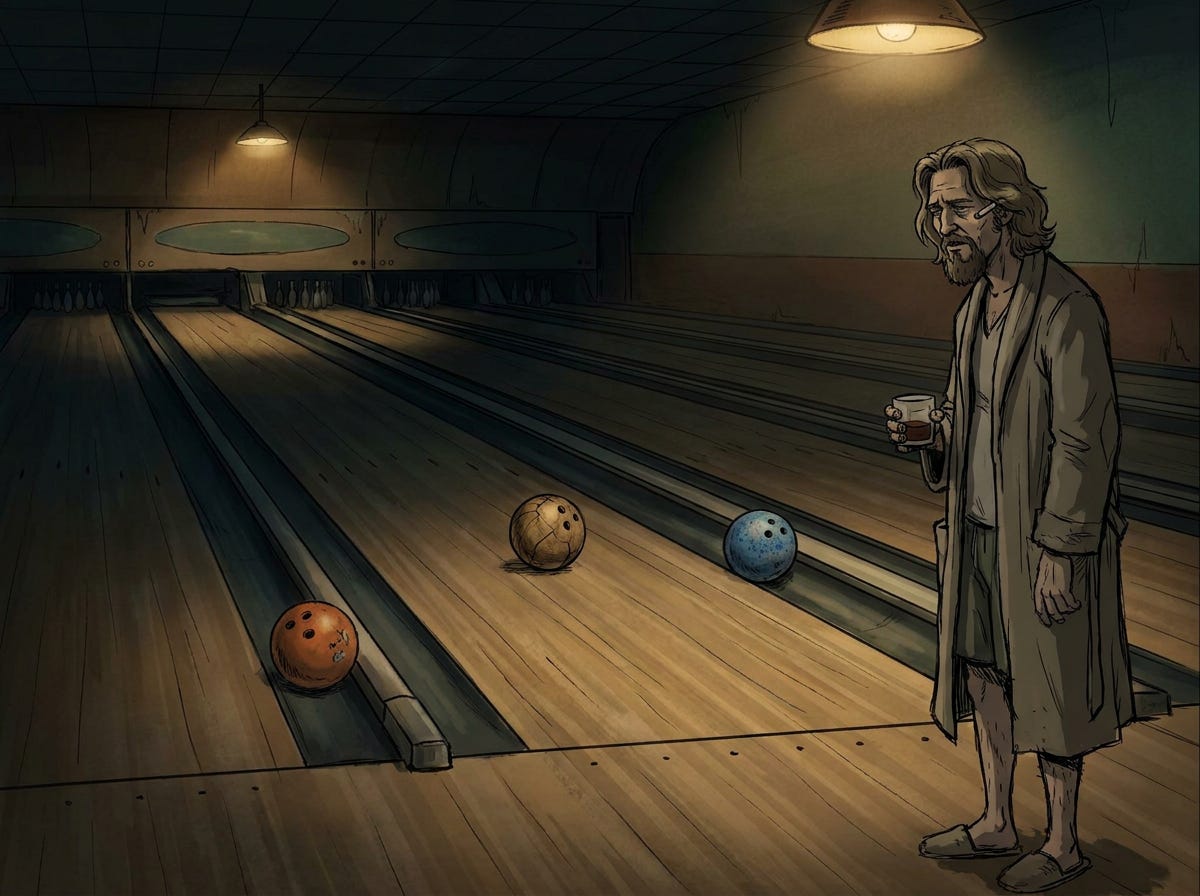
People keep telling me it’s coming. Some Republican, somewhere, is gonna stand up, look the whole thing in the eye, and say enough. The grown-ups retake the wheel. The party gets its spine back. There’s a name for this, apparently — a “Buckley moment,” after William F. Buckley supposedly reading the John Birch Society out of the conservative movement back in the sixties, and everybody just sort of straightening up afterward and going back to being a normal political party. I hear this a lot. I want to be straight with you about it, man, because I’ve gone and looked, and I gotta tell you what I found, and it’s not gonna be the fun kind of post. There’s no rug joke coming that fixes this one. I checked.
Here’s what I found: it’s never happened. Not once. Not in a way that actually worked the way people mean when they say it. I went looking for the fourth outcome — the clean one, party finds a captured extremist faction, expels it, walks back to the podium, coherent again — and there is no fourth outcome in the record. There’s three. And none of the three end where anybody’s hoping.
Outcome One: The Purge That Wasn’t
Buckley did write the editorial. That part’s true. What happened after is the part everyone forgets to check.
This is Walter’s favorite, so let’s start there. Walter loves this one because it’s got a guy standing on principle, drawing a line, and refusing to move it. Real Walter energy. 1962, National Review, Buckley calls Birch Society founder Robert Welch a man “far removed from common sense.” Strong stuff. Line drawn.
Except nothing actually happened to the Birch Society. No mass exodus. No collapse. Buckley wrote from inside a magazine, not from inside the party, and a magazine doesn’t have the authority to excommunicate anybody from a movement it doesn’t control. Two years later — two years, man — Barry Goldwater won the Republican nomination, and by his own account the Birchers were everywhere in his coalition. Not fringe guys in the back. “Men of affairs,” Goldwater called them. Buchanan, Atwater, Limbaugh — you can trace the Bircher conspiracist strain running clean through all of them, decade after decade, long after the editorial that supposedly ended it. So the purge got attempted. And the faction won. That’s outcome one, and it’s the one everybody cites as the model, and it’s actually the strongest evidence that the model doesn’t work.
Walter went quiet on this one for a second, which for Walter is basically a full stop. Then: “So the guy wrote the editorial, and the crazies just... won anyway?”
Yeah, Walter. That’s the finding. I didn’t write the finding, I just read it.
Outcome Two: No Purge At All
Sometimes there’s nothing to expel from, because there’s no party left to do the expelling.
The Whigs didn’t even try. Slavery split them into Conscience Whigs and Cotton Whigs, and there was no version of that argument that both sides were gonna sit through together, so nobody attempted a purge, because there was no faction small enough to purge and no coalition strong enough to survive the fight either way. A Whig was in the White House as late as the winter of 1853. Two years later, fall of 1855, the party was functionally dead. Not weakened. Dead. The anti-slavery wing went and built the Republican Party from scratch. The rest scattered into the Know-Nothings. Maude’s read on this one is the flattest of the three, and she delivered it standing in my doorway holding a folder of something I didn’t ask about: “There’s no purge to analyze here. There’s just dissolution. The party didn’t correct itself. It stopped existing and was replaced by something else within two years.” She said this the way she says everything, which is to say without any interest in whether I liked hearing it.
Outcome Three: The One We Already Covered
We did this one Monday. Quick version for anybody catching up.
The Dixiecrats. Thirty-five delegates walked out of the 1948 Democratic convention over the civil rights plank, formed their own party, lost, and were back inside the Democratic Party — unpunished, no sanctions, nothing — within four years. Thurmond himself didn’t even leave for the Republicans until 1964, sixteen years after the walkout, and that wasn’t a consequence of anything from 1948. Goldwater’s campaign just finally gave him a better address. The dramatic exit and the actual defection happened a decade and a half apart and had nothing to do with each other. Outcome three: the faction leaves on its own terms, gets welcomed back unpunished, and eventually departs again on a schedule that has nothing to do with any decision the party made.
Donny had been quiet through most of this, which usually means he’s either asleep or about to say the one thing that actually matters. This time it was the second one. He looked up and went: “So what’s the fourth way? The one where it actually works?”
And, Donny — man, I wish I had one for you. There isn’t a fourth way. That’s not me being tired or cynical, that’s just what’s in the record. Three outcomes, over roughly a hundred and fifteen years of American political history, and all three of them are bad news for anybody hoping the GOP is gonna do this to itself cleanly. Faction wins outright. Party dissolves outright. Faction leaves and comes back outright. Pick one. There isn’t a secret fourth door.
Why This Time Isn’t Even the Good Version of a Bad Precedent
The GOP doesn’t have Buckley’s problem. It has a worse one.
Here’s the part that actually keeps me up, and I don’t get kept up easy, man, I sleep like nine hours most nights. In every one of these three cases, the party needed something from the faction it would’ve had to expel — votes, money, turnout, a whole region’s worth of electoral votes — more than it needed to be a coherent, functioning party. That’s the actual mechanism under all three outcomes. It’s never been about willpower. Nobody’s ever been one brave editorial away from fixing this. It’s been about dependency, every single time, and whichever side held the leverage kept it. And today’s version of that dependency isn’t smaller than Buckley’s. It’s bigger. MAGA doesn’t need to be courted by the party’s elites the way the Birchers did, or the Dixiecrats did. It already deposed the elites who would’ve done the courting. There’s nobody left in the building with both the standing and the independence to write that editorial, because the people who’d have written it don’t run anything anymore. I’ll be honest with you, this didn’t happen by accident either. A lot of the same donor class now wringing its hands about what MAGA’s become spent thirty years deliberately using cultural resentment as a delivery mechanism for tax cuts and deregulation, figuring they could always meter the dose. That’s a whole separate post, and I’ll get to it, but it’s worth saying here: nobody stumbled into this. Somebody built the tiger they’re now surprised is loose.
So What Do You Do With That
I don’t have a bit to close this one, man. I looked for one. There’s no version of this where I land it on a joke and everybody feels better on the way out. The honest version is: this doesn’t resolve on an election cycle. It doesn’t resolve on a presidency, even a two-term one. The closest precedent that ever actually corrected itself — Dixiecrats to Goldwater’s coalition — took sixteen years, and that wasn’t even a correction, it was just a slower version of the same guy finding a better address. The Whigs took about two years to just stop existing. None of these are a timeline anybody voting in the next election is gonna get to see resolved. I keep thinking about the rug. Not as a joke this time. A rug doesn’t clean itself. Somebody has to actually do the work, on their knees, for a long time, and there’s no promise anybody’s coming to do it. Sometimes it just gets thrown out and replaced by a different rug entirely, one that doesn’t remember the stain, built by people who weren’t in the room when it happened. The Dude abides. I’m not saying that like I’ve got an answer tonight. I’m saying it because it’s the only thing I know how to do while I wait and see which of the three bad outcomes we’re actually living through. Some of us have got a long wait ahead of us. Might as well not do it standing up.
The GOP as it exists today has shown that it is utterly spineless and willing to blindly abandon even the pretext of governance or accountability in the name of party power and enabling ever more drift into culture war chaos
They’re damaged goods of the worst kind
And that is honestly kind of sad.
The Party of Lincoln and Eisenhower deserves better
The craven pursuit of a “permanent majority” envisioned by Gingrich way back when, carried forward by McConnell and his ilk, is what led us to today. Those kinds of stains just don’t come out, no matter how much anyone scrubs
And
As I’m thinking on it, the Dems as they exist today aren’t much better
As I think even more - it’s not the parties that are even ultimately to blame
A political party wants to have seats at the table, and will do craven and culpable things to get those seats - so long as the voters allow it
That’s what happened with the Dixiecrats. The voters never held them to account
That’s what created and enabled what eventually became MAGA.
It’s the voters
We, ourselves, are the ones who have to take a deep look in the mirror, take a deep breath, and actually hold our representatives responsible
That’s the whole game. The whole rug