

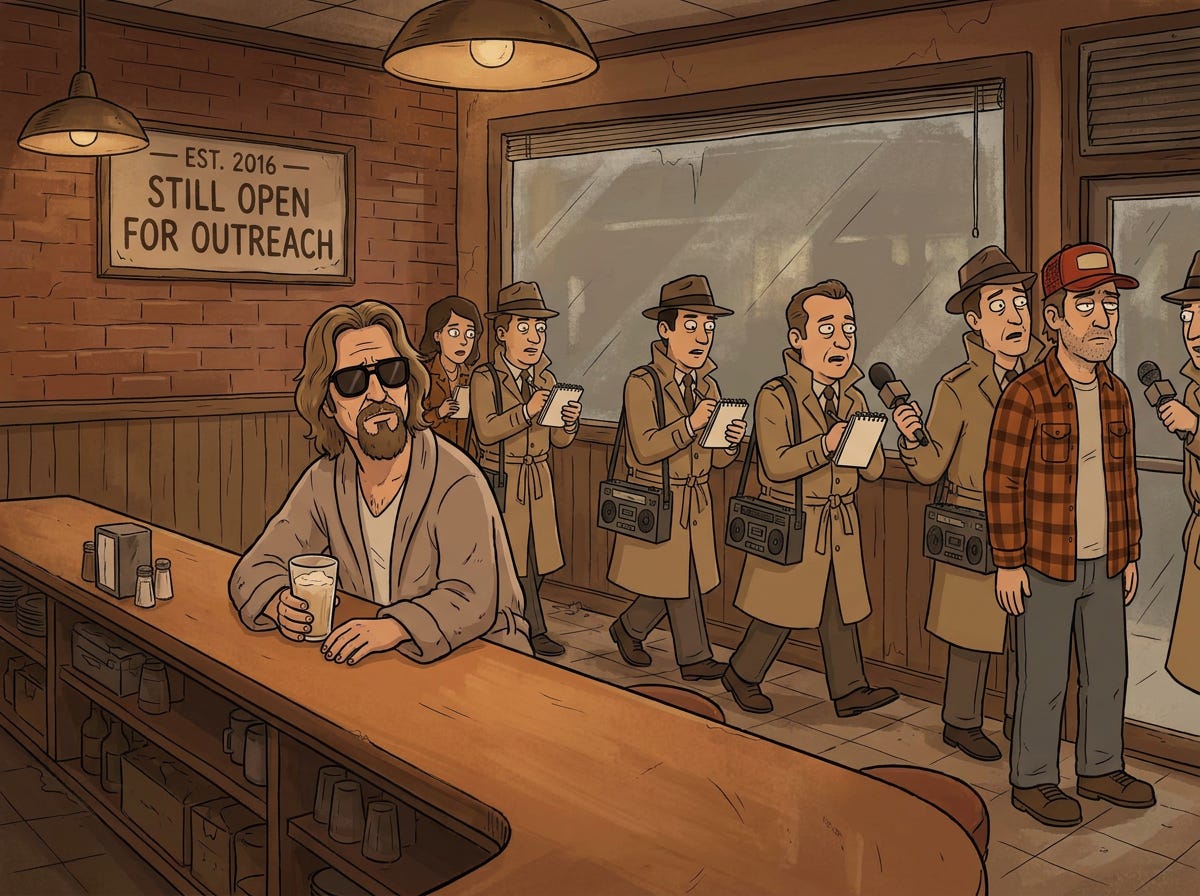
So there’s this piece (gift link) in The Atlantic, man. Very careful, very respectful, a lot of good reporting — researchers who spent months embedded with conservative Trump voters in Wyoming and Michigan and South Carolina. And what they found is: the “save democracy” framing doesn’t work with these voters, has never worked, and cannot work, because it is structurally incompatible with how they think.
This finding surprised exactly no one who has been paying attention. But here’s the thing that’ll keep you up at night, man: everyone is going to read it and conclude we need to do better outreach. The diner safari will continue. The consultants will re-up. The same number will come in on election night, and we’ll commission another study.
I’m getting ahead of myself. Crack a White Russian. Let me explain.
Walter Has Always Known About The Loop
Here’s the part of the Atlantic piece that the researchers are too polite to say plainly: these voters have built a fully closed epistemological system. Every bad outcome — and there have been genuinely bad outcomes, man, we’re not talking invented grievances — gets metabolized as evidence of hostile forces rather than evidence that their guy’s policies caused harm. Farm bankruptcies: Democratic regulatory sabotage, finally showing up on the ledger. Rural hospitals closing: decades of coastal elites defunding real America. Coal keeps dying despite every promise: enemies, always enemies.
You cannot crack a closed epistemological system with outcomes data. The system was designed to survive outcomes data. Every bad result is processed as further confirmation of the original premise. The worse things get, the more the theory is vindicated.
Now. Here’s the thing, man. I live with Walter. And I will tell you something about Walter.
Walter cannot contextualize anything — anything — without Vietnam. You step over the line at the bowling alley, Walter draws a firearm. Because: Vietnam. A millionaire wants his wife back, Walter hatches a scheme involving a severed toe. Because: Vietnam. The world is not, to Walter, a place containing many kinds of situations. The world is a place containing Vietnam, and everything else is Vietnam with different decor.
Now ask yourself: is Walter’s epistemological loop fundamentally different from the loop the researchers spent months documenting?
I’m not saying this to be mean to Walter. Walter is my friend. But Walter is also a cautionary tale about what happens when one framework becomes load-bearing for an entire identity, and you build a life around the premise that the framework cannot be wrong.
The difference is Walter’s loop is just exhausting. The other loop has a TV show and three hundred Electoral College votes.
The Diner Safari Must Be Stopped
Okay. This is the part I actually wanted to talk about.
The diner safari, man.
You know the format. A reporter from New York or DC — let’s be real, it’s always the Times, it’s always the Times — makes a pilgrimage to a diner in Youngstown or a VFW hall in rural Michigan or a church parking lot in South Carolina. They order something with gravy. They have a series of reverent conversations with a guy named Dale or Randy — always one syllable, always working-class — who is worried about inflation and the border and a factory that closed fifteen years ago that he traces back to a trade deal. Dale/Randy doesn’t love Trump’s personality, but he likes that Trump fights. He’s never met a Democrat. He says he just wants someone to listen.
The reporter wraps up. The piece lands. The conclusion — and I want you to really hear this, because it has been the conclusion every single time — is that Democrats need to do a better job of meeting people where they are.
This advice has been dispensed continuously since November 2016. It has produced zero observable electoral results. Zero.
There is a certain Youngstown diner that has achieved more column inches than some small nations. The regulars must be completely fucking exhausted.
Donny looks up from his bowling ball.
“But maybe this time, if we really listen—”
“DONNY. YOU ARE OUT OF YOUR ELEMENT.“
Here’s what everyone doing the diner safari knows and will not say out loud: these are not movable votes. They are not undecided. They are not waiting to be listened to more carefully. They have arrived — through lived experience, through community, through a fully coherent worldview — at a political conclusion. Treating them as perpetually persuadable voters who just need the right message is condescending as hell and factually wrong.
The diner safari doesn’t inform politics. It soothes the conscience of the professional class consuming it. We went there. We listened. We tried to understand. The subtext is always the same: someone should really do something about these people. The safari exists to maintain one fiction — that a persuasion play is available if someone were clever enough to find it. There isn’t one. Admitting that forces a conclusion the entire genre was constructed to avoid.
The Lincoln Project And Other Ways To Light Money On Fire
Lights the spliff.
You want to talk about the Lincoln Project? I can talk about the Lincoln Project.
These guys spent — conservatively — hundreds of millions of dollars on ads, constitutional argument-making, and very clever television spots aimed at voters who do not watch those channels, do not engage with those arguments because the arguments have been pre-identified as illegitimate, and are philosophically immune to the Lincoln Project’s entire theory of persuasion before the first ad rolls.
The spots were devastatingly clever. They won effusive praise from Twitter users in Brooklyn. They moved approximately zero persuadable Trump voters.
But they looked great in the reel. And the invoices cleared.
Man. The invoices cleared.
I have a theory about this. When a consulting operation fails consistently and keeps getting funded, it is not because the people funding it are stupid. It is because the actual function of the operation is not what it appears to be. The Lincoln Project wasn’t really trying to move Trump voters. The Lincoln Project was trying to soothe the existential dread of a certain class of center-right donor who needed to feel like something was being done. That is a real service. There is genuine market demand for it. It’s just not electoral strategy, man. It’s anxiety management with a media buy attached.
The center-left version is less flashy but equally futile — the “we need to talk to rural voters about kitchen table issues” school of Democratic consultancy, a sector that has survived 2010, 2014, 2016, 2020, and 2024 without a single billing rate taking a hit. They show up with healthcare talking points and broadband promises and occasionally a Democrat who hunts. They are received politely. The returns come in. It’s the same number.
The rug, man. They keep trying to get the rug back.
Here’s the thing nobody wants to say: that rug was never in our room to begin with. We’ve been chasing a rug that was always somebody else’s. The votes the Lincoln Project was trying to peel off, the Dale/Randy votes the safari reporters are reverently transcribing — they were never available. The whole premise was the Big Lebowski’s fortune: everyone kept insisting it was there. Turns out Maude had the money the whole time, and the Pasadena operation was fraud in a better suit.
So Where Do We Actually Bowl?
The electoral math is not subtle. The resistance to it is.
The path — for Democrats, for anyone who’d prefer not to live inside a competitive authoritarian state — runs through urban and suburban voters. College-educated voters, particularly women, who have been moving toward Democrats in measurable ways since 2018. Turnout infrastructure in Atlanta, Milwaukee, Phoenix, Detroit. Latino voters who have been quietly drifting away while everybody argues about who the Real America is. These are actual leverage points. They exist. Nobody’s renting a car to cover them. But they’re there, and the lanes are open.
Every dollar spent on a diner safari or a Lincoln Project ad is a dollar not spent registering voters in Fulton County. That’s the trade. It gets made every cycle. It gets made with great rhetorical cover — we can’t abandon these communities — but there’s an important distinction between abandoning a community as human beings and abandoning them as persuasion targets. Those are two different things. Conflating them has been ruinous, and the conflation is very convenient for the people cashing the strategy checks.
You want good policy for rural America? Great. Me too. Fix the hospital closures. Address the opioid crisis. Stop the farm bankruptcies. But you have to win elections to do any of that, and winning elections requires being honest about which votes are actually available — which means being honest about which ones aren’t.
The Stranger drifts through, adjusts his hat.
“Well, I’ll tell you, Dude — I don’t reckon a man’s obliged to keep bowling on a lane with a Closed sign on it. Sometimes the wisdom’s in knowin’ which lanes got pins.”
He tips his hat and is gone.
Whether the Democratic Party is capable of that kind of clarity is, as Maude would say, a separate question. Based on available evidence, I have my doubts. But that’s a White Russian for another evening.
The Dude abides.
— Jeffery Lebowski, Reseda, CA
Good analysis, Dude. But you’re out of your element when it comes to counting syllables. (You want a one-syllable name? I can get you a one-syllable name…).
The MAGA base that still exists isn’t going to shift away from their comfortable identity chamber any time soon. The only voices they listen to come from those inside that room. Voices they know and trust and actually watch/read/listen to.
If we want to reach them, those are the people whose message we need to shift
And that is a hard nut to crack
Fox and Tucker Carlson and their ilk know that grievances are what butter their bread, so they feed that narrative.
Every now and then, one of them will find a personal Red Line (Epstein or the Iran war, for instance), and say something - those shifts have real impact within the base, because the shift is in one of their own
If the Lincoln Project and the DNC want to have actual impact, *those* are the people they need to reach. Not by publicly calling them out, because that only feeds the grievance machine that keeps paying their bills, but by finding ways to shift the grievance narrative to include more things like the Epstein files and the impact of the Iran war in everyone’s wallet