

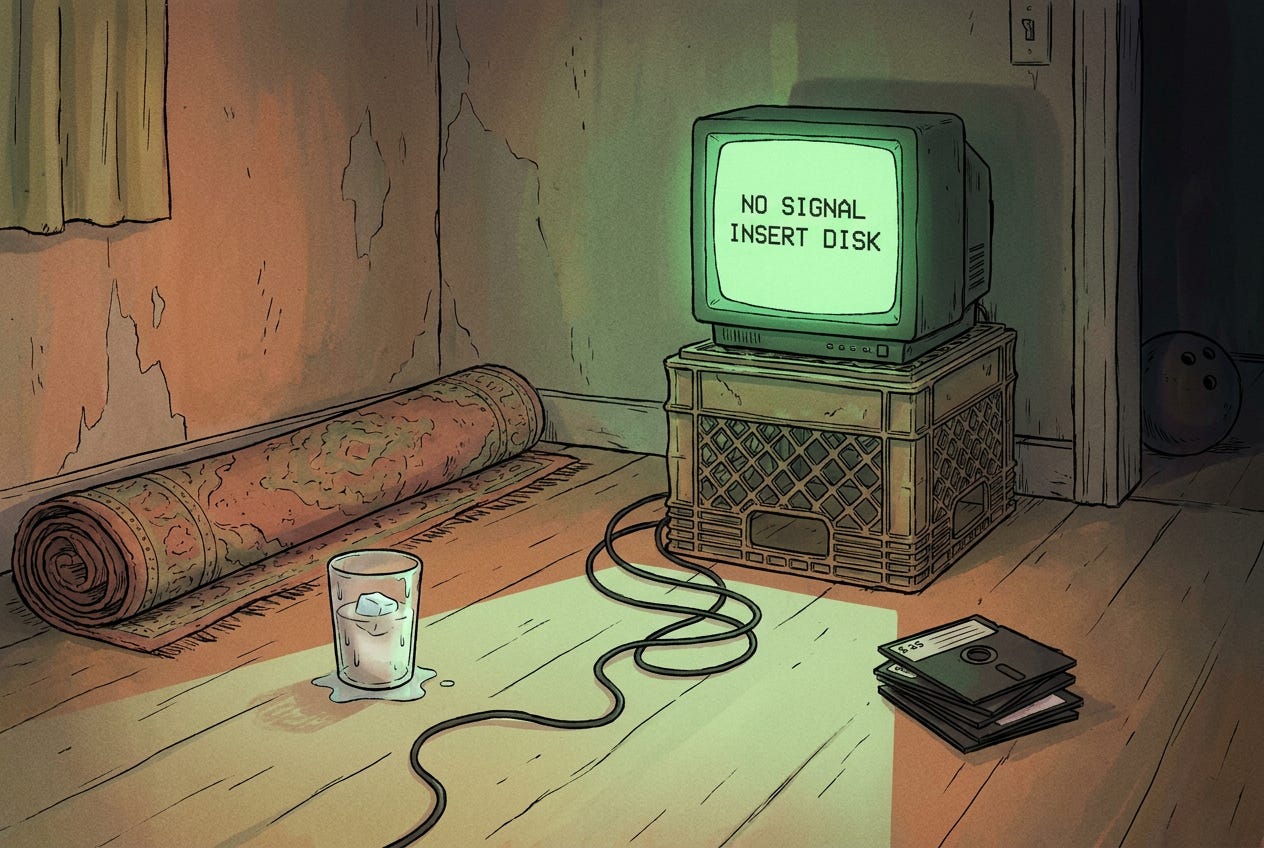
So it’s two in the morning and I’m lying there with a laptop on my chest, which is not a great look for a man of my particular vintage, and I’ve got about seventeen browser tabs open and every single one of them is a thirteen-inch Sony Trinitron.
Six hundred bucks. Plus shipping, which on a CRT runs roughly the GDP of a small island nation, because the thing weighs about what a bowling bag weighs if the bowling bag were full of other bowling bags. Guy in Sacramento. Listing says works, some burn-in, smells fine.
Smells fine. That’s the pitch, man. That’s what six hundred American dollars gets you in the year of our lord whatever this is — a forty-year-old television that a total stranger has personally certified as odor-neutral.
And the thing is, I own a monitor. It’s right there on the desk. It’s thin and enormous and so sharp it’s honestly a little rude about it. It does not smell at all. It has never once required me to adjust a dial labeled V-HOLD while the picture rolled like a slot machine.
So I’m not shopping for a monitor.
I’m shopping for a Tuesday afternoon in 1982.
And look — I’ve been here before. I know this feeling in my bones. This is the rug thing. This is exactly the rug thing. Because I’ve spent a considerable portion of my life trying to replace a rug, and I have acquired several rugs in the process, and not one of them tied the room together, and it took me an embarrassingly long time to work out that what tied the room together was never the goddamn rug.
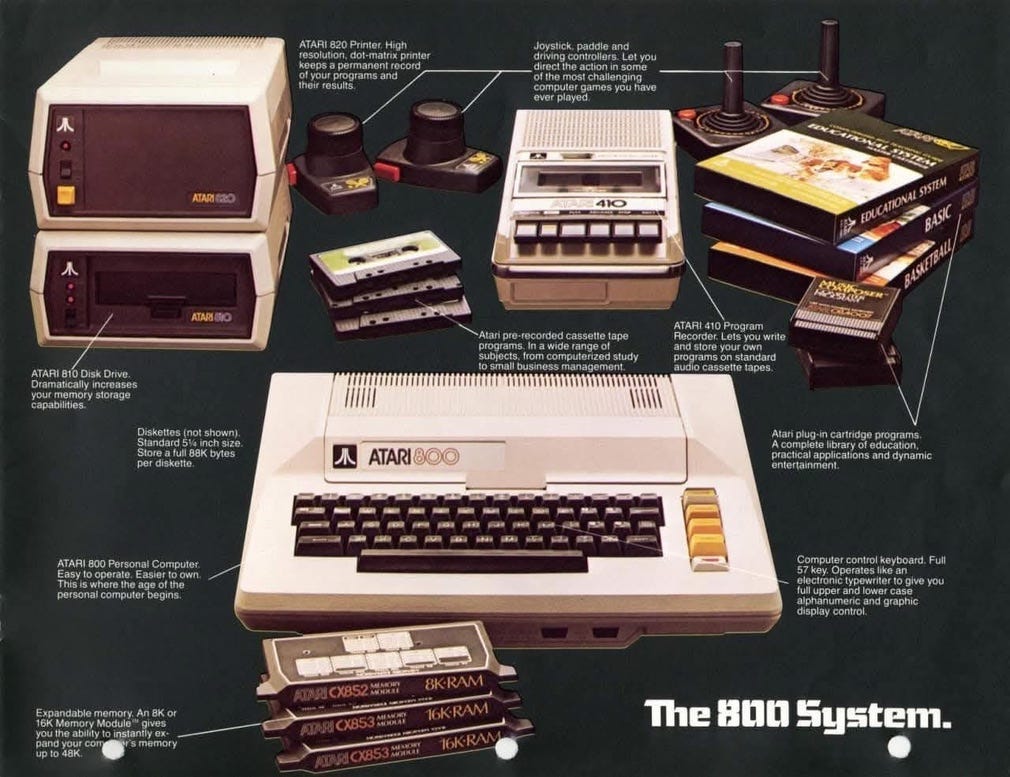
Here’s 48K. Knock Yourself Out.
You gotta understand what the machine was actually offering.
You flipped the switch and there was BASIC. Not a login. Not a spinning thing. Not a cheerful little popup asking if you’d like to personalize your experience. Just a cursor, blinking at you with what I can only describe as an attitude.
And you typed:
10 PRINT "BUTTS"
20 GOTO 10
And the computer did it. Forever. Filled the whole screen with your one stupid word until you made it stop.
That was the whole deal, man. Two lines between curiosity and consequence. You could poke a memory address and turn the screen purple and not fully understand why, and that not fully understanding why was the good part, because it meant there was somewhere to go.
The other thing nobody tells you about that era is how porous everything was. You’d play Star Raiders for four hours, and then you’d start wondering how the stars moved, and then you’d type in a program out of a magazine — a whole program, by hand, off a page, like a monk — and then you’d change a number in it just to see what broke. And then some kid at school would hand you a floppy with nine games and a text editor and a strange little utility somebody’s older brother wrote with no documentation whatsoever.
The line between playing with the thing and taking the thing apart barely existed. You were a consumer for about ten minutes and then you were something else.
That’s not nostalgia. That’s just what the machine was.
Walter Would Like to Discuss the Licensing Agreement
“You didn’t buy it, Dude.”
Walter’s got his finger up. This is a finger-up situation.
“You think you bought it. You licensed it. There’s a difference and the difference is the whole ballgame. You bought a cartridge in 1982 — that cartridge was YOURS. You could throw it in a lake. You could sell it to a guy in a parking lot. You could pry the case open with a screwdriver and look at the guts, and the guts were also YOURS.”
Walter, man—
“I’m not finished. Now you ‘buy’ something and it’s a revocable license to access a service, and the service can be discontinued at the sole discretion of a company that will be acquired twice before Christmas. That’s not ownership. That’s a hall pass. Am I wrong?”
You’re not wrong, Walter. You’re just—
“And the tractors! You want to talk about the tractors? A man buys a two-hundred-thousand-dollar tractor and cannot legally fix his own tractor. This is farmland, Dude. This is not ‘Nam. There are rules, and the rules got quietly rewritten while everybody was looking at their phones.”
Here’s the annoying part: he’s right. That’s not a rug problem. That’s not a feelings problem. Right-to-repair, interoperability, who’s allowed to open the case — those are real fights with real lawyers, and they’re happening right now, and they’d be worth fighting even if none of us had ever touched an Atari.
Maude Has the Numbers, and They Are Unhelpful
Maude turns from the easel with that expression she gets.
“It’s called rosy retrospection. It’s well documented. You retain the emotional peaks of an experience and the routine friction decays. Related mechanisms: peak-end evaluation, fading affect bias. The unpleasantness is not repressed. It simply doesn’t survive storage.”
Yeah, okay, but—
“You remember the disk drive’s clunk. You do not remember the forty minutes it spent failing to read sector 347. You remember the graphics. You do not remember the RF interference, or the cassette loader, or the fact that a task requiring fifteen seconds today required an afternoon.”
“And the surrounding decade, since we’re doing this: leaded gasoline still in the tank. Smog you could chew. No Americans with Disabilities Act until 1990. Considerably worse odds on most cancers. If you’d like a decade with better outcomes on nearly every measurable axis, you are currently standing in it.”
She’s not wrong either. Nobody in my life is ever wrong, it’s exhausting.
Yeah, Well, That’s Just, Like, Your Data, Man
Except here’s where I get off the bus.
Because rosy retrospection explains a lot of it and it doesn’t explain all of it, and the part it doesn’t explain is the part that actually matters.
Some of it was true.
The machine was legible. You could hold a meaningful fraction of it in your head, and the parts you couldn’t hold were reachable if you got curious enough. Now you click an icon and it talks to fifteen services you’ll never see about things it will never tell you.
You owned it. No account. No terms. No thing that phones home. Nobody was watching you use it, because there was nobody on the other end and no other end to be on.
And it was finite. There was a bottom to it. You could conceivably get to the bottom.
Those aren’t distortions, man. Those are losses, and they’ve got names, and some of them have got policy attached. So when a guy tells you the past was better and you feel that little click of recognition — the click is real. Something did get taken. The click is not the problem.
The problem is who’s standing there when you feel it.
The Big Lebowski Would Like to Sell You 1982
Somebody figured out a while back that the ache is the product.
Not the thing. The ache. Because the thing is a dying television with burn-in and the ache is priceless, and once you understand that a legitimate grievance about ownership can be repackaged as an aesthetic, you can charge whatever you want and people will thank you for it. Six hundred for the Trinitron. Ninety bucks for a plastic console with thirty games in it. There’s a whole industry now selling people the feeling of a machine they can’t get back, which — fine, honestly. It’s a hustle but it’s a small hustle. Nobody’s getting hurt over a mini NES.
The bigger version of the hustle doesn’t sell you hardware.
You know the pitch. Everything was better, everything was ours, everything worked, and then they took it, and if you’ll just come this way I’ll get it all back for you. And Brandt walks you down the hall showing you the plaques and the photographs and the key to the city from a city that maybe never gave him one, and the whole time you’re admiring the achievements of a man who has personally achieved approximately nothing, whose money came from somewhere else entirely, who is going to look you dead in the eye and inform you that your revolution is over and the bums lost.
He didn’t lose anything. He never had it. That’s what makes him so good at this — a guy who genuinely remembers the thing can’t sell it to you clean, because he’d get distracted telling you about it. A fraud never gets distracted. The past is just inventory.
And the tell is always the same: he’ll talk about the feeling all day long and he will never, not once, take a position on who’s allowed to open the case.
Donny Says a Thing
Donny looks up from his shoes.
“Are you trying to get the computer back, or the kid back?”
“Donny, you’re out of your element.”
Yeah. Sure. Okay.
The Two Piles
So what I’ve settled on, more or less, is that you gotta sort the ache into two piles.
Pile one is stuff you can actually do something about. Whether you own the thing you bought. Whether you can fix it. Whether it talks about you behind your back. Whether four companies get to decide what a computer is. That’s all legislation, man. It’s boring and it’s slow and it involves committees, but it’s real, and anybody who’s genuinely mad about what happened to computers should be able to say a sentence about it that doesn’t involve the word “vibes.”
Pile two is that you were twelve, and the world was brand new, and nobody knew what the thing on the desk was going to become — including the people who built it. That’s not coming back. Not for six hundred bucks, not for six million, not for a candidate. That pile is closed. You can visit but you can’t move in.
I closed the tabs, incidentally. Left the Trinitron to some other sucker in Sacramento. Poured myself a beverage, put on some Creedence, and sat in a room that a rug has not tied together in a very long time.
Room’s still fine, man. Room’s still a room.
The Dude abides.
Do you have a tale from your discovery of technology and computers? Share it below! The Dude wants to know man.