

This is part 2, a continuation of:

So I got the TV on, no particular reason, just background noise while I’m nursing a White Russian and letting my mind wander, and it’s one of those old reruns. Family in a kitchen. Mom’s got an apron on that’s never once seen actual grease. Dad comes home, hangs his hat on a hook that exists solely for hanging hats. Everybody’s laughing at something that isn’t funny, because there’s a laugh track telling them to.
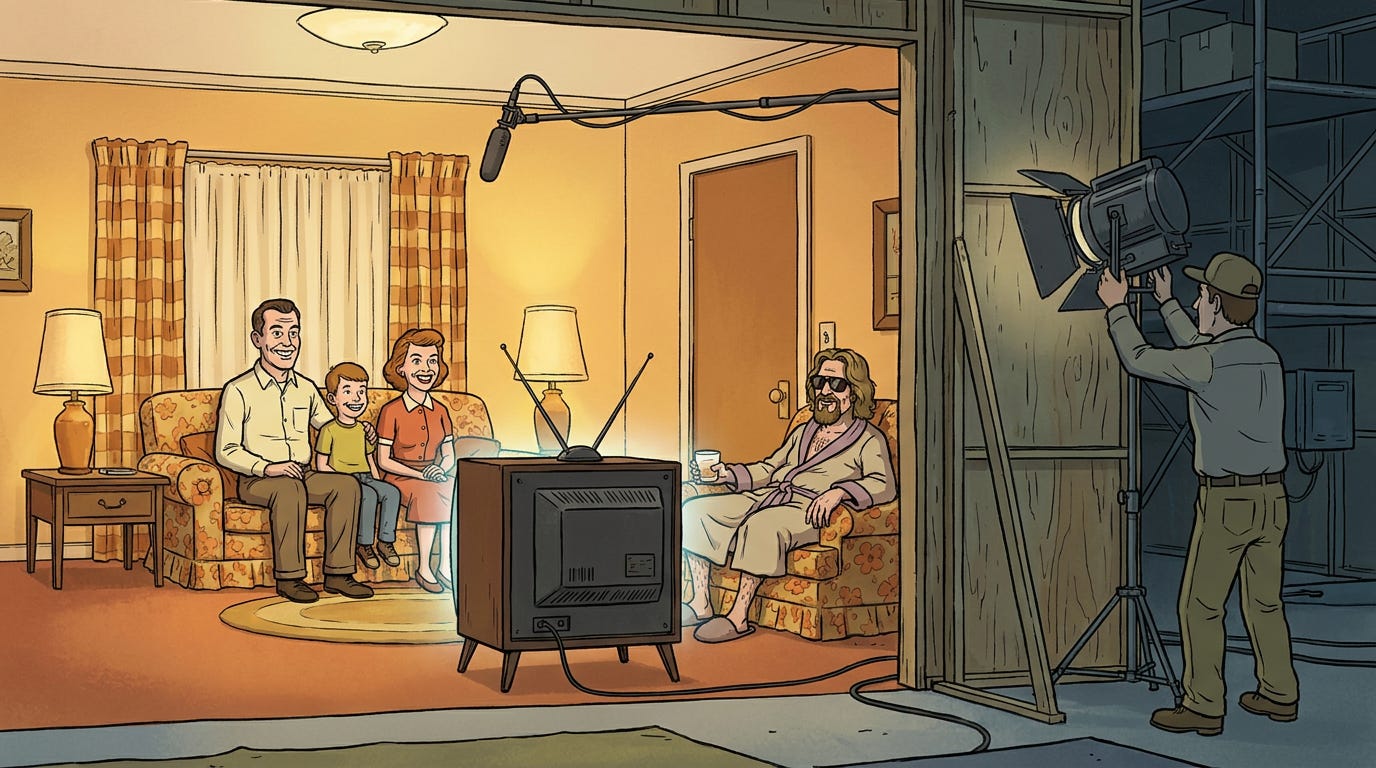
And I’m watching this, half-baked, and I start noticing the seams. The wall behind the fridge doesn’t quite meet the ceiling right. The window’s got a painted backdrop behind it instead of an actual outside. It’s not a memory, man. It’s a set. Somebody built this. Same deal as that rug situation I went through a while back — you think you’re looking at something that was always there, and then you notice the tag on the corner.
Here’s the thing I keep coming back to. All this talk about wanting the country back the way it was, back to the fifties, back to whenever — none of that’s nostalgia for the fifties. Nobody’s nostalgic for the actual nineteen-fifties, man, because nobody currently mad on the internet was old enough to pay taxes in it. What they’re nostalgic for is a sitcom about the fifties. Different thing entirely. One’s a decade. The other’s a rerun.
Now look, I’m not gonna sit here and tell you nothing in that decade was real, because that’d be a lie, and lying’s not really my scene. Church attendance actually was way up back then — membership jumped something like 57 percent by 1950, and Gallup had close to half the country saying they went regularly, which is the highest that number’s ever been. That part’s true. That part happened.
What’s not true is the story about why it happened, and that’s the part that gets left on the cutting room floor.
Turns out the boom wasn’t some spontaneous nationwide spiritual awakening — it tracked the suburbs. Churches got built where the housing developments got built, chasing the same white suburban expansion and baby boom everybody else was chasing. Rural America, meanwhile, has always had lower church attendance, not because folks out there believe less, but because there’s nobody putting up a Methodist church every half mile when your nearest neighbor’s four miles off. Same story today. It was never about devotion. It was about supply.
I mentioned the “In God We Trust” and “under God” thing to Walter — both of those got bolted onto the currency and the Pledge in this exact same little window, mid-fifties, like a limited release — and Walter, a man who has converted religions, been divorced by a woman who then converted him back out of spite, and can quote you scripture and shoot craps in the same breath, gets very quiet for a second.
“Say that again,” he says.
“Real estate boom, Walter. Not a revival.”
“Three thousand years of beautiful tradition, Dude, and it turns out half of it’s a zoning decision.”
Even the attendance numbers themselves were padded, and not by faith — by shame. Businesses closed on Sundays. Blue laws on the books. Showing up wasn’t always about God, sometimes it was about your neighbors not clocking that you didn’t. Which, by the way, is exactly why the whole thing collapsed as fast as it went up — you pull the social penalty for staying home, and the pews empty out practically overnight.
Donny, who’d been quiet through most of this, goes: “Wait — so people went to church because if they didn’t, everybody would know they didn’t go?”
“Yeah, Donny.”
“That’s — that’s not really about God then, is it.”
“No, Donny, it is not.”
First time all year the man’s landed one clean.
Now here’s where the sitcom really starts cutting scenes, because the stuff that got left in the editing room is where it gets ugly. Eisenhower signs an order in ‘53 that boots gay people out of federal employment wholesale — the Lavender Scare, running right alongside the Red Scare, purging more people off suspected homosexuality than off suspected Communism, which nobody puts in the highlight reel. This is sixteen years before Stonewall, so we’re not talking about some far-off injustice, we’re talking about the exact same golden years everybody wants the rerun of.
Same stretch, women who’d spent the war running factories, doing real work, proving they could do it — get shoved back into the kitchen. Not by nature reasserting itself, not organically. By policy. By union contracts written to free up jobs for returning vets. That’s not culture, that’s an engineered rollback with a smile painted over it, and everybody wondering what was wrong with housewives a decade later was living downstream of a decision, not a default setting.
Same stretch, the 1924 immigration quotas are still fully in force — the whole golden age runs under a law explicitly designed to freeze the country’s makeup in favor of Northern and Western Europeans, and it doesn’t get repealed until ‘65. Same stretch, redlining and a GI Bill administered so unevenly that the entire postwar mobility boom — the boom everybody wants back, the one where a guy with a high school diploma could buy a house — ran almost entirely for white families. Same trick as always, man. Somebody’s uncredited exclusion holding the whole set together, same as that rug in Part One, just wearing a better suit this time.
But here’s the part that actually made me put the joint down for a second. Everybody assumes the religious right got organized over abortion, or prayer in schools, something with a little moral weight to it. That’s not it. Not the origin, anyway. The actual founding grievance was tax exemptions — specifically, keeping the tax-exempt status for segregated Christian schools that popped up after Brown v. Board, some of them literally operating out of church basements. Prince Edward County, Virginia shut down its entire public school system for five years rather than integrate. When the IRS finally moves to strip the tax break from schools like that, then pulls Bob Jones University’s exemption outright in ‘76 — that’s when Weyrich and Falwell get the movement organized. Abortion gets bolted onto the platform after the fact, because “defending the unborn” polls a hell of a lot better than “defending our tax break for segregated schools.”
I ran this past Walter and he actually sat with it a second before he said anything, which for Walter is basically a moment of silence.
“That’s...” he starts, and I can see him fighting it, “that’s actually a hell of a maneuver, Dude. Say what you want about the man, he identified the terrain and organized around it. There’s a certain — battlefield logic to it.”
“Walter, it’s segregated schools.”
“I said I respect the maneuver, Dude, not the objective.”
Maude, when I told her about all this, didn’t even blink. She was mid-project, something involving a harness I didn’t ask about. “Nostalgia isn’t memory,” she said, not looking up. “It’s a rewrite. And rewrites always flatter the person doing the rewriting.” Then she went back to whatever she was doing, and I decided not to press further, because with Maude you generally get one good line per visit and I’d already gotten mine.
So look — I turned the TV off. Not because the show’s bad. It’s fine as a show. Laugh track, hats on hooks, whole bit. Problem’s never been the sitcom. Problem’s people trying to actually move back into the set, furniture and all, treating a rerun like it’s oral history handed down from the elders.
Me, I’ll take the bowling alley over the sitcom kitchen any day. Hollywood Lanes never pretended to be clean. Carpet’s ugly, shoes smell like feet, some guy in a purple jumpsuit’s always licking his own ball a lane over — but at least nobody’s telling you it used to be better before they let people like you in. That’s a real place, man. You don’t get nostalgic for a real place. You just go bowling in it.
The Dude abides. He’d just like everyone to stop citing the syndicated version as history, is all.