

So Walter’s got the finger up again.
“You don’t own it, Dude. I want you to really sit with that. You’ve got an ACCOUNT. Somebody else’s machine, somebody else’s rules, and a guy you have never met can revoke your access on a Tuesday for reasons he is not obligated to explain to you. There’s a quota. There’s a LOG. Every single thing you do on there, somebody could pull up and read—”
Walter.
“—and you PAY for this. Monthly. Like rent. For the privilege of using a computer you will never see, in a building you will never enter, in a city you have never been to—”
Walter, man.
“What.”
You’re describing the computer lab.
“...I’m sorry?”
Nineteen eighty-six, man. You just described the computer lab.
So a while back I wrote about wanting to buy a CRT at two in the morning, and I landed on this whole tidy business about sorting your nostalgia into two piles — the stuff that’s a memory trick, and the stuff somebody actually took from you. Felt pretty good about it, honestly. Had a beverage. Considered the matter closed.
Then I thought about the lab, and the whole thing fell apart on me.
You Had an Account, Man
Here’s what a college computer lab was in the mid-eighties, and I want to be clear this was not exotic, this was almost every state school in the country.
There were no computers in the computer lab.
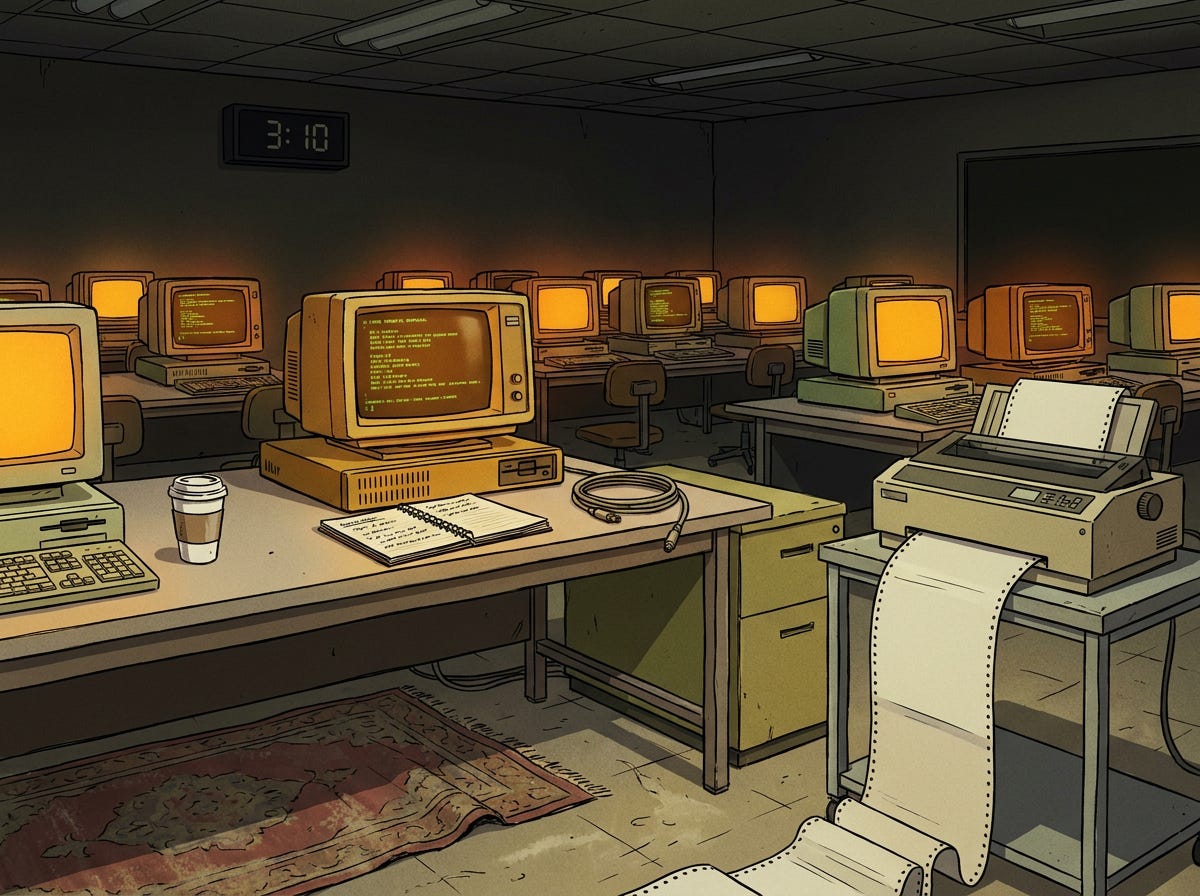
There were terminals. Glass and a keyboard and a cable, and the serial cable went into the wall, and somewhere on the other side of that wall was a PDP-11/70 running RSTS/E, and that machine was not in the room. Might not have been in the building. At our shop it wasn’t even in the same city— there was one of them at a campus a few hundred miles down the coast, reachable over an X.25 link that was about as reliable as a candle in a hurricane.
You had an account. You had a quota. You scheduled your time, because there were maybe thirty terminals and rather more than thirty students, and at the end of the semester you took whatever slot you could get, which is how you ended up in a fluorescent room at three in the morning with people you’d never met, and a cup of vending-machine coffee, all of you hunched over glass, waiting.
Waiting, mostly. Because the other thing about that room is that you could feel everybody else in it.
That’s not a figure of speech. When the lab filled up, the machine got slow, and you felt it in your hands. You’d hit return and there’d be this pause, and the pause was thirty other people’s work getting divided by one processor, and you learned to read the room by how long the pause was. Shared infrastructure you could sense. A queue you could feel in your fingertips.
And when the X.25 link went sideways it didn’t garble anything, which would’ve at least been honest. It just stopped. You’d keep typing into a black rectangle for a minute and a half, and then either everything you’d written would arrive all at once like a burp, or the session was already dead and had been dead the whole time and nobody had thought to mention it.
Account. Quota. Logs. Scheduled access. An administrator who could turn you off. A machine you would never lay eyes on, in a city you’d never been to, reached over a connection that failed by pretending it hadn’t.
Every single grievance in the modern complaint, man. All of it. Nineteen eighty-six.
And Then, Briefly, an Accident
So what happened?
What happened is that the chips got cheap faster than anybody worked out how to keep charging you rent.
That’s the whole story. It’s not a triumph of the human spirit. Nobody set out to liberate anybody. It’s a gap — a stretch of maybe twenty-five years where you could put a machine on a desk and the machine was yours, outright, no account, nobody to ask, nothing phoning home, mostly because there was no home to phone and nobody had built one yet.
You bought it and then you owned it. You could open it. You could sell it. You could throw it in a lake and the only consequence was a wet lake.
And everybody who came up inside that window — which is me, and possibly you, and definitely Walter — filed the whole arrangement under how computers are.
It was not how computers are. It was how computers were, for about twenty-five years, for reasons nobody planned and nobody defended, because it never occurred to us that it was the kind of thing that needed defending.
Maude Has a Word for This
“You’ve made a category error about your baseline.”
She doesn’t even look up.
“You believe you’re defending a norm. You’re defending an outlier. Timesharing precedes the desktop and timesharing succeeds it — the intervening period is the deviation, not the trend. Your PDP-11 is the direct ancestor of every machine you now own. Unix was built on that hardware. C was designed against that instruction set. The lineage runs from the shared machine to the rented one with a brief accident in the middle.”
Yeah, okay, but—
“And your accident wasn’t distributed evenly, which you keep declining to mention. The machine only taught you anything if you had one. That required money, unstructured time, and a household in which a child taking apart an expensive object was tolerated rather than punished. Most of the people in that lab at three in the morning had none of those things. You are nostalgic for an inequality you happened to land on the correct side of.”
...Yeah. Yeah, that one’s fair.
Three Piles Now
So I gotta amend the thing I said last time, because two piles wasn’t enough. It’s three.
Pile one: stuff that genuinely got worse. You can’t open the case. You can’t fix it. You don’t own it after you buy it. Four companies decide what a computer is allowed to be. That’s real, it’s got names, and it’s got lawyers.
Pile two: stuff that only looks better because nobody had gotten around to exploiting it yet.And the flagship item here, man, the absolute champion: your student ID number was your Social Security number. Printed on class rosters. Taped to hallway walls. On graded exams left in a cardboard box outside a professor’s office where anybody could flip through them.
That wasn’t safe. That was a loaded gun on a coffee table in a house where nobody had yet thought to pick it up. Identity theft as a going concern needed credit reporting to go online first. We weren’t careful. We were early.
Every era’s got a pile two, and if you can’t name yours you’re not actually remembering, you’re just decorating.
Pile three: stuff somebody took on purpose. Which is where it gets interesting, because I used to think pile three meant they took something we had.
They didn’t. They closed a gap. There’s a difference and the difference is the whole ballgame.
Walter Is, Unfortunately, Right
“So we take it back.”
That’s the thing, Walter. There’s no back. Back is the lab. Back is a quota and a scheduling clipboard and a link to San Diego that dies in the middle of your sentence. You’d be marching toward the exact thing you’re mad about.
“Then we don’t take it back.”
No.
“We build it. Because the anomaly was REAL, Dude. It happened. Twenty-five years, in this country, a person could buy a machine and own the goddamn machine. That’s not a fantasy, that’s a documented historical period, and the only thing that made it happen was an accident of manufacturing costs — which means it can be made to happen ON PURPOSE. Right to repair. Interoperability. You bought it, you own it, forever, including the part where you open it up and look inside. None of that is nostalgia. That’s all NEW CONSTRUCTION.”
And here’s the thing that’s been sitting funny with me for about a week: he’s right.
Walter’s whole deal — the entire engine of the man — is that he cannot accept that a war is over. And usually that’s the problem. Usually that’s exactly the problem. But point that same refusal at the right target and it stops being a pathology and starts being the only useful instinct in the room.
He’s not asking to go back. He’s the only one of us who understood there was nowhere to go back to.
Donny
“So the good part was the mistake?”
“Donny, you’re out of your element.”
Yeah.
Abide
Small confession to close this out.
Around 2002 I looked into buying one. A real PDP-11. Turns out the machines were cheap by then, almost embarrassingly so — people were giving them away out of basements, this thing that a university once mortgaged a building for.
What killed it was the disk pack. Couldn’t find media that would talk to it, couldn’t find a drive, and the whole plan died right there in a parking lot conversation.
So that’s twice now. Twice I’ve tried to purchase a decade, and both times the decade was in stock and the accessories were the problem. There’s a lesson in there and I’ve decided not to look at it directly.
Twenty-five years isn’t nothing, though. It’s most of a working life. It happened by accident, and it was never fairly handed out, and it is not the natural condition of anything — and none of that makes it less worth having. Some accidents are good enough that you should go back and cause them deliberately.
Which is a stranger position than it sounds, incidentally. You’d think wanting the old arrangement makes you a conservative. It doesn’t. There’s nothing to conserve. You’d be building something that has essentially never existed on purpose — a thing that showed up once, briefly, by mistake, and that somebody would now have to decide to make real.
That’s not looking backward. That’s about the most forward-looking thing there is. It just happens to be wearing a bathrobe and holding a grudge about a disk pack.
Anyway. I’ve got a rug now. Not the rug — a rug. Ties the room together about sixty percent, which honestly is fine, and I’m going bowling.
The Dude abides.